


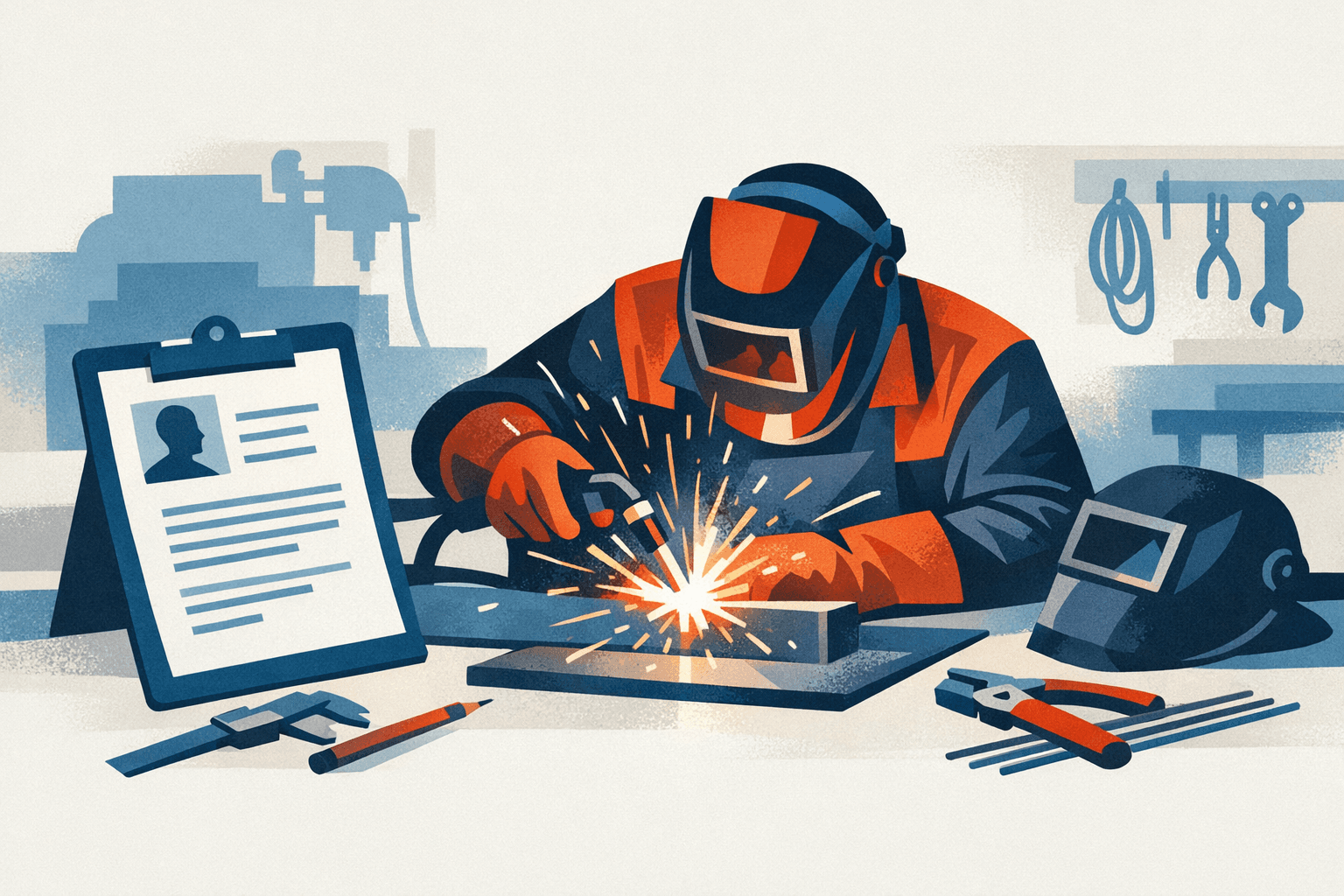
Welder Resume: The Ultimate Guide to Best Results
Discover why a tailored Welder Resume is essential and learn how to create one that stands out to employers and gets you hired faster.
 John Cronin
Introduction
In my 25 years in talent acquisition, I've learned that a generic resume often ends up in the discard pile. Whether you're a software engineer or a welder, a one-size-fits-all approach simply doesn't cut it. The welding industry is competitive, with the US Bureau of Labor Statistics counting 457,300 welders, cutters, solderers, and brazers in 2024, and about 45,600 openings projected per year through 2034. That's a lot of candidates vying for the same positions, and your resume is your first—and sometimes only—chance to make an impression.
A tailored welder resume isn't just a nice-to-have; it's essential. It highlights your potential and makes a strong first impression on employers who are scanning dozens of applications. When you customize your resume to align with the specific job you're applying for, you're not just listing your skills—you're showing the hiring manager that you understand what they need and that you're the solution to their problem. Just as I increased the qualified candidate pipeline by 50% at Imgur through targeted employer-branding programs, you can increase your chances by customizing your resume.
Most welders make the mistake of sending the same resume to every job posting, hoping something will stick. But hiring managers can spot a generic resume in seconds. They're looking for specific certifications, relevant experience with particular welding processes, and evidence that you've worked in their industry or on similar projects. If your resume doesn't speak directly to their needs, it won't matter how skilled you are—you won't get the call. Understanding how ATS reads resumes can also give you an edge in getting past initial screening systems.
This guide will walk you through why generic resumes fail, what elements make a welder resume stand out, and how to customize your application for each job. You'll learn common mistakes to avoid, see real examples of tailored resumes, and discover the measurable impact that a well-crafted resume can have on your job search. By the end, you'll have a clear roadmap for creating a resume that gets you noticed and hired faster.
Why a Generic Resume Fails
A generic welder resume is a losing bet before it ever reaches human eyes. The problem starts with applicant tracking systems—shops and staffing agencies use them to filter resumes against keyword lists pulled directly from the job posting. If your resume says "general fabrication experience" when the posting asks for "MIG welding on structural steel," the software flags you as a mismatch. You never make it to the foreman's desk.
The ATS Gatekeeper
Even in the trades, automation decides who gets a phone call. Applicant tracking systems scan for specific certifications, processes, and materials mentioned in the job description. A resume that treats all welding as interchangeable work gets filtered out early. The system doesn't care that you're a fast learner or that you've done "various welding projects"—it's looking for AWS D1.1, 6G pipe certification, or aluminum TIG experience, depending on what the employer needs.
What Hiring Managers Actually Want to See
Once a resume clears the ATS, a foreman or hiring manager spends about six seconds deciding whether to keep reading. A generic resume forces them to hunt for proof you can do the job. A tailored resume puts that proof right at the top. A resume that leads with a current AWS or ASME qualification, a recent X-ray pass rate, and a clean safety record tells a foreman this candidate is worth scheduling a weld test for. Anything less specific makes them move on to the next applicant.
Understanding how ATS reads resumes can give you a significant edge in getting past the initial screening and into the hands of decision-makers.
The Cost of Being Vague
Vague language kills your chances. Phrases like "experienced welder" or "skilled in multiple processes" tell an employer nothing useful. They need to know whether you can weld stainless pipe in a power plant or run a robotic MIG cell in an auto shop. A generic resume makes them guess, and they won't. They'll interview the candidate who made it obvious they're qualified for this specific role.
Elements of a Tailored Welder Resume
A strong welder resume needs to mirror the qualities of good metalwork: structured, uncluttered, and strong under pressure. Each section should serve a clear purpose, giving hiring managers the information they need without forcing them to hunt for it. When you're competing against dozens of other candidates, clarity wins.
The essential building blocks are straightforward, but each one demands attention to detail. Skip a component or treat it as filler, and you've just given the employer a reason to move on to the next resume.
Core Components Every Welder Resume Needs
Start with a summary or objective statement that positions you for the specific role. This isn't a generic intro about being a "hardworking professional"—it's a two-to-three sentence snapshot of your welding specialty, years of experience, and what you bring to this particular employer. If you're entry-level, frame it as an objective that connects your training to their needs. If you're experienced, lead with your strongest credential.
Your work experience section is where most hiring decisions happen. List positions in reverse chronological order, and for each role, include the job title, company name, location, and dates. Then add three to five bullet points that describe what you actually did: the welding processes you used, the materials you worked with, the types of projects you completed. Specificity matters more than length.
The education section should list your welding certifications, technical school credentials, or apprenticeship completion. Include the institution name, location, and graduation year. If you hold AWS certifications or state-specific licenses, list those here or in a separate certifications block—they're often deal-breakers for compliance-heavy roles.
Your skills section is not a dumping ground for every welding term you've heard. Focus on the techniques and equipment you've actually used in production environments: MIG, TIG, stick welding, flux-cored arc welding, blueprint reading, metal fabrication, welding inspection. Match these to the job description when you can do so honestly.
Finally, if you have awards, safety records, or notable accomplishments, add them in a brief section at the end. A zero-incident safety record over multiple years or recognition for quality work can differentiate you when technical skills are otherwise equal. Just keep it concise—one or two lines per item.
A welder's resume needs to mirror the qualities of good metalwork: structured, uncluttered, and strong under pressure.
If you're looking for guidance on structuring professional experience for technical roles, the principles in our Electrical Engineer Resume Template: The Ultimate Simple Guide apply across trades—clear formatting and role-specific detail always win.
These elements form the foundation. The next step is learning how to adjust each one for the job you're actually applying to, not the job you wish existed.
How to Customize Your Resume
Customizing your welder resume isn't about rewriting the entire document for every application. It's about making strategic adjustments that align your experience with what the employer is actually looking for. Most welders skip this step and wonder why they're not getting calls back. The truth is, hiring managers can spot a generic resume in seconds, and it rarely makes it past the first round.
Start by reading the job posting carefully. Circle or highlight the specific welding processes mentioned—MIG, TIG, stick, flux-core—and note any certifications or materials they emphasize. If the posting mentions stainless steel fabrication and you've done that work, it needs to be front and center on your resume. Don't bury your most relevant experience in the middle of a long job description.
Match Your Skills to the Job Requirements
Once you know what the employer wants, adjust your skills section to mirror their language. If they're looking for someone with "expertise in TIG welding aluminum," and you have that skill, use those exact words. Applicant tracking systems scan for keyword matches, and so do human recruiters. This isn't about lying—it's about emphasizing the parts of your background that matter most for this specific role.
Similarly, if you understand how ATS reads resumes, you'll know that using the employer's terminology increases your chances of getting through initial screening filters. Many qualified welders get filtered out simply because they described their skills differently than the job posting.
Step 1
Collect your information
Gather all your certifications, job history, and project details before you start writing. Include dates, employer names, welding processes you used, and any measurable outcomes like production improvements or safety records. Having everything in one place makes customization faster.
Step 2
Add and adjust resume elements
Tailor your professional summary, skills section, and work experience bullets to emphasize what this specific employer needs. If the job requires pipe welding experience, your summary should mention pipe welding in the first sentence. Rearrange your bullet points so the most relevant accomplishments appear first under each job.
Step 3
Proofread and edit
Before you send it, read through your customized resume at least twice. Check that certification names are spelled correctly, dates are accurate, and you haven't left in details from a previous version that don't apply to this job. A single typo can cost you an interview.
Update Your Resume Regularly
Keep your master resume current even when you're not actively job hunting. Every time you complete a major project, earn a new certification, or learn a new welding technique, add it to your file. When you need to customize for a job application, you'll have all your recent experience ready to pull from. In a competitive job market, having an up-to-date resume means you can respond to opportunities quickly without scrambling to remember what you did six months ago.
Customization doesn't mean inventing skills you don't have. It means presenting the skills and experience you do have in a way that speaks directly to the employer's needs. That focused approach is what gets your resume moved from the "maybe" pile to the "call for interview" pile.
Common Mistakes to Avoid
Even experienced welders trip over the same resume pitfalls. I've screened thousands of resumes, and the mistakes I see most often are easy to fix once you know what to look for. A single error—like burying your certifications or listing duties instead of outcomes—can knock you out of contention before anyone picks up the phone.
Hiding Your Credentials
Your AWS or ASME qualifications belong at the top, not buried in paragraph three. A foreman scanning fifty resumes will skip yours if they can't see your certifications in the first ten seconds. Lead with your current credentials, your recent X-ray pass rate, and your safety record. That combination tells a hiring manager you're worth scheduling a weld test for.
Writing Job Descriptions Instead of Achievements
Trade professionals often struggle to quantify their work, but listing "performed MIG and TIG welding" doesn't set you apart—everyone applying can do that. Instead, focus on outcomes: "Maintained 98% X-ray pass rate on structural welds" or "Completed pipeline project two weeks ahead of schedule with zero safety incidents." Numbers and results give hiring managers confidence that you deliver.
Using a One-Size-Fits-All Format
Sending the same resume to a pipeline contractor and a manufacturing plant is a missed opportunity. Each employer cares about different things—pipeline work demands field mobility and code compliance, while manufacturing values production speed and quality control. Tailor your skills and experience to match the job description. If the posting emphasizes "blueprint reading" and "tight-tolerance work," those exact phrases should appear in your resume.
Understanding how ATS reads resumes can also help you avoid formatting mistakes that cause your application to get filtered out before a human ever sees it.
Ignoring Safety and Compliance
Welding is a high-risk trade, and employers scrutinize safety records closely. If you omit your OSHA training, confined-space certifications, or years without a recordable incident, you're leaving your strongest selling point off the table. A clean safety record signals professionalism and reduces the employer's liability risk.
A resume that proves you can weld safely is more valuable than one that only proves you can weld.
Overloading with Irrelevant Details
Your high school diploma from fifteen years ago and your summer job at a retail store don't belong on a welder resume. Keep the focus tight: relevant certifications, welding experience, technical skills, and safety training. If it doesn't directly support your case for the job, cut it. Hiring managers spend seconds per resume—make every line count.
Examples of Tailored Welder Resumes
Seeing concrete examples helps clarify what a tailored welder resume actually looks like in practice. Below are two sample summaries that demonstrate how to position your experience and skills for maximum impact.
Example 1: Manufacturing-Focused Welder
Madison Taylor is a passionate and skilled Welder with over 3 years of manufacturing experience, specializing in MIG and TIG welding techniques. This summary immediately tells a hiring manager in the manufacturing sector that Madison has the exact technical skills they need. Notice how it leads with years of experience and names specific welding processes—MIG and TIG—rather than vague language like "various welding methods." If you're applying to a manufacturing plant that runs MIG lines all day, this kind of specificity gets you noticed.
Example 2: Company-Specific Experience
Another strong approach: "Experienced MIG welder with 2+ years of experience working for Lincoln Electric." This example does two things well. First, it quantifies experience with a number (2+ years). Second, it drops a recognizable employer name. If you've worked for a well-known company in the welding or manufacturing world, include it. Brand recognition builds instant credibility and signals that you've already been vetted by a reputable organization.
What Makes These Examples Work
Both samples avoid generic filler. They don't waste space saying "hardworking team player" or "detail-oriented professional." Instead, they anchor the reader with facts: years of experience, specific welding processes, and relevant employers. When you draft your own summary, ask yourself: does this tell the hiring manager exactly what I do and where I've done it? If the answer is no, tighten it up.
For more guidance on structuring your resume to pass automated screening systems, see our guide on How ATS Reads Resumes: The Ultimate Guide to Surprising Success.
The Impact of a Tailored Resume
A tailored welder resume doesn't just look better on paper—it fundamentally changes your job search outcomes. When you customize your resume to match a specific welding position, you're signaling to employers that you understand their needs and have taken the time to demonstrate your fit. This first impression matters more than most candidates realize.
How Tailoring Affects Your Interview Rate
Employers receive dozens of applications for every welding position. A generic resume blends into the pile, while a tailored one catches attention immediately. When a hiring manager sees that you've highlighted MIG and TIG experience for a job that specifically requires those techniques, they're far more likely to call you in. The difference isn't subtle—it's the difference between getting screened out in the first pass and making it to the interview stage.
Tangible Results From Customization
The numbers tell the story. Welders who tailor their resumes report measurably better outcomes. For instance, showcasing specific achievements—like maintaining a high client satisfaction rate through quality welds on steel components—gives employers concrete proof of your capabilities. When you can point to performance metrics that align with what the employer values, you're no longer just another applicant.
This principle applies across all technical roles. Just as understanding how ATS reads resumes can improve your screening success, understanding what hiring managers look for in welding candidates helps you present your experience more effectively.
The Compounding Effect
Tailoring your resume doesn't just help you get one job—it builds momentum throughout your career. Each time you refine your resume for a specific opportunity, you're also clarifying your own professional narrative. You learn which experiences matter most, which skills are in demand, and how to articulate your value. Over time, this practice makes you a stronger candidate for progressively better positions.
A tailored resume doesn't just open doors—it positions you as the candidate who already understands the job before you walk into the interview.
Who Should Tailor Their Resume
Every welder should tailor their resume, but some candidates benefit more than others from investing extra time in customization. If you're changing industries, stepping up to a supervisory role, or targeting a specialized welding position, a tailored resume isn't optional—it's the difference between an interview and silence.
Career Changers and Specialty Welders
If you're moving from structural welding to aerospace or pipeline work, your generic resume won't speak the language hiring managers expect. Aerospace employers want to see your experience with TIG welding on thin-gauge aluminum and your familiarity with AS9100 standards. Pipeline companies care about your field welding certifications and your ability to work in remote locations. A one-size-fits-all document won't highlight these distinctions.
Similarly, if you're transitioning from another trade into welding—say, from fabrication or machining—you need to draw clear lines between your transferable skills and the welding certifications you've earned. Employers won't do that work for you.
Entry-Level and Experienced Welders Alike
Even if you're fresh out of welding school, tailoring matters. The US Bureau of Labor Statistics counted 457,300 welders, cutters, solderers, and brazers in 2024, with about 45,600 openings projected per year through 2034. With that many candidates in the market, your resume has to show why you're the right fit for a specific shop or project.
For experienced welders, the stakes are higher. The American Welding Society projects a welder shortage of more than 400,000 by 2028, driven by retirements and reshored manufacturing. That shortage creates opportunity, but only if your resume demonstrates the exact skills and certifications the employer needs. A vague summary of "10 years of welding experience" doesn't cut it when the job requires AWS D1.1 certification and documented experience with X-ray inspection.
When Tailoring Is Non-Negotiable
You should absolutely tailor your resume if:
- You're applying to a union shop that requires specific certifications or apprenticeship credentials
- The job posting lists multiple welding processes (MIG, TIG, stick, flux-core) and you need to show proficiency in the exact ones they use
- You're moving into a supervisory or lead welder role and need to highlight your crew leadership and quality control experience
- You're returning to the workforce after a gap and need to emphasize recent certifications or refresher training
In my experience screening technical resumes, I've seen how specificity separates the callback from the pass. Whether you're an electrical engineer or a welder, the principle is the same: show the hiring manager you understand their needs and you've done the work to meet them.
Final Tips for a Successful Resume
You've built the structure, customized the content, and avoided the common pitfalls. Now it's time to polish your welder resume with a few final touches that can make the difference between an interview and a pass. These best practices aren't about reinventing the wheel—they're about ensuring every detail works in your favor.
Lead With Your Strongest Technical Skills
Writing the perfect welder resume means showing employers you've got the technical skills, certifications, and work ethic to get the job done right. Place your most relevant certifications and welding processes at the top of your skills section. If the job description emphasizes TIG welding and blueprint reading, those should be front and center. Employers scan resumes quickly, and you want your strongest qualifications visible within the first few seconds.
Proofread Like Your Career Depends on It
Typos and formatting errors signal carelessness, and in welding, carelessness can mean safety issues. Read your resume out loud, then read it backward sentence by sentence to catch mistakes your brain might skip over. Ask a friend or colleague to review it with fresh eyes. A single misspelled certification name or inconsistent date format can raise doubts about your attention to detail.
Keep It Concise and Scannable
Your resume should fit on one page if you have less than ten years of experience, two pages maximum for longer careers. Use short paragraphs, bullet points, and clear section headings. Hiring managers often spend less than ten seconds on an initial scan. If they can't quickly find your certifications, relevant experience, and key skills, they'll move to the next candidate.
Update It Before Every Application
Even a strong tailored resume needs refreshing for each new opportunity. Review the job posting, adjust your skills section to match their priorities, and tweak your summary to reflect the specific role. This doesn't mean rewriting everything—it means making small, strategic adjustments that show you've read the posting carefully. For more insights on tailoring resumes for technical roles, see our Electrical Engineer Resume Template: The Ultimate Simple Guide.
Save and Send in the Right Format
Unless the job posting specifies otherwise, save your resume as a PDF to preserve formatting across different devices and software. Name the file clearly: "FirstName_LastName_Welder_Resume.pdf" makes it easy for hiring managers to find your document later. Avoid generic names like "Resume.pdf" or "Final_Version_3.pdf."
Conclusion
A tailored welder resume isn't just a nice-to-have—it's the difference between landing an interview and watching your application disappear into the void. Throughout this guide, we've covered why generic resumes fail, what elements make a welder resume stand out, and how to customize your document for each employer. The core message is simple: specificity wins. When you align your certifications, welding processes, and project experience with what the job posting asks for, you demonstrate that you understand the role and can deliver from day one.
In my 25 years in talent acquisition, I've seen countless resumes cross my desk, and the ones that get attention are always the ones that speak directly to the hiring manager's needs. Whether I was recruiting AI engineers at Meta or reviewing technical profiles at Imgur, the principle remained the same: a one-size-fits-all approach lands in the discard pile. The same holds true for welding positions. Employers want to see that you've taken the time to understand their operation—whether that means highlighting your TIG experience for aerospace work or emphasizing your structural certifications for construction projects.
Keep your welder resume updated regularly, especially after completing new certifications or major projects. The job market moves quickly, and an outdated resume can cost you opportunities before you even know they exist. Use the strategies we've outlined—tailoring your skills section, quantifying your accomplishments, and avoiding common mistakes—to build a document that opens doors.
If you're looking for more guidance on crafting effective resumes across different industries, check out our Recruiter Resume Template: The Ultimate Guide to Best Results for additional insights on what hiring professionals look for. Your next welding role is out there, and a well-crafted, tailored resume is your best tool for securing it. Take action today—review your current resume, identify where it falls short, and make the changes that will set you apart from the competition.
Related reading
Pharmacist Resume: The Ultimate Guide to Standing Out
Real Estate Agent Resume: The Ultimate Guide to Best Results

Written by
John Cronin
Published September 6, 2026 · 19 min read
John Cronin is a talent-acquisition leader with 25 years in recruiting, most recently as a Principal Technical Recruiter at Meta hiring machine-learning and AI engineers. He has been a founding recruiter at GoPro and Chipper Cash and led talent acquisition at Imgur. He writes about what recruiters actually do with your resume.
Want this kind of read on your résumé?
We'll tell you what's actually working, what's holding you back, and what to fix — in plain English.
Get My Job Match ScoreYou Might Also Like
More articles to help you advance your career
Electrician Resume: Licenses, Hours and Skills That Matter
Discover why a generic Electrician Resume won't work and learn practical strategies to tailor yours for success in today's competitive job market.

Construction Resume: The Ultimate Guide to Simple Success
Discover why a generic Construction Resume won't work and learn the best strategies to tailor yours for maximum impact and career success.

Chef Resume: Stations, Volume and Menu Experience
Discover why a tailored Chef Resume is essential for standing out in the culinary field and how to create one that gets results.

Product Manager Resume Template: The Ultimate Stress-Free Guide
Discover the best product manager resume template strategies to create a tailored, effective resume that stands out in product management roles.