



Your Resume Isn't Broken: Revamp Your Job Search Strategy
Your resume vs strategy matters more than you think. Learn how to enhance your job search approach and framework for better results.
Introduction
You've rewritten your resume three times this month. You've tweaked the formatting, shuffled bullet points, and agonized over every verb. Yet the silence from recruiters remains deafening. The problem isn't your resume — it's the framework surrounding how you're using it.
The resume vs strategy debate reveals a fundamental truth: resume quality alone rarely determines job search success. While crafting a polished resume is undoubtedly important, it's only one piece of the puzzle. A comprehensive job search strategy involves understanding the landscape of the industry you're targeting, networking effectively, and tailoring your applications to each specific role.
Most job seekers treat their resume as a magic document that will open doors on its own. They pour hours into formatting decisions and keyword optimization, expecting the perfect resume to do the heavy lifting. This mindset misses a fundamental truth: even the most impressive resume fails without a deliberate strategy to get it in front of the right people at the right time. An ATS-friendly resume format matters, but only when paired with a thoughtful approach to where and how you apply.
The resume is your marketing collateral, not your entire marketing campaign.
What Is the Resume vs Strategy Distinction?
Resume vs strategy represents the choice between perfecting your document and perfecting your approach to the job market. Your resume documents what you've done. Your strategy determines who sees it, when they see it, and in what context. Without the latter, the former sits unread in digital folders alongside hundreds of other well-formatted documents.
By shifting your focus from merely tweaking your resume to developing a comprehensive job search framework, you can significantly enhance your chances of landing the right position. This means being proactive about researching potential employers, aligning your skills and experiences with the specific needs of companies you're interested in, and building relationships before you ever hit "submit" on an application. This strategic job hunting mindset can make all the difference in a competitive job market.
The following sections will break down exactly why your current approach may be falling short and provide actionable steps to build a job search strategy that actually works. You'll learn how to move beyond resume obsession and into the systematic, strategic thinking that separates candidates who struggle from those who land offers.
Why Does the Resume vs Strategy Balance Matter?
Most job seekers believe their resume is the problem. They spend weeks refining bullet points, adjusting margins, and obsessing over whether to include their GPA. Yet the callbacks never come. The real issue isn't what's on the page—it's the fundamental misunderstanding of what a resume can and cannot do in a competitive hiring landscape.
The Resume Polishing Trap
Job searches are intimidating, and putting yourself out there is hard. Tweaking your resume feels productive because it's something you can control. You get into a routine: polish the summary, reorder the bullets, swap synonyms, repeat. It's comfortable work that delays the harder task of actually reaching out to people and companies.
The belief that a perfect resume will unlock opportunities perpetuates a harmful myth. Professional resume writers and optimization tools promise transformative results, but the underlying assumption is flawed: that hiring decisions hinge on formatting choices or action verb selection. In reality, resumes are screened in seconds, and recruiters look for specific signals—top-tier brands, relevant skills, or educational pedigree—that either exist or don't.
What Recruiters Actually See
When a recruiter opens your resume, they're not reading carefully. They're scanning for immediate proof that you meet a narrow set of criteria. Research shows that resume evaluation is inconsistent and often arbitrary; the same resume can receive vastly different scores from different reviewers depending on what they prioritize in that moment. Source
For candidates who already look strong on paper—graduates of top schools, employees of well-known companies—minor rearrangements can help if those credentials are buried. Moving your most impressive experience to the top or highlighting niche skills in the summary can increase visibility. But if you lack those marquee items, no layout trick will manufacture them.
If you don't have top-tier brands, the best bang for your buck is to switch from online applications to hiring manager outreach.
The Strategy Gap
The disconnect between resume effort and job search results reveals a deeper problem: a missing or ineffective search strategy. Applying online is the default approach because it feels straightforward, but it's also the least effective channel for most candidates. Hundreds of applicants funnel into the same portal, and without a standout credential, your resume disappears into the stack.
Understanding what recruiters actually look for is useful, but it's only part of the equation. The real leverage comes from changing how you access opportunities—shifting from passive applications to proactive outreach, from hoping to be noticed to making direct contact with hiring managers. That requires a strategic framework, not a better font.
The misconception that resume quality is the bottleneck keeps job seekers stuck in low-yield activities. Until you recognize that the resume vs strategy question tilts heavily toward strategy, you'll keep polishing a document that was never designed to carry the full weight of your job search.
Solution Steps to Improve Your Job Search Strategy
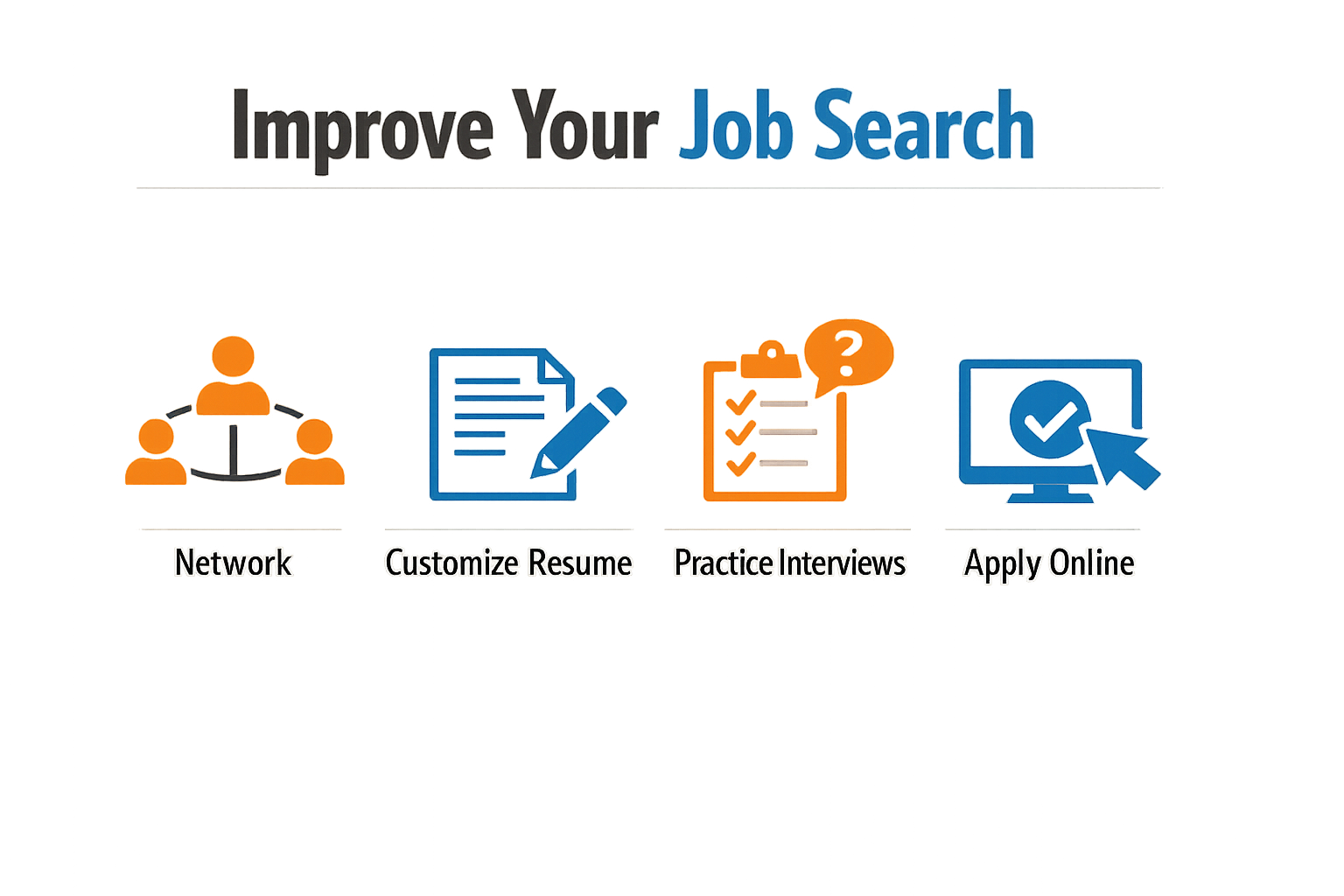
Shifting from resume tweaking to strategic job searching requires deliberate action. The steps below move you from passive application submission to active career positioning.
Step 1: Target Positions That Match Your Profile
Random resume-blasting is ineffective. Instead, target your job search to positions that are a strong match for your skills and experience. Before you apply anywhere, ask yourself whether the role aligns with your career trajectory and whether you meet the core qualifications. A smaller number of well-targeted applications will outperform a high volume of generic submissions.
Review each job description and identify the three to five non-negotiable requirements. If you don't meet at least 70% of them, move on. Apply only where your background genuinely aligns with what the employer needs.
Step 2: Learn the Mechanics of Effective Job Searching
Many job seekers wing their search without understanding the fundamentals. Learn how to job search properly: prepare application packages that speak to the specific role, research common interview questions for your field, and understand how ATS resume formats influence whether your application gets seen. Structured preparation beats improvisation.
Document your process: templates for cover letters, a list of tailored interview answers, a tracking spreadsheet for applications, and a weekly outreach schedule. Treat your search like a project with repeatable systems.
Step 3: Prioritize Outreach Over Resume Polishing
It's easier to believe that perfecting your bullet points will finally get you responses, but that's rarely the bottleneck. Once your resume is clear and competently formatted, stop revising it and start doing outreach. Reach out to hiring managers, connect with employees at target companies, and engage with your professional network. Direct contact often bypasses the resume pile entirely.
The time you spend rewriting the same three bullets could be spent sending five personalized messages to people who can actually refer you.
Set a weekly quota: if you spend more than two hours on resume edits, you're over-indexing on the wrong activity. Reallocate that time to LinkedIn outreach, informational interviews, or follow-ups with referrals.
Step 4: Understand How Your Application Fits the Employer's Needs
Recruiters and hiring managers see countless applications where the candidate's career plan doesn't align with the role. Before you apply, articulate to yourself why this job makes sense for you and why you make sense for them. If you can't answer both questions clearly, the employer won't be able to either.
For each application, write: "I'm applying because [specific reason this role fits my goals], and I'm a strong match because [specific value I bring based on their needs]." If you can't write this cleanly, reconsider the application.
Tips and Tricks for Effective Job Searching
Beyond the foundational steps of refining your job search strategy, a handful of targeted techniques can amplify your results. These best practices shift the focus from resume perfection to strategic positioning — the difference between waiting for opportunities and creating them.
Activate Your Network Early and Often
Your network is the most underutilized asset in any job search. Reach out to former managers, colleagues from past internships, and even your parents' professional contacts. Let them know you're actively looking and what kind of roles interest you. This isn't pushy — it's standard practice. Many positions are filled through referrals before they're ever posted publicly, and a warm introduction sets you apart from the hundreds of applicants applying cold.
Build a Positive Online Presence
Cleaning up your social media profiles is table stakes. The real advantage comes from proactively building credibility online. Create a portfolio showcasing your work, contribute thoughtful comments on industry blogs, or share insights on professional platforms. Employers increasingly search for candidates online — give them something valuable to find. This positions you as engaged and knowledgeable, not just qualified on paper.
Diversify Your Search Channels
Relying solely on online job boards puts you in direct competition with thousands of other applicants. While job postings are a necessary part of the process, balance them with other approaches: attend industry events, join professional organizations, and reach out directly to hiring managers at companies you admire. The goal is to be visible in multiple places, increasing the likelihood that the right opportunity finds you. For more on optimizing your application materials once you've identified opportunities, see our guide on honest resume scoring.
The most effective job searches combine online applications with direct outreach and network activation — no single channel is enough on its own.
Keep Building Skills During Your Search
If your search extends longer than expected, use the time strategically. Take on freelance projects, volunteer in roles that develop relevant skills, or pursue certifications that strengthen your candidacy. This not only fills gaps on your resume but also demonstrates initiative and continuous learning — qualities employers value highly.
Conclusion
Your resume isn't broken — your approach to job searching might be. Throughout this guide, we've seen that traditional resume metrics like GPA, degree level, and even where you went to school matter far less than you think. What truly drives results is a strategic framework: targeted research, deliberate networking, and applications tailored to the specific needs of each employer. When you shift focus from endlessly polishing your resume to building a comprehensive job search strategy, you position yourself to stand out in ways that keyword-matching systems and overworked recruiters can't ignore.
The evidence is clear: Applicant Tracking Systems rely on outdated keyword-based matching that often misses the semantic relevance of your actual skills and experience. That's why a strategic job hunting mindset — one that prioritizes understanding the industry landscape, aligning your narrative with company pain points, and reaching decision-makers directly — makes all the difference in a competitive market. By being proactive, researching potential employers thoroughly, and demonstrating how your background solves their problems, you bypass the limitations of resume-only evaluation and create opportunities that passive applicants never see.
Ultimately, the resume vs strategy debate isn't about choosing one over the other — it's about recognizing that your resume is just one piece of a much larger puzzle. A well-crafted resume opens doors, but a well-executed strategy ensures you're knocking on the right ones. Invest your energy in the framework that surrounds your resume: the research, the relationships, and the tailored outreach that turn applications into conversations. That's where job search success lives, and that's what separates candidates who land offers from those who keep waiting for callbacks that never come. For additional guidance on optimizing your materials within this strategic approach, explore our ATS résumé format guide to ensure your resume clears technical hurdles while your strategy does the heavy lifting.
Frequently Asked Questions About Resume vs Strategy
How do I know if my resume or my strategy is the problem?
If you're getting no callbacks after 20+ applications to roles where you meet most qualifications, your strategy is likely the issue. A resume problem typically shows up as interviews that don't convert to offers, not a lack of interviews entirely.
What percentage of my job search time should go to resume work vs strategy?
Spend no more than 10-15% of your time on resume refinement once you have a clean, competent version. Dedicate the remaining 85-90% to research, networking, targeted outreach, and application customization — the strategic activities that actually move the needle.
Can a great strategy overcome a weak resume?
Yes, to a point. A strategic approach — especially direct outreach to hiring managers and warm referrals — can bypass initial resume screens entirely. However, you still need to clearly communicate relevant skills and experience once you're in conversation. The resume vs strategy balance tips toward strategy for access, but both matter for closing.
Should I use the same resume for every application?
No. Part of an effective strategy is tailoring your resume to each role by emphasizing the most relevant experience and using language from the job description. This doesn't mean rewriting from scratch — it means adjusting emphasis and keywords to match what each employer values.
How long should I wait before changing my job search strategy?
If you've applied to 30+ well-matched positions over 4-6 weeks with fewer than 2-3 responses, it's time to reassess. Don't wait months to pivot — the resume vs strategy framework should be continuously evaluated and adjusted based on real feedback and results.
Resume vs strategy: discover why your job search framework matters more than endless resume edits and how to shift focus for better results.
Sources(40)
- Ask a Manager (2012)
- Ask a Manager (2016)
- Ask a Manager (2014)
- interviewing.io (2025)
- Ask a Manager (2012)
- Ask a Manager (2013)
- interviewing.io (2025)
- Ask a Manager (2014)
- Ask a Manager (2015)
- interviewing.io (2024)
- Ask a Manager (2013)
- Ask a Manager (2014)
- Ask a Manager (2009)
- Clarify Capital
- Ask a Manager (2026)
- Ask a Manager (2018)
- Ask a Manager (2012)
- Ask a Manager (2013)
- Ask a Manager (2014)
- Ask a Manager (2013)
- Ask a Manager (2013)
- Ask a Manager (2015)
- Ask a Manager (2011)
- Ask a Manager (2014)
- Ask a Manager (2017)
- Ask a Manager (2014)
- Ask a Manager (2014)
- Ask a Manager (2012)
- Ask a Manager (2015)
- Ask a Manager (2013)
- Ask a Manager (2013)
- Ask a Manager (2012)
- aam-6805c76b5249de77 (practitioner_guidance)
- aam-d5f28215402d9259 (practitioner_guidance)
- aam-95c6e8d68c8b907c (practitioner_guidance)
- aam-701a7f5c0950f82d (practitioner_guidance)
- aam-ba7c32de1c66e3e2 (practitioner_guidance)
- aam-4f80555bdffd5270 (practitioner_guidance)
- aam-6b3c8dcbab307f08 (practitioner_guidance)
- aam-eae1b2652581116a (practitioner_guidance)
Written by
Resume Coach Team
Published October 18, 2026 · 12 min read
Want this kind of read on your résumé?
We'll tell you what's actually working, what's holding you back, and what to fix — in plain English.
Get My Job Match ScoreYou Might Also Like
More articles to help you advance your career

Low Resume Score Value: Honest Resume Score: Why 35% Beats 92%
An honest resume score of 35% reveals real issues to fix, while 92% hides problems. Learn why lower scores drive better outcomes than inflated ones. Discover the low

Job Search Strategy 2024: The Honest Guide to What Actually Works
Discover what actually works with our honest job search strategy 2024 guide. Real tactics, proven methods, and career advice that cuts through the noise. Get honest job

Honest Resume Score Example: What An 'Honest' Resume Score Looks Like
Learn what an 'Honest' Resume Score looks like with this resume score sample, featuring a real example to guide your resume improvement. Discover how an honest resume