
Good Resume Examples That Actually Got People Hired (2024 Guide)
I spent 25 years screening resumes as a technical recruiter, and I can tell you the same mistakes show up in stack after stack.
 John Cronin
Introduction
I spent 25 years screening resumes as a technical recruiter, and I can tell you the same mistakes show up in stack after stack. Candidates harm their own chances by making it hard for hiring managers to see why they're the right fit. The frustrating part? Most of these problems are easy to fix once you know what you're looking at.
You don't need gimmicks. You don't need to send overnight packages or turn your resume into an infographic. What you need is a document that clearly demonstrates you can do the job — and do it well. That means focusing on achievements, not activities. It means showing outcomes, not just listing responsibilities.
This article walks through good resume examples that landed real jobs and breaks down exactly what made them work. You'll see the difference between a resume that reads like a job description and one that shows hiring managers you're someone who gets results. We'll cover the structure that gets past applicant tracking systems, the language that catches a recruiter's eye in the first six seconds, and the specific mistakes that send your application straight to the rejection pile.
What You'll Learn
By the end of this guide, you'll understand why most resumes fail before they reach human eyes, how to structure your experience to highlight what actually matters, and the practical steps to turn your job history into a compelling case for why you're the candidate they need to interview. No theory, no fluff — just the tactics that work when real hiring managers are making real decisions about who moves forward.
The Challenge of Standing Out in a Competitive Job Market

You send out fifty resumes. You hear back from three. One of those three is a form rejection. Sound familiar?
The problem isn't your experience — it's that your resume isn't doing the work it needs to do. Most candidates sabotage themselves before a human ever reads their application. They write resumes that read like job descriptions instead of accomplishments. They bury their wins under generic bullet points. And they assume someone will connect the dots for them.
The Resume Screening Reality
Here's what I see from the recruiter side: hundreds of resumes for every open role, and maybe fifteen minutes to decide who moves forward. That means I'm scanning, not reading. I'm looking for proof you can do the job, and I need to see it in the first ten seconds.
When your resume lists activities instead of outcomes, you're making me guess whether you were any good at those activities. "Managed billing" tells me nothing. "Resolved a four-month backlog of invoices in three weeks" tells me you can fix a mess under pressure. One of those gets you a phone screen. The other gets you nothing.
Research into resume evaluation shows just how unreliable the process can be. When recruiters and engineers were asked to evaluate resumes from both strong and weak candidates, the results were all over the place. Average scores for less strong candidates hovered around 0.3, while strong candidates only reached 0.5 — barely better than a coin flip. Even more telling: 10% of evaluators couldn't correctly identify a single strong resume, and only 5% got five out of six right.
That's not because the evaluators were incompetent. It's because resumes are a terrible signal when they're written poorly. The document that's supposed to open doors ends up closing them instead.
What Actually Stops Recruiters Cold
The mistakes I see most often are small and fixable, but they're fatal:
- Generic bullet points that could describe anyone in your role
- No quantifiable outcomes to prove you moved the needle
- Typos and formatting errors that signal you didn't care enough to proofread
- Overloaded layouts that make it impossible to scan quickly
The unpredictability of the hiring process makes this worse. You can't predict your chances based on credentials alone, because the decision isn't just about what you've done — it's about how clearly you communicate what you've done. Two candidates with identical backgrounds will get wildly different response rates if one writes a resume that highlights impact and the other writes a resume that lists duties.
The strongest candidates don't always get the interview — the candidates with the clearest resumes do.
If you want to stand out, you need to clean up your resume and make it easy for someone like me to see why you're the right hire. That means rewriting every bullet point to focus on accomplishments, not activities. It means showing outcomes, not just effort. And it means understanding that your resume isn't a career history — it's a marketing document with one job: get you to the next round.
For more on how to structure your resume to highlight the right skills, see What Hiring Managers Actually Look for in Resume Skills Sections.
Steps to Crafting a Winning Resume
Most candidates harm their own chances by making the same small set of fixable mistakes. I see it day after day: resumes that read like job descriptions instead of success stories. The fix isn't complicated, but it does require rethinking how you present your work history.
Step 1: Replace Duties with Achievements
Step 1
Rewrite every bullet point as an outcome
Go through your resume line by line. Anywhere you see a phrase like "managed billing" or "edited documents," ask yourself: what changed because I did this work? The hiring manager doesn't care that you performed a task — they care whether you did it well. Replace "managed website" with "revamped client billing system to ensure bills are now sent out on schedule" or "resolved an inherited four-month backlog of invoices in three weeks." That's the difference between describing a job and proving you excelled at it.
Quantifiable results grab attention. If you increased web traffic by 30 percent over 12 months, say so. If you built a reputation for working successfully with previously unhappy clients, that's an achievement worth naming. Specifics make you memorable.
Step 2: Use Bulleted Lists, Not Paragraphs
Step 2
Break dense text into scannable bullets
Employers skim resumes initially — they don't read them word-for-word. Large blocks of text get skipped. Convert every paragraph under a job title into short, punchy bullet points. Each bullet should start with a strong verb and end with a result. Three to five bullets per role is usually enough.
Simple formatting lets the hiring manager absorb more information in less time. If your resume is hard to skim, it won't get read.
Step 3: Drop the Objective Statement
Step 3
Replace your objective with a skills summary
Objective statements waste space. Hiring managers don't care about your career goals — they care what you can do for them. Instead of "Seeking a challenging role in software engineering," open with a brief skills summary or a few highlighted achievements that align with the job posting. If you have nothing compelling to say at the top, leave it blank and let your work history speak first.
Step 4: Write in Normal Language
The most compelling resumes are written in real language, not corporate jargon. Write the way you'd describe your achievements to a friend. Don't suck the life out of your resume with stuffy phrases like "responsible for" or "tasked with." Use active verbs and concrete nouns. Keep it direct.
Step 5: Make It Specific to the Job
Step 5
Tailor every application
A generic resume reads like every other candidate's. If your bullet points could describe anyone in your field, you're not standing out. Pull keywords from the job posting and mirror the language where it's honest to do so. Highlight the two or three experiences that map most directly to what the employer needs. What skills should you actually put on your resume depends entirely on the role you're applying for — one-size-fits-all doesn't work.
Customizing takes time, but sending 10 tailored resumes will get you more interviews than sending 50 generic ones.
Tips and Tricks for an Effective Resume
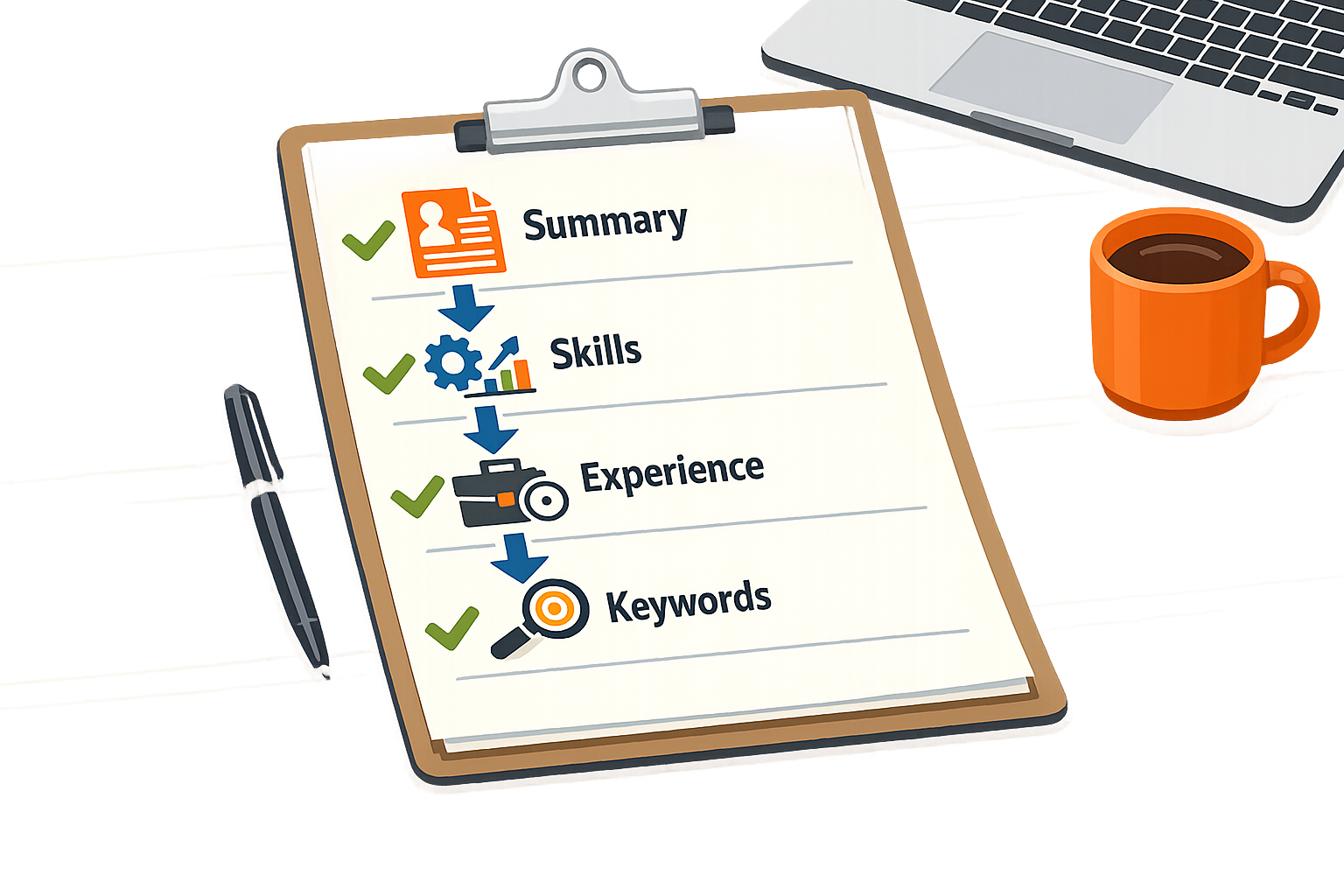
After screening thousands of resumes, I've seen patterns in what works and what doesn't. The advice that got candidates hired ten years ago can actively hurt your chances today. Here's what actually moves the needle when a hiring manager has thirty seconds to decide whether your resume goes in the "yes" pile or the trash.
Forget the One-Page Rule
The one-page resume rule is dead. If you have more than a few years of experience, use two pages. I've never rejected a strong candidate because their resume was two pages, but I've passed on plenty of one-pagers that crammed everything into an unreadable mess. If you're early in your career, stick to one page. Everyone else: give yourself room to breathe.
Write Like a Human Being
Your resume should sound like you're describing your work to a colleague, not reciting from a corporate manual. Drop the jargon and the stiff language. "Led cross-functional initiatives to optimize stakeholder engagement" tells me nothing. "Coordinated three engineering teams to ship the product two weeks early" tells me exactly what you did. Real language beats corporate-speak every single time.
Skip the Objective Statement
Objectives waste space. Hiring managers don't care what you want from the job — they care what you can do for them. Replace that objective with a skills summary or a few highlighted achievements. Better yet, let your experience section speak for itself and use the extra space to add another accomplishment.
Focus on What You Accomplished, Not What You Did
The fastest way to improve any resume is to rewrite job duties as accomplishments. "Managed customer support team" is a duty. "Reduced average ticket resolution time from 48 hours to 12 hours while maintaining 95% satisfaction scores" is an accomplishment. Numbers matter, but so does the story behind them. Show the impact you had, not just the tasks you completed.
For more detailed guidance on structuring your resume to highlight achievements, see Good Resume Examples That Landed Real Jobs (2025 Templates).
Don't Get Creative with Design
Unless you're a designer, keep your resume clean and simple. Fancy fonts, colors, and graphics make your resume harder to scan and raise questions about whether you think your work can stand on its own. I want to see a straightforward list of what you've accomplished, organized chronologically, in a format I can read in thirty seconds. That's it. Save the creativity for the work you'll do once you're hired.
Standing out is about the strength of your candidacy, not the beauty of your font choice.
Never Include a Photo
In the United States, including a photo on your resume is a rookie mistake. It makes employers uncomfortable because it opens the door to discrimination claims, and it signals that you don't understand professional norms. Photos are standard in some countries, but not here. Leave it off.
The Real Way to Stand Out
You stand out by being highly qualified and showing it clearly. That means a resume with a track record of real achievements, a cover letter that explains why you're the right fit, and responsiveness throughout the process. You can't buy that with a fancy template or a gimmick. The candidates who get hired are the ones whose qualifications speak for themselves.
Conclusion
Your resume isn't a design showcase or a place to inflate your credentials. It's a document that proves you can deliver results in the role you're applying for. After 25 years screening resumes, I've seen thousands of candidates trip themselves up by chasing the wrong signals — fancy formatting, exaggerated titles, skills they don't actually have. The resumes that get people hired are the ones that show a clear track record of achievement, use straightforward language, and make it easy for a recruiter to see the match between the candidate and the job.
Standing out doesn't come from a gorgeous template or a purchased design. It comes from the strength of your candidacy: specific accomplishments, quantified results, and a resume that highlights what you've actually done. Pair that with a compelling cover letter, and you're already ahead of most applicants who rely on aesthetics over substance.
If you're looking for more concrete examples of what works, check out our guide to Good Resume Examples That Landed Real Jobs — it walks through real resumes that got people interviews and offers.
Take the time to revise your resume using the principles we've covered. Focus on results, keep the format clean, and make every line count. The job market is competitive, but a well-crafted resume gives you a real advantage — one that no amount of fancy design can replicate.
Sources(28)
- Ask a Manager (2012)
- interviewing.io (2025)
- interviewing.io (2025)
- Ask a Manager (2012)
- Ask a Manager (2016)
- Ask a Manager (2011)
- interviewing.io (2014)
- Ask a Manager (2025)
- Ask a Manager (2012)
- Zenodo (CERN European Organization for Nuclear Research) (2026)
- Zenodo (CERN European Organization for Nuclear Research) (2026)
- Ask a Manager (2011)
- Ask a Manager (2010)
- Ask a Manager (2015)
- Ask a Manager (2012)
- Ask a Manager (2017)
- Ask a Manager (2015)
- Ask a Manager (2013)
- Ask a Manager (2015)
- Ask a Manager (2012)
- John Cronin
- Zenodo (CERN European Organization for Nuclear Research) (2026)
- Ask a Manager (2020)
- Ask a Manager (2021)
- interviewing.io (2024)
- Ask a Manager (2017)
- Ask a Manager (2011)
- Ask a Manager (2014)

Written by
John Cronin
Published November 23, 2026 · 10 min read
John Cronin is a talent-acquisition leader with 25 years in recruiting, most recently as a Principal Technical Recruiter at Meta hiring machine-learning and AI engineers. He has been a founding recruiter at GoPro and Chipper Cash and led talent acquisition at Imgur. He writes about what recruiters actually do with your resume.
Want this kind of read on your résumé?
We'll tell you what's actually working, what's holding you back, and what to fix — in plain English.
Get My Job Match ScoreYou Might Also Like
More articles to help you advance your career