
CV vs Resume: Which One Do You Need?
 John Cronin
Introduction
When it comes to the debate of CV vs Resume, it's essential to understand the context in which each is used. Having spent 25 years in talent acquisition, including my time as a Principal Technical Recruiter at Meta, I've seen countless documents cross my desk. The confusion between these two formats causes real problems for candidates — submitting the wrong document can mean an immediate rejection, even when you're qualified for the role.
The distinction matters because hiring managers and Applicant Tracking Systems expect specific formats for specific contexts. A resume is typically a concise, one-page summary of your skills and experiences, tailored to a specific job. It's what I looked for when hiring machine learning and AI engineers at Meta. On the other hand, a CV is more comprehensive, detailing your entire career history, publications, and academic achievements.
In today's competitive job market, resume screening plays a critical role in recruitment processes. Traditional Applicant Tracking Systems rely heavily on keyword matching and specific formatting expectations. Understanding whether to submit a CV or resume isn't just about following convention — it's about ensuring your document gets past automated screening and into human hands.
For most industry positions in the United States, you'll submit a resume. For academic positions, research roles, or jobs in Europe, you'll typically need a CV. The challenge is knowing which format to use when the job posting doesn't explicitly state a preference, and understanding how to adapt your document to meet those expectations. If you're struggling with getting your application past initial screening, understanding what ATS systems actually check can help you optimize whichever format you choose.
Problem Statement
You're staring at a job posting, cursor hovering over the upload button, and the question hits: do I send a CV or resume? The posting doesn't specify. Your document is titled "Resume," but it's three pages long and includes every project since grad school. A friend told you CVs are only for professors. Another said resumes are an American thing. You're applying to a U.S. tech company, but the role involves research. Now you're second-guessing everything.
This confusion isn't academic. I've watched candidates send the wrong document format and get filtered out before a human ever sees their work. At high-growth startups where I was a founding recruiter, we'd receive multi-page academic CVs for engineering roles that needed a one-page resume. The opposite happened too: candidates sent single-page resumes to research positions that expected a full publication history. Both scenarios create the same problem — the hiring manager assumes you don't understand the role or the industry norms.
What's the Difference Between CV vs Resume?
The core issue is that "CV" and "resume" aren't interchangeable terms with regional spelling differences. They're fundamentally different documents with different purposes, and using the wrong one signals a misunderstanding of what the role requires. When a volunteer coordinator receives professional resumes and CVs for positions clearly advertised as volunteer roles, it shows candidates aren't reading the context — they're just sending whatever document they have on file.
The confusion gets worse when you're applying internationally or crossing between academia and industry. A CV in the U.K. means something different than a CV in the U.S. A resume that works for a software engineer won't work for a postdoc. And most job postings don't clarify which one they want because they assume you already know.
What Hiring Managers Actually See
When I was screening candidates at Meta, the difference was immediate. A resume told me you understood the role: you'd edited your experience down to what mattered for this specific job. You highlighted impact, not just activities. A CV, on the other hand, was a comprehensive record — every publication, every grant, every conference presentation. That's exactly what a research role needs, but it's overwhelming for a product engineering hire.
The mistake isn't having the wrong information. It's failing to package it correctly for the audience. Employers care most about your work experience and what you accomplished, not a chronological list of every job you've held since college. A resume is a marketing document; a CV is an academic record. Mixing them up doesn't just waste space — it wastes the ten seconds a recruiter spends deciding whether to keep reading.
The Hidden Cost of Guessing Wrong
Here's what candidates don't see: when you send the wrong format, you don't get feedback. The application just goes into a "not a fit" pile. You might have the exact skills the role needs, but if your document doesn't match the industry's expectations, you never get the chance to prove it. I've seen PhD candidates with incredible research backgrounds get passed over for industry roles because they sent a CV when the company expected a resume. The work was relevant — the format wasn't.
The same thing happens in reverse. A one-page resume might work for a startup engineering role, but if you're applying to a tenure-track faculty position and you don't list your publications, grants, and teaching experience in full, you look underqualified. The hiring committee isn't going to guess that you have more to show — they'll assume what you sent is all you've got.
Understanding the difference between a CV and a resume isn't about memorizing definitions. It's about reading the context of the role, the industry, and the geography, then choosing the document that matches what the hiring manager expects to see. Get it wrong, and your application stops before it starts. Get it right, and you've cleared the first filter without saying a word.
Solution Steps
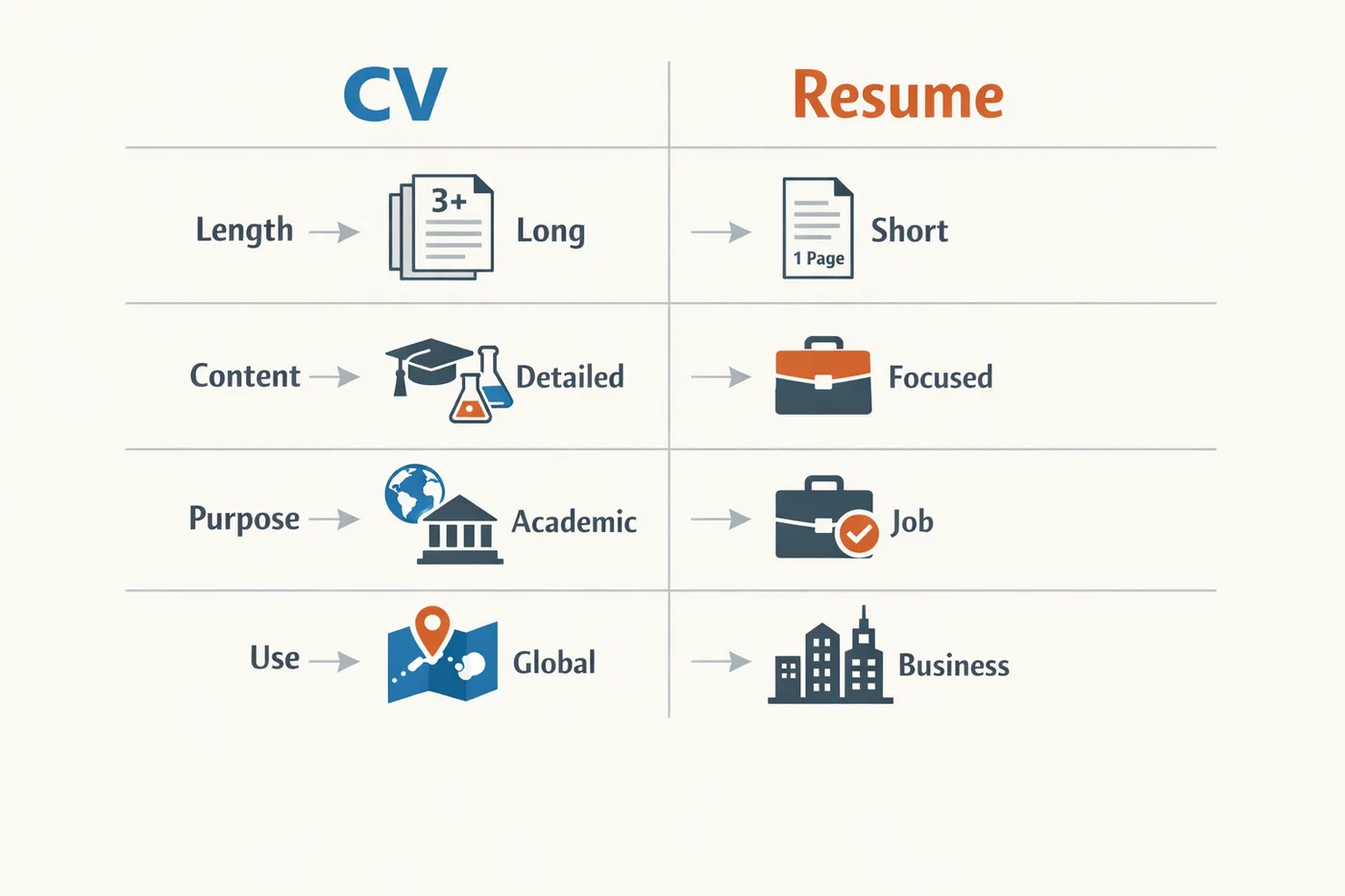
Understanding when to use a CV versus a resume comes down to a simple decision tree. The steps below will help you choose the right document for your situation and tailor it effectively.
Step 1: Identify the Job Category
Step 1
Determine the role type
Start by identifying the category of job you're applying for. Academic positions, research roles, and medical fellowships almost always require a CV. Industry jobs — especially in tech, finance, marketing, and operations — expect a resume. International applications vary by country: most of Europe and parts of Asia use CV as the default term, even for industry roles, though the format may resemble what Americans call a resume.
If you're applying for multiple types of roles — say, both editing jobs and theater work — you'll need different versions of your application document, each emphasizing the relevant skills for that category.
Step 2: Assess the Employer's Expectations
Step 2
Read the job posting carefully
The job description often signals which document to submit. Look for explicit instructions like "submit CV" or "attach resume." If the posting asks for a list of publications, grants, or teaching experience, that's a CV request. If it emphasizes "one-page preferred" or mentions an applicant tracking system, that's a resume context.
When in doubt, default to the shorter, tailored resume for industry roles and the comprehensive CV for academic or research positions.
Step 3: Build Your Master Document
Step 3
Create a comprehensive master file
Before you draft any version to send, build one master document that lists everything you've accomplished everywhere you've worked. This can run pages and pages — publications, presentations, certifications, project outcomes, metrics, awards. Think of it as your career database. You'll pull from this master file to create the tailored resume or CV you actually send.
Step 4: Tailor the Document to the Specific Job
Once you know which format to use, customize it for the role. If the job has a heavy emphasis on a particular skill — say, machine learning model deployment — and your document only mentions it in passing, pull more detail from your master file to highlight that experience. You don't need to rewrite the entire document for every application, but understanding what ATS systems look for can help you prioritize the right keywords and structure.
Step 4
Adjust emphasis based on the job
For a resume, keep it to one or two pages and lead with accomplishments, not duties. Use bullet points that start with action verbs and quantify results where possible. For a CV, organize by category — education, publications, grants, teaching, service — and include everything relevant to your academic or research trajectory, even if it spans multiple pages.
Step 5: Format for the Submission Method
Many online application systems strip formatting or require plain text. If you're pasting your resume into a Taleo-powered site or a text-only form, prepare a plain-text version in advance. Remove tables, columns, and special characters. Use simple dashes or asterisks for bullets. Test the paste in a text editor first to catch any formatting issues before you submit.
Tips and Tricks
Whether you're polishing a resume or building a CV, the fundamentals of clear, compelling presentation stay the same. Here's what actually moves the needle when a recruiter scans your document in the first ten seconds.
Write Achievements, Not Job Descriptions
The most common mistake I see is bullet points that read like a job posting: "managed billing," "edited documents," "collected data." Those lines tell me what your job was, not how well you did it. Swap activity for outcome. Instead of "managed billing," write "completely revamped client billing system to ensure bills are now sent out on schedule." That second version shows impact—it tells me you solved a problem and left the place better than you found it.
Every bullet should answer: What did you accomplish? What changed because you were there? If a line could describe any warm body in that role, rewrite it.
Keep Language Plain and Real
Drop the corporate jargon. Write your resume the way you'd describe your work to a colleague over coffee—clear, specific, human. Stuffy phrasing ("leveraged synergies to optimize cross-functional deliverables") makes hiring managers' eyes glaze over. Real language ("cut onboarding time by 40% by rewriting the training manual") lands harder and sticks longer.
If you wouldn't say it out loud, don't put it on the page.
Front-Load What Matters Most
Your work experience is the first thing I want to see. Don't bury it under a wall of certifications, skills matrices, or a mission statement. If your employment history doesn't start until the bottom of page one—or worse, page two—you've already lost momentum. Put your most recent, most relevant roles at the top. Everything else is supporting material.
For resumes: keep it tight. If you have fewer than five years of experience, one page is the target. Beyond that, two pages is standard and expected—just make sure both pages earn their space.
For CVs: comprehensiveness is the point, but even a long CV needs hierarchy. Lead with your strongest credentials—publications, grants, keynote talks—then let the supporting details follow.
Edit Ruthlessly
A resume isn't a career autobiography. You don't need every job you've ever held. Focus on the last 10–15 years and the roles that directly relate to what you're applying for now. If a job from two decades ago doesn't strengthen your case, leave it off. Long documents signal that you can't prioritize—and hiring managers notice.
CVs are longer by design, but even there, relevance matters. If a publication or conference presentation no longer reflects your current expertise, consider moving it to a secondary list or dropping it entirely.
Design for Scannability
Avoid unusual colors, creative fonts, or unconventional layouts. Hiring managers want a clean, easy-to-scan document that lets them pull out the highlights in seconds. Stick to standard headings, consistent formatting, and plenty of white space. If I have to work to find your job titles or decode your structure, I'm moving on to the next candidate.
Simple beats clever every time.
Conclusion
Choosing between a CV vs resume isn't about picking the "better" document — it's about matching the right format to the situation. A resume works when you're applying to industry roles where hiring managers spend 20 to 30 seconds scanning your application. A CV fits when you're in academia, research, or international markets where comprehensive documentation of your career is expected.
The decision comes down to three questions: Where are you applying? What does the employer expect? What format best shows your relevant achievements without burying them in unnecessary detail? If you're targeting a tech startup, a two-page resume highlighting your last five years will outperform a ten-page CV listing every conference presentation since grad school. If you're applying for a faculty position, that CV is non-negotiable.
Having spent 25 years in talent acquisition, including hiring machine learning engineers at Meta and building recruiting functions at high-growth startups like GoPro, I've seen both formats work — and fail — based entirely on context. At Meta, I looked for resumes that showed impact in two pages or less. At research-focused organizations, I expected CVs with full publication lists. The format itself doesn't get you the job; showing the right achievements in the format the employer expects does.
Tailor your document to the role, keep it scannable, and make sure every line earns its place. Whether you're building a resume that passes ATS screening or a CV that demonstrates research depth, the goal is the same: get the reader to call you in. Choose wisely, and you're already ahead of most applicants.
FAQ
When should I use a CV vs Resume?Use a resume for most U.S. industry jobs in tech, finance, marketing, and operations. Use a CV for academic positions, research roles, medical fellowships, and job applications in Europe or parts of Asia.
What is the main difference between a CV and a resume?A CV is a comprehensive document listing your entire career history, publications, grants, and academic achievements, often running multiple pages. A resume is a concise, tailored one- or two-page summary focused on relevant skills and accomplishments for a specific job.
Can I use the same document for all job applications?No. You should maintain a master document with all your accomplishments, then create tailored versions—either a resume or CV—based on the role, industry, and employer expectations.
How long should a CV vs Resume be?A resume should be one to two pages. A CV can run as long as needed to document your full academic and research history, often 3–10+ pages depending on your career stage.
Will an ATS reject my CV if I apply to an industry job?Many ATS platforms are optimized for resumes, not lengthy CVs. Submitting a multi-page CV to a role expecting a resume can hurt your chances because the system may not parse it correctly, and hiring managers may view it as a failure to tailor your application.

Written by
John Cronin
Published November 7, 2026 · 11 min read
John Cronin is a talent-acquisition leader with 25 years in recruiting, most recently as a Principal Technical Recruiter at Meta hiring machine-learning and AI engineers. He has been a founding recruiter at GoPro and Chipper Cash and led talent acquisition at Imgur. He writes about what recruiters actually do with your resume.
Want this kind of read on your résumé?
We'll tell you what's actually working, what's holding you back, and what to fix — in plain English.
Get My Job Match ScoreYou Might Also Like
More articles to help you advance your career