



Accountant Resume: The Ultimate Guide to Stress-Free Success
Discover why a generic Accountant Resume won't work and learn practical strategies to tailor yours for specific job types and stand out to employers.
 Emily Johnson
Introduction
You've polished your CPA credentials, tallied your achievements, and formatted your experience into a clean one-page document. You hit "submit" on three job postings, then wait. And wait. The silence is deafening, and you're left wondering why your carefully crafted accountant resume isn't generating responses.
Here's the uncomfortable truth: a generic accountant resume—no matter how well-written—rarely makes it past the first screening. Research shows that 70% of accounting resumes fail automated screening before a human ever reads them, due to formatting problems, missing keywords, or buried certifications. The systems scanning your application are looking for specific signals, and if your resume doesn't speak their language, it gets filtered out.
The good news? Customizing your resume for each application by analyzing job descriptions and incorporating exact phrasing can increase callback rates by 3-4x. After reviewing thousands of resumes as a recruiter, I've seen firsthand how small strategic adjustments transform rejection into interview invitations. Whether you're targeting public accounting, corporate finance, or government positions, understanding how to tailor your accountant resume for the specific role makes all the difference.
This guide will show you exactly why the one-size-fits-all approach fails, which components matter most for different accounting roles, and how to customize your resume so it lands in the "yes" pile every time. You'll learn practical strategies that work with both automated systems and human reviewers, ensuring your qualifications get the attention they deserve.
Understanding the Importance of Tailoring
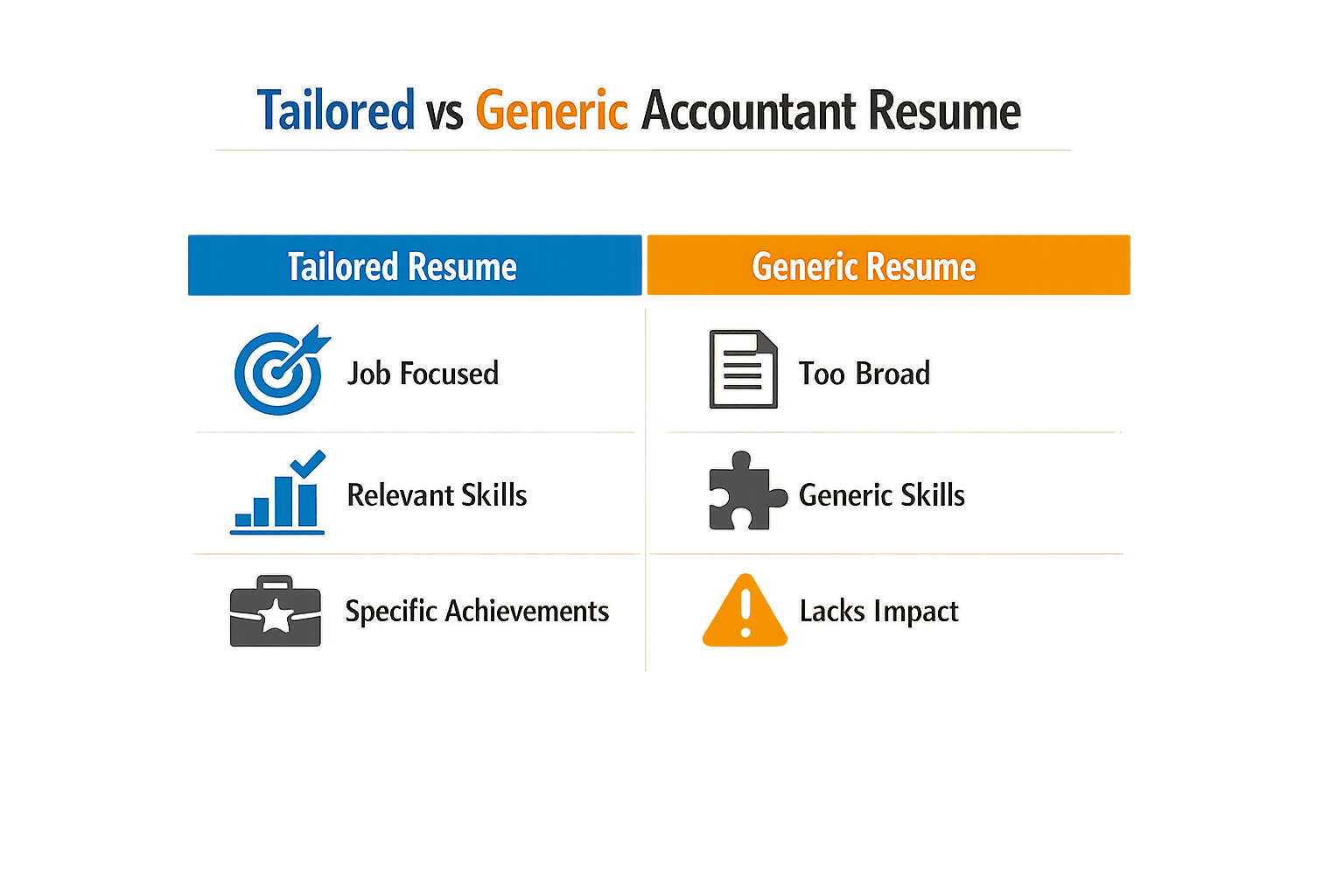
A generic accountant resume is the professional equivalent of showing up to a tax audit with last year's paperwork. It might cover the basics, but it won't address what the person across the table actually needs to see. Hiring managers reviewing accountant resumes aren't looking for a laundry list of every skill you've ever touched—they're scanning for evidence that you understand their specific challenges and can solve them.
The difference between a tailored resume and a one-size-fits-all version isn't subtle. When you customize your resume for each application by analyzing job descriptions and incorporating exact phrasing, callback rates can increase by three to four times. That's not a marginal improvement—it's the difference between your resume landing in the "maybe" pile and moving directly to the interview queue.
Why Generic Resumes Fall Short
Generic resumes fail because they treat all accounting roles as interchangeable. A cost accountant working in manufacturing needs to demonstrate process optimization and variance analysis. A tax accountant needs to show regulatory knowledge and deadline management. A senior accountant at a nonprofit needs to highlight fund accounting and compliance reporting. When your resume doesn't speak directly to these distinctions, it signals to the hiring manager that you haven't done your homework—or worse, that you don't understand the role.
The screening process amplifies this problem. Many organizations use applicant tracking systems that rank resumes based on keyword matches and relevance scores. If your resume uses "financial reporting" when the job description specifies "GAAP-compliant financial statements," you've just lost points in a system that has no room for interpretation. For more insights on how these systems work, see our guide on how ATS reads resumes.
The Tangible Benefits of Tailoring Your Accountant Resume
Tailoring your resume isn't about rewriting it from scratch for every application. It's about strategic emphasis—highlighting the 60% of your experience that directly maps to the role while downplaying the 40% that doesn't. This approach respects the hiring manager's time and makes their decision easier.
Generic accountant resumes yield generic results; specificity is what moves you from consideration to conversation.
When you tailor effectively, you're also building credibility. Using the same terminology the employer uses—whether that's "month-end close," "revenue recognition," or "internal controls"—demonstrates that you're already familiar with their operational language. It suggests you'll require less onboarding and can contribute faster, which is exactly what hiring managers want to believe about their next hire.
The investment pays off in interview quality too. When your resume is tightly aligned with the job description, interview questions become more substantive. Instead of spending the first ten minutes explaining what you actually do, you're discussing how you'd approach their specific challenges from day one.
Key Components of an Accountant Resume
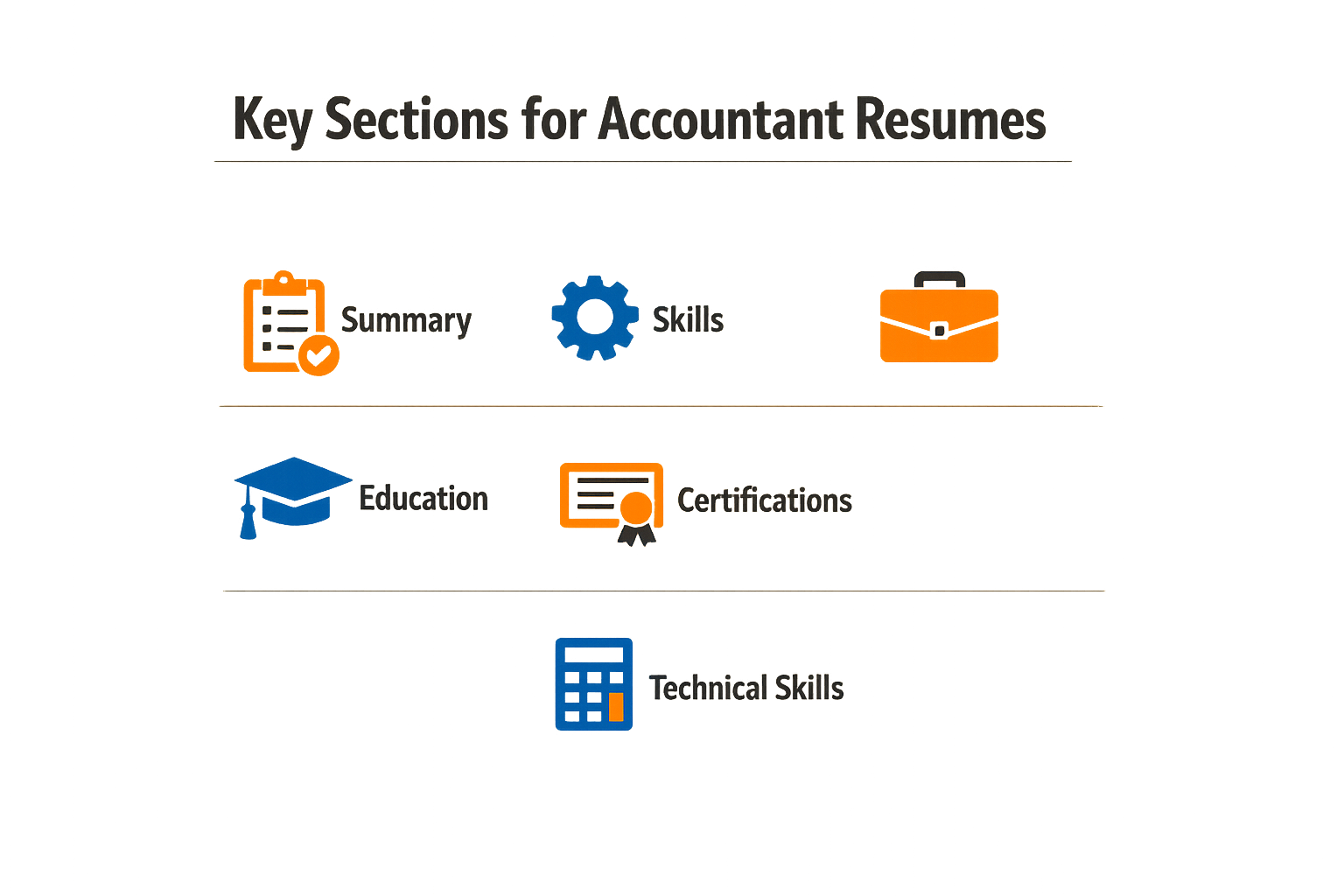
Every accountant resume needs a solid foundation—one that hiring managers can scan in seconds and that passes through applicant tracking systems without getting lost in the digital shuffle. The difference between a resume that lands interviews and one that disappears into the void often comes down to structure. Let's break down the essential sections that belong in every strong accountant resume.
Must-Have Sections for Your Accountant Resume
Your resume should include these core components in a logical order that guides the reader through your qualifications:
- Header — Your name, phone number, email, and location (city and state). Keep it clean and professional.
- Professional Summary — A brief overview of your experience, key strengths, and what you bring to the role. Think of this as your elevator pitch in three to four sentences.
- Certifications — CPA, CMA, or other relevant credentials deserve prominent placement, especially in accounting where certifications carry significant weight.
- Professional Experience — Your work history with measurable achievements. Focus on what you accomplished, not just what you did.
- Technical Skills — Software proficiency matters in accounting. List the platforms you know, from QuickBooks to SAP to Excel.
- Education — Degree, institution, and graduation year. If you're a recent graduate, this section moves higher on the page.
- Additional Certifications — Any specialized training or coursework that strengthens your candidacy.
What Makes These Components Work
The structure above isn't arbitrary—it reflects what employers actually look for when they review accountant resumes. Accuracy and compliance knowledge are baseline expectations, but hiring managers also want to see measurable financial impacts. Did you reduce close time by a certain percentage? Did you identify cost savings? Numbers tell the story better than adjectives.
Software proficiency deserves special attention. Accounting has become increasingly tech-driven, and employers expect candidates to hit the ground running with the tools their teams already use. If you're familiar with how ATS reads resumes, you already know that keyword matching for software skills can make or break your application.
A well-structured resume doesn't just list qualifications—it demonstrates the precision and attention to detail that define great accounting work.
When you organize your resume around these components, you create a document that works for multiple audiences: the ATS that screens it first, the recruiter who skims it in ten seconds, and the hiring manager who digs deeper during the interview process. Each section serves a purpose, and together they build a compelling case for why you're the right fit.
Common Accountant Job Types
The accounting profession encompasses diverse specializations, each demanding distinct skill sets and resume priorities. Understanding these variations is essential before you tailor your accountant resume—what impresses a tax director may fall flat with a forensic accounting team.
Public Accounting Roles
Public accountants serve multiple clients across industries, often through CPA firms. These positions emphasize audit experience, tax preparation, and client advisory work. Your resume should highlight certifications like CPA or CMA, showcase client relationship management, and demonstrate proficiency with industry-standard software like CCH Axcess or Thomson Reuters.
Staff accountants in public firms typically progress through associate, senior, and manager tracks. Each level requires different resume emphasis: entry roles stress technical skills and education, while senior positions demand leadership experience and business development contributions.
Corporate and Management Accounting
Corporate accountants work within single organizations, focusing on internal financial operations, budgeting, and strategic planning. These roles value industry-specific knowledge—manufacturing accountants need cost accounting expertise, while tech company controllers prioritize SaaS revenue recognition.
Management accountants analyze financial data to guide business decisions. Resumes for these positions should emphasize analytical capabilities, forecasting accuracy, and cross-functional collaboration. Quantify achievements: "Reduced budget variance by 18% through improved forecasting models" carries more weight than generic responsibility lists.
Specialized Accounting Positions
Forensic accountants investigate financial discrepancies and fraud, requiring resumes that highlight investigative skills, litigation support experience, and relevant certifications like CFE (Certified Fraud Examiner). Government accountants navigate public sector regulations and compliance frameworks—emphasize your understanding of GASB standards and grant accounting.
Tax accountants need resumes showcasing deep knowledge of tax codes, filing software proficiency, and client advisory experience. International tax specialists should emphasize cross-border transaction expertise and familiarity with transfer pricing regulations.
Industry-Specific Considerations
Healthcare accounting demands knowledge of revenue cycle management and insurance reimbursement. Real estate accountants must understand property depreciation and CAM reconciliations. Each industry expects you to speak its language—generic accounting terminology won't demonstrate the specialized expertise these employers seek.
The Bureau of Labor Statistics projects 6% growth in accounting roles through 2034, adding approximately 136,400 jobs. This expansion creates opportunities across all specializations, but competition remains fierce for senior positions. Your resume must immediately signal which accounting niche you serve and why you excel there.
For guidance on structuring professional experience across different career paths, explore our Financial Analyst Resume Template: The Ultimate Stress-Free Guide, which addresses similar challenges in adjacent finance roles.
How to Tailor Your Accountant Resume
Customizing your resume for each accounting role isn't just good practice—it's the difference between landing interviews and getting lost in the applicant tracking system. Generic resumes yield generic results, but a targeted approach can increase your callback rates significantly. The key is treating each application as its own project, not a mass-mailing campaign.
Analyze the Job Description Like a Balance Sheet
Start by reading the job posting as carefully as you'd review a financial statement. Highlight the exact skills, certifications, and software mentioned. If the role emphasizes "budget forecasting" and "variance analysis," those phrases need to appear in your resume—verbatim. Employers and ATS systems scan for exact keyword matches, so close synonyms won't cut it.
Create a simple spreadsheet with three columns: required skills, preferred qualifications, and your matching experience. This visual map shows you exactly where to focus your tailoring efforts and reveals any gaps you'll need to address in your cover letter.
Step 1
Extract and match keywords
Open the job description and your current resume side by side. Copy every technical term, certification, and skill requirement into a list. Then mark which ones already appear in your resume and which need to be added. For accounting roles, pay special attention to software names (QuickBooks, SAP, Oracle), regulatory frameworks (GAAP, IFRS), and specific accounting functions (reconciliation, audit support, tax preparation).
Step 2
Rewrite your professional summary
Your summary should mirror the job title and top three requirements. If you're applying for a Senior Tax Accountant role emphasizing corporate tax compliance, your summary might read: "Senior Tax Accountant with 6+ years specializing in corporate tax compliance and multi-state filing." Save a master version of your resume, then create role-specific copies with tailored summaries.
Step 3
Reorganize your experience bullets
Move your most relevant achievements to the top of each job entry. If the role prioritizes month-end close processes, lead with your accomplishments in that area. Quantify everything with specific metrics—"Reduced close time by 3 days" beats "Improved efficiency" every time. Use the same action verbs from the job posting when describing similar work.
Step 4
Adjust your skills section
List technical skills in the order they appear in the job requirements. If the posting mentions Excel before QuickBooks, do the same. Remove skills that aren't relevant to this specific role—your proficiency in retail POS systems doesn't matter for a corporate accounting position. Keep the section scannable and directly aligned with what the employer needs.
Format for ATS Success
Even the most tailored content fails if the ATS can't read it. Use a simple, clean format with standard section headings like "Professional Experience" and "Education." Avoid tables, text boxes, headers, and footers—these confuse parsing software. Stick to common fonts and save your resume as a .docx file unless the application specifically requests PDF.
The investment in tailoring pays compound returns. Each customized resume demonstrates that you've done your homework and understand exactly what the role requires. Hiring managers notice the difference immediately, and so do the algorithms screening your application. For more insights on optimizing your resume for applicant tracking systems, check out How ATS Reads Resumes: The Ultimate Guide to Surprising Success.
Tips for Successful Accountant Resumes
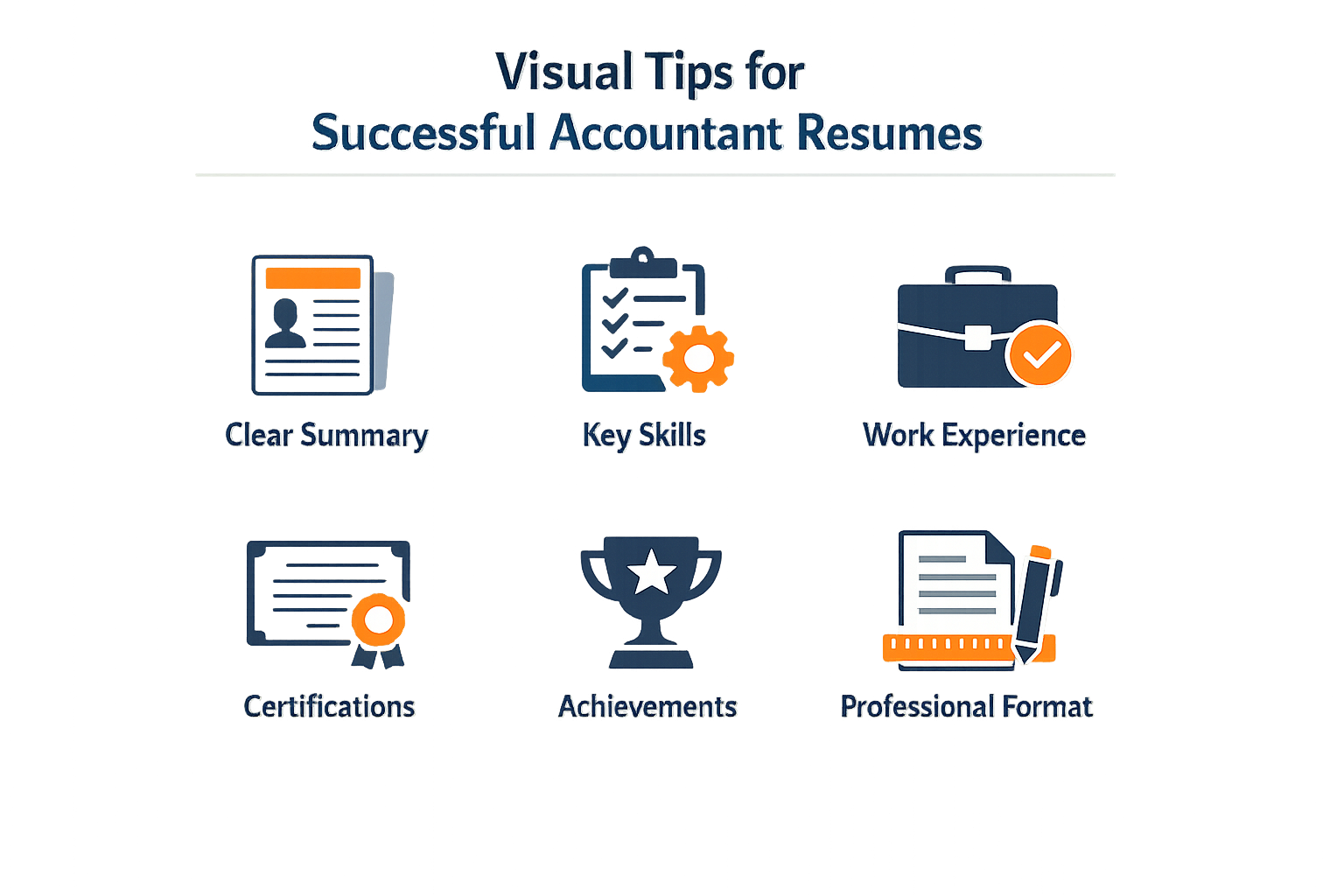
Crafting a standout accountant resume requires more than listing your previous roles. The difference between a resume that lands interviews and one that gets overlooked often comes down to how you present your experience and what you choose to emphasize.
Focus on Achievements, Not Just Duties
The most common mistake on accounting resumes is listing job duties instead of achievements. Instead of writing "Managed accounts payable," demonstrate your impact with specific accomplishments. For example, "Reduced processing time for accounts payable by implementing automated workflow, improving efficiency by 25%." This approach shows employers what you can deliver, not just what you were responsible for.
Quantifying your accomplishments makes your contributions tangible and memorable. Whenever possible, include metrics that demonstrate accuracy, efficiency, or cost savings.
Highlight Technical Skills and Compliance Knowledge
Accountant resumes must specify software experience and relevant compliance frameworks. Don't simply list "proficient in accounting software"—name the exact tools you've used, such as QuickBooks, SAP, Oracle, or Excel with advanced functions.
Similarly, specify which compliance frameworks you've worked with, whether GAAP, IFRS, SOX, or industry-specific regulations. These details help your resume pass through applicant tracking systems and demonstrate your readiness for the role.
Demonstrate Accuracy and Efficiency Metrics
Employers in accounting value precision and productivity. Common mistakes include failing to show accuracy or efficiency metrics in your work history. Instead of vague statements, include concrete examples like "Maintained 100% accuracy in month-end close processes" or "Completed quarterly audits 15% faster than departmental average."
These metrics reassure hiring managers that you bring both competence and reliability to their team. For additional guidance on optimizing your resume for applicant tracking systems, see our guide on How ATS Reads Resumes: The Ultimate Guide to Surprising Success.
Tailor Your Summary and Skills Section
Your resume summary should immediately signal your fit for the specific role. A generic summary like "Experienced accountant with strong analytical skills" doesn't differentiate you. Instead, customize it to reflect the job type: "CPA-certified accountant with 5+ years specializing in tax compliance and multi-state filings for mid-sized corporations."
Your skills section should mirror the language in the job description while remaining truthful. If the posting emphasizes "financial forecasting" and "variance analysis," ensure those exact phrases appear in your skills or experience sections—assuming you genuinely possess them.
Keep Formatting Clean and ATS-Friendly
Even the strongest content can be undermined by poor formatting. Use standard section headings like "Professional Experience," "Education," and "Skills" so applicant tracking systems can parse your information correctly. Avoid tables, text boxes, headers, and footers, which often confuse ATS software.
Stick to common fonts like Arial, Calibri, or Times New Roman, and save your resume as a .docx or PDF file unless the application specifically requests otherwise. Clean, simple formatting ensures your qualifications reach human reviewers.
Avoiding Common Mistakes
Even experienced accountants can sabotage their job search with preventable resume errors. The difference between landing an interview and getting overlooked often comes down to small but critical missteps that hiring managers spot immediately.
Listing Duties Instead of Achievements
The most damaging mistake is describing what you were supposed to do rather than what you actually accomplished. A line like "Responsible for accounts payable" tells the reader nothing about your impact. Instead, focus on quantifiable outcomes: "Reduced accounts payable processing time by 30% through vendor consolidation and workflow automation." This shift from duties to achievements transforms a generic resume into a compelling case for your value.
Missing Critical Technical Details
Vague references to "accounting software" or "spreadsheet proficiency" raise red flags. Employers need to know exactly which systems you've mastered—QuickBooks, SAP, Oracle NetSuite, or specific ERP platforms. Similarly, failing to specify compliance frameworks like GAAP or IFRS suggests surface-level knowledge rather than deep expertise. Name the tools and standards you've worked with, and whenever possible, attach a metric to prove competency.
Ignoring Accuracy and Efficiency Metrics
Accounting is fundamentally about precision and speed, yet many resumes never demonstrate either. If you've maintained zero discrepancies across thousands of transactions, say so. If you've closed books three days faster than the previous standard, quantify it. These numbers prove you understand what matters in the role—not just completing tasks, but completing them flawlessly and efficiently.
The best accountant resumes don't just list software—they show how that software drove measurable improvements in accuracy, speed, or cost control.
Overlooking ATS Optimization
Many well-qualified candidates never reach human eyes because their resumes can't pass applicant tracking systems. Generic language, missing keywords from the job posting, and unconventional formatting all trigger ATS rejections. For deeper insight into how these systems evaluate your application, review How ATS Reads Resumes: The Ultimate Guide to Surprising Success to ensure your resume makes it through the initial screening.
Using One Resume for Every Application
Sending the same resume to a tax accountant position and a cost accounting role signals that you haven't thought carefully about what each employer needs. Tailoring doesn't mean rewriting everything—it means emphasizing the experience and skills most relevant to each specific opportunity. A few strategic adjustments per application dramatically improve your response rate.
Who Should Choose What
Not every accountant resume should look the same—and that's the point. The format, emphasis, and certifications you highlight depend entirely on the role you're pursuing. A staff accountant breaking into the field needs a different strategy than a controller eyeing executive leadership. Understanding which resume elements matter most for your target position helps you allocate space where it counts.
Entry-Level and Staff Accountant Roles
If you're targeting entry-level or staff accountant positions, prioritize education and relevant coursework over extensive work history. Highlight internships, part-time bookkeeping roles, or volunteer tax preparation experience. Use a chronological format that shows steady progression, even if that progression includes academic projects or campus leadership. Employers at this level care more about your ability to learn systems quickly than your tenure at a Big Four firm.
Soft skills matter here too. Communication, attention to detail, and teamwork often separate candidates with similar GPAs. If you've collaborated on group audits or presented financial analysis to non-accountants, call it out explicitly.
Senior Accountant and Specialist Positions
For senior accountant, cost accountant, or tax specialist roles, shift your focus to technical proficiency and measurable outcomes. Employers expect you to manage month-end close independently, reconcile complex accounts, or navigate multi-jurisdiction tax filings without hand-holding. Your resume should demonstrate ownership: "Led quarterly close process for $50M revenue division" carries more weight than "Assisted with financial reporting."
This is also where certifications start to differentiate you. A CMA (Certified Management Accountant) signals cost accounting expertise; an EA (Enrolled Agent) proves tax authority. If you're pursuing a CPA but haven't passed all sections yet, list "CPA candidate—2 of 4 sections passed" to show momentum.
Controller and Leadership Roles
Controller-level positions demand strategic oversight, not just technical execution. Your resume must prove you can translate financial data into business decisions, manage cross-functional teams, and communicate with non-finance executives. Lead with leadership accomplishments: process improvements that saved time, audit results with zero findings, or budgeting frameworks you designed from scratch.
Certification becomes critical here—87% of controller-level job postings require or strongly prefer CPA certification. If you lack a CPA, you'll need compensating factors: an MBA in finance, 10+ years of progressive responsibility, or industry-specific credentials like a CTP (Certified Treasury Professional). A combination resume format works well at this level, allowing you to feature a "Key Qualifications" summary before diving into your career history.
Remember that 92% of hiring managers value communication as much as technical ability. If you've presented to boards, led ERP implementations, or trained junior staff, those examples prove you can operate at the leadership level the role requires.
Industry-Specific Considerations
Certain industries impose unique resume requirements. Public accounting firms want to see your billable hours experience and client portfolio; manufacturing companies care about cost accounting and inventory valuation; nonprofits need fund accounting and grant compliance expertise. If you're pivoting industries, bridge the gap by emphasizing transferable skills—GAAP knowledge applies everywhere, even if the account structure differs.
For roles requiring niche expertise (forensic accounting, international tax, or healthcare revenue cycle), your resume should front-load relevant certifications and case examples. A generic "prepared financial statements" bullet won't differentiate you; "conducted fraud investigations resulting in $2M asset recovery" will.
The best accountant resume isn't the one with the most credentials—it's the one that proves you've solved problems identical to the ones the employer faces today.
If you're unsure which format suits your career stage, review templates designed for similar roles. A well-structured financial analyst resume template can offer guidance on balancing technical skills with business impact, especially if you're transitioning from analysis to accounting leadership.
Case Studies or Examples
Seeing how tailored resume strategies work in practice makes the difference between theory and results. The following examples demonstrate how specific, measurable achievements transform a generic accountant resume into a compelling case for hiring.
Example 1: Accounts Receivable Specialist
A candidate applying for an AR-focused role replaced vague task descriptions with concrete outcomes. Instead of "Managed invoices and collections," the resume stated:
"Processed 1,200+ invoices monthly with 99.4% accuracy; reduced overdue AR from 18% to 6%"
This approach immediately signals competence in high-volume environments and demonstrates impact on cash flow—two critical concerns for AR positions. The specificity (1,200+ invoices, 99.4% accuracy) builds credibility, while the outcome (reducing overdue AR) shows business value beyond task completion.
Example 2: Financial Accountant in Month-End Close
Another professional targeting financial accounting roles focused on process improvement rather than routine duties. The tailored bullet point read:
"Reduced monthly close cycle from 8 days to 5 days by automating 6 recurring journal entries and standardizing the reconciliation checklist across 4 entities."
This example works because it addresses a universal pain point in accounting departments—lengthy close cycles—and quantifies both the improvement (8 days to 5 days) and the method (automation, standardization). Hiring managers immediately understand the candidate can streamline operations, not just execute them.
What Makes These Examples Effective
Both cases follow the same pattern: they start with a measurable action, specify the scope or volume, and conclude with a business outcome. Generic statements like "Responsible for month-end close" or "Handled invoicing" offer no differentiation. The tailored versions prove capability through evidence.
When you review your own accountant resume, apply this test to each bullet point: Does it show what you accomplished, or just what you were assigned? The difference determines whether your resume gets a second look or gets passed over.
For additional guidance on structuring achievement-based content, see our Account Manager Resume Template: The Ultimate Stress-Free Guide, which covers similar principles for client-facing roles.
Conclusion
A generic accountant resume is a missed opportunity. Throughout this guide, we've seen that tailoring your resume to match specific job types—whether you're pursuing public accounting, corporate finance, tax specialization, or forensic roles—dramatically improves your chances of landing interviews. Customizing your resume by analyzing job descriptions and incorporating exact phrasing can increase callback rates by several multiples, transforming your job search from frustrating to focused.
The key components we've covered—professional summaries aligned to job goals, skills sections that mirror employer language, and quantified achievements that speak to measurable impact—work together to position you as the precise candidate hiring managers are seeking. Remember that each accountant role demands different competencies: a staff accountant needs operational precision, while a senior accountant must demonstrate strategic oversight and team leadership.
After years of reviewing resumes as a recruiter, I've seen firsthand how candidates who invest time in tailoring their materials consistently outperform those who rely on one-size-fits-all documents. The difference isn't talent—it's presentation. Your resume is your marketing document, and like any effective marketing, it must speak directly to its audience.
Avoid the common pitfalls we've discussed: keyword stuffing that reads unnaturally, vague responsibilities without outcomes, and formatting that confuses applicant tracking systems. Instead, focus on clarity, relevance, and proof. Every bullet point should answer the question, "So what?" by connecting your work to business results.
As you move forward, treat each application as a unique opportunity to demonstrate fit. Review the job description carefully, identify the three to five most critical requirements, and ensure your resume addresses each one explicitly. This targeted approach takes more time upfront but saves countless hours of waiting for responses that never come.
The accounting profession continues to grow, with strong demand across industries and specializations. Position yourself to capture that opportunity by presenting a resume that doesn't just list your credentials—it tells the story of why you're the right accountant for this specific role. For additional guidance on crafting professional documents that stand out, explore our Account Manager Resume Template: The Ultimate Stress-Free Guide to see how tailoring principles apply across finance and business roles.
Start with one job posting today. Analyze it, adjust your resume accordingly, and submit a version that speaks directly to what that employer needs. Your tailored accountant resume is your competitive advantage—use it.

Written by
Emily Johnson
Published September 1, 2026 · 20 min read
Emily Johnson is a seasoned career strategist with over a decade of experience in recruitment and talent acquisition. With a background in human resources, she excels at helping professionals refine their job search strategies, from crafting compelling resumes to mastering interview techniques. As an expert in Applicant Tracking Systems (ATS), Emily is dedicated to guiding individuals toward their dream careers.
Want this kind of read on your résumé?
We'll tell you what's actually working, what's holding you back, and what to fix — in plain English.
Get My Job Match ScoreYou Might Also Like
More articles to help you advance your career

ATS Meaning Resume: Understanding ATS and What Applicant Tracking
Learn what ATS meaning resume entails and how Applicant Tracking Systems work in 2026 to streamline your hiring process and recruitment workflows.

Honest Résumé Score Example: What It Looks Like and How to Improve
Learn what an honest résumé score looks like with this real walkthrough. See actual examples and discover how to improve your résumé evaluation results with an honest

Why a Generic Cybersecurity Resume Won't Work and What Will
Discover why a generic cybersecurity resume won't cut it and learn how to tailor your application for success in the tech industry.

Free ATS Resume Checker: What's Useful and What's Not
Discover what Free ATS Resume Checker tools can and can't do. Learn which features actually help optimize your resume for applicant tracking systems.