



CNA Resume: The Ultimate Guide to Crafting a Simple Winner
Discover why a generic CNA Resume fails and learn the ultimate strategies to craft a simple, effective resume that stands out to employers.
 Emily Johnson
Introduction
You've completed your CNA training, passed your certification exam, and you're ready to launch your healthcare career. But when you sit down to write your resume, you realize the generic template you downloaded isn't doing you any favors. After reviewing hundreds of CNA applications over the years, I've seen firsthand how a one-size-fits-all approach leaves qualified candidates buried in the pile.
The truth is that a generic CNA resume won't work in today's competitive healthcare environment. Hiring managers spend mere seconds scanning each application, looking for specific skills, relevant experience, and clear evidence that you understand the demands of patient care. When your resume reads like everyone else's—filled with vague duties and cookie-cutter phrases—it becomes invisible.
A well-prepared resume is a marketing tool for your skills and experience, essential for standing out among applicants. It's not just about listing where you worked or what tasks you performed. It's about demonstrating that you understand what the facility needs and that you're the solution to their staffing challenges. For more insights on creating effective professional documents, explore our guide on How ATS Reads Resumes: The Ultimate Guide to Surprising Success.
In this guide, we'll break down exactly why the generic approach fails and walk you through the specific strategies that will help your CNA resume open doors. You'll learn how to highlight the experience that matters, avoid the pitfalls that sink most applications, and customize your document so it speaks directly to the needs of each employer. By the end, you'll have a clear roadmap for creating a resume that actually gets you hired.
Understanding the CNA Resume
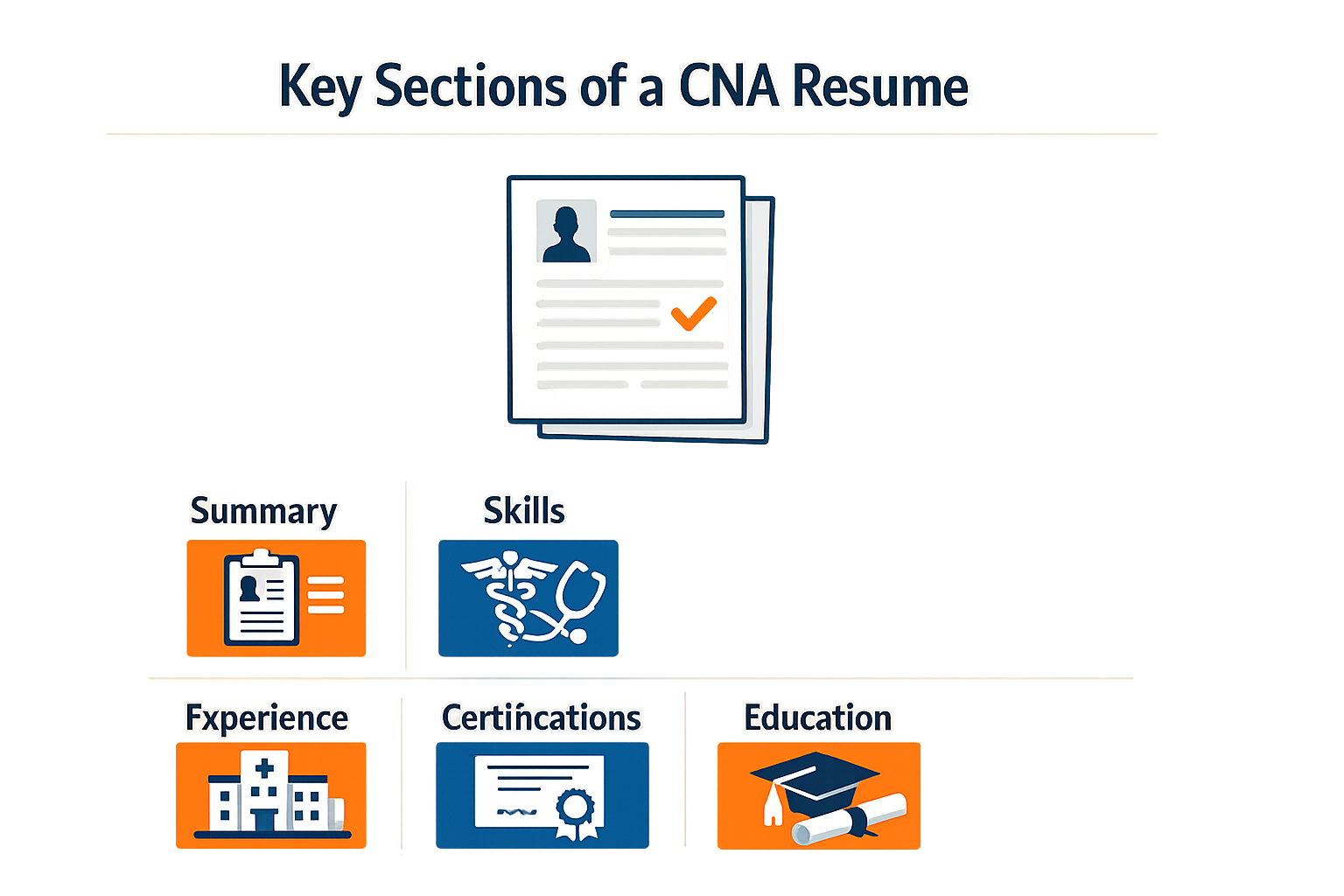
A CNA resume is your professional introduction to hiring managers in healthcare facilities — hospitals, nursing homes, assisted living centers, and home health agencies. It's a one-page document that summarizes your certification, clinical skills, patient care experience, and the soft skills that make you effective in high-pressure environments. Unlike resumes in other fields, a CNA resume must immediately signal two things: that you hold current state certification and that you understand the physical and emotional demands of direct patient care.
The significance of this document goes beyond landing interviews. With over 200,000 CNA job openings annually and a competitive market driven by high turnover, your resume is the filter that determines whether you're seen as a qualified candidate or lost in the pile. Employers scan for specific certifications, hands-on experience with activities of daily living (ADLs), and evidence that you can follow care plans under supervision. A strong CNA resume doesn't just list duties — it demonstrates reliability, compassion, and competence in a format that hiring managers can assess in seconds.
Why Your CNA Resume Carries More Weight Than You Think
Healthcare recruiters often review dozens of applications for a single opening. They're looking for red flags — gaps in certification, vague job descriptions, or resumes that read like they were copied from a template without customization. Your resume is the first test of your attention to detail, a quality that directly translates to patient safety. If you can't clearly communicate your qualifications on paper, hiring managers question whether you'll document patient care accurately in the field.
The Bureau of Labor Statistics projects steady demand through 2033, but that doesn't mean every applicant gets hired. The candidates who stand out are those whose resumes reflect real clinical experience, not generic phrases like "provided excellent care." Employers want to see that you've worked with specific patient populations, used medical equipment, and handled the physical tasks — lifting, turning, bathing — that define the role. If you're exploring ways to make your application materials more effective across different roles, resources like the Account Manager Resume Template: The Ultimate Stress-Free Guide offer structural insights that apply to any profession.
The Three Core Functions of a CNA Resume
First, it proves eligibility. Your resume must confirm that you're a certified nursing assistant in good standing, with no ambiguity about your training or licensure status. Second, it showcases relevant experience. Employers care about where you've worked, how long you stayed, and what patient care tasks you performed daily. Third, it signals cultural fit. Healthcare is team-based work under stress; your resume should reflect reliability, empathy, and the ability to follow protocols without cutting corners.
A well-constructed CNA resume answers the hiring manager's unspoken question: "Can I trust this person with my patients on day one?" Every line should build that trust, from your certification details to the way you describe your last shift. Generic resumes fail because they don't answer that question — they simply restate the job description without evidence that you've lived it.
Common Pitfalls of Generic Resumes

Generic resumes fail before a human ever sees them. In healthcare, job applications have the lowest ATS first-submission score of any tracked industry, averaging just 28 out of 100. That means seven out of ten CNA resumes are filtered out by software before they reach a hiring manager's desk.
The volume makes things worse. Hospital HR teams and skilled nursing facility administrators screen hundreds of applications for every Certified Nursing Assistant opening. When your resume looks like everyone else's, it becomes invisible.
Vague Descriptions That Say Nothing
The most common mistake is writing duties instead of results. Phrases like "helped patients" or "assisted with daily care" tell an employer nothing about your actual capability. These descriptions could apply to anyone who walked through the door on their first day.
Instead, specify the types of care you provided and include patient-to-CNA ratios to help employers understand your workload and experience level. A recruiter reading "managed ADLs for 12 memory-care residents on night shift" knows immediately what you can handle. "Helped patients with daily activities" tells them nothing.
Missing Keywords That ATS Systems Demand
Applicant tracking systems scan for exact matches to job descriptions. A generic resume uses broad terms that don't align with how facilities write their postings. If the job listing says "vital signs monitoring" and your resume says "checked patient health," the ATS won't connect the two.
Healthcare employers also look for certifications, specific care settings, and patient populations. Leaving out "dementia care," "post-operative support," or "pediatric experience" means your resume won't surface in filtered searches—even if you have that background.
Understanding how ATS reads resumes can help you avoid these invisible rejections and structure your document to pass automated filters.
One-Size-Fits-All Formatting
Generic resumes often bury the most important information under irrelevant details. A CNA applying to a skilled nursing facility doesn't need to lead with retail experience from five years ago, yet many templates encourage chronological listings that do exactly that.
The first third of your resume is the only part guaranteed to be read—make every line in that space directly relevant to patient care.
Employers also dismiss resumes with inconsistent formatting, unexplained gaps, or duties listed without context. If you worked in a 120-bed facility but don't mention the setting, a recruiter assumes you lack the experience to handle their environment.
Key Components of an Effective CNA Resume
A strong CNA resume isn't just a list of where you've worked—it's a carefully assembled document that speaks directly to what healthcare recruiters need to see. Every section serves a purpose, and missing even one critical element can mean your application gets passed over before a human ever reads it.
Active Certification and Licensure Details
Your state CNA certification is the first credential recruiters verify. Include your active license number, the state where you're registered, and the expiration date. BLS and CPR certifications belong here too—list the issuing organization and current status. If your license is about to expire, renew it before you apply; an outdated credential is a red flag that stops the conversation cold.
Results-Focused Professional Summary
Your summary is a three-to-four-sentence snapshot of who you are as a caregiver. Lead with your years of experience and the type of unit you've worked on—long-term care, acute care, or memory care. Then highlight one or two measurable outcomes: patient satisfaction scores, safety records, or efficiency improvements. This section sets the tone for everything that follows.
Quantified Experience Bullets
Each role you list should include three to five bullets that describe what you accomplished, not just what you did. Instead of "provided patient care," write "assisted 12 patients daily with ADLs while maintaining a zero fall rate over six months." Numbers give recruiters concrete proof of your competence. If you worked on a specialized unit or with a particular patient population, name it—those details help you stand out when facilities are hiring for specific needs.
A resume that shows outcomes, not just tasks, tells recruiters you understand the difference between showing up and making an impact.
Targeted Skills Section
List both clinical and interpersonal skills that match the job description. Clinical skills might include vital signs monitoring, catheter care, wound dressing, or infection control. Soft skills like patient advocacy, family communication, and teamwork are equally important—healthcare is a people business. Keep the list to eight to twelve items, and make sure each one is something you can discuss confidently in an interview.
If you're looking for more guidance on structuring your resume sections, check out our Recruiter Resume Template: The Ultimate Guide to Best Results for additional formatting strategies that apply across healthcare roles.
Education and Training
Include your CNA training program, the institution where you completed it, and your graduation date. If you've taken continuing education courses—dementia care, palliative care, pediatric care—list those too. They demonstrate initiative and specialized knowledge that can tip the scales when two candidates look equally qualified on paper.
Customizing Your CNA Resume
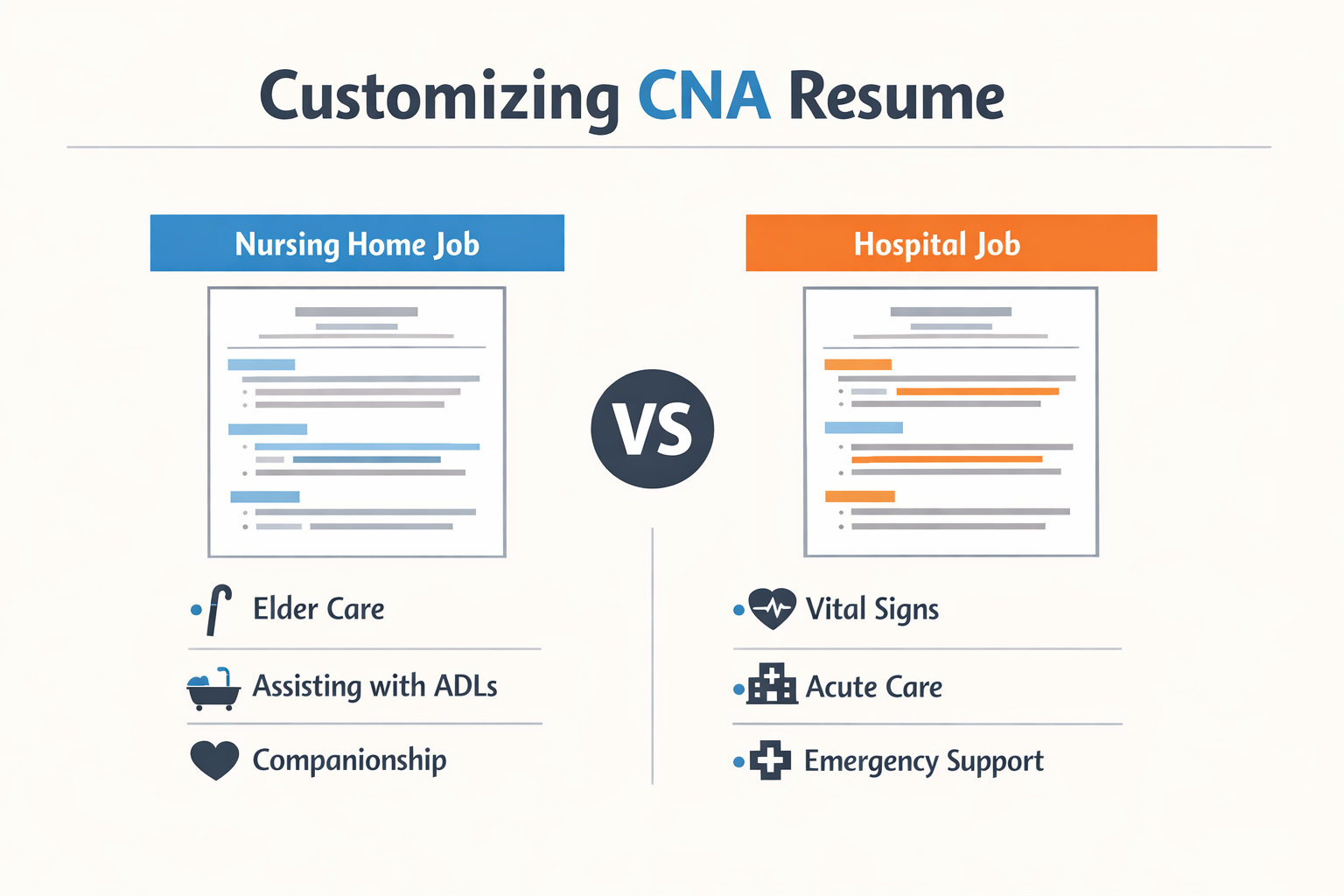
A one-size-fits-all resume rarely makes it past the first screening. Hospitals, nursing homes, and assisted living facilities each use applicant tracking systems that scan for specific terms tied to their job postings. When your resume mirrors the language in the posting, you increase your chances of ranking high enough for human review.
Match the Job Posting Language
Many healthcare facilities rely on ATS software that ranks candidates by keyword frequency and relevance. If the posting asks for "patient mobility assistance" and your resume says "helping residents move," the system may not connect the dots. Copy the exact phrases from the job description and weave them naturally into your summary, skills, and experience sections. This alignment signals that you understand the role's priorities and speak the facility's language.
Lead with Certification Details
Your certification is the first filter hiring managers apply. Name your credential, state registry status, and current BLS or CPR certification in both your headline and summary. For example, "CNA – State Registered (CA) | BLS Certified" tells the reader—and the ATS—that you meet baseline requirements before they read another word. When the posting emphasizes a specialty like dementia care or pediatric support, add that qualifier to your headline if you hold the training.
Avoid Multi-Column Layouts and Decorative Elements
ATS parsers struggle with tables, text boxes, and graphics. A two-column format may look polished on screen, but the software often scrambles the reading order or skips entire sections. Stick to a single-column layout with standard headings like "Experience," "Education," and "Certifications." Skip icons, logos, and decorative borders—they add visual noise without improving your rank. If you want to understand how automated systems process your document, review guidance on how ATS reads resumes to see where common formatting mistakes trip up even strong candidates.
Step 1
Pull keywords from the posting
Highlight every skill, certification, and duty the employer lists. Note repeated terms—they signal high-priority qualifications.
Step 2
Map keywords to your experience
For each highlighted term, find a place in your resume where you can truthfully use that exact phrase. If you performed the task under a different name, adopt the posting's language.
Step 3
Simplify your layout
Convert any multi-column or table-based sections into a single-column format with clear headings. Remove icons, text boxes, and graphics that ATS cannot parse.
Tailor Your Summary to the Facility Type
A hospital emergency department values speed and critical-thinking skills, while a long-term-care facility prioritizes patience and relationship-building. Adjust your opening summary to emphasize the traits the employer seeks. If the posting mentions "fast-paced environment," lead with your ability to manage multiple patients under time pressure. If it highlights "compassionate care," open with your track record of building trust with residents and families. This targeted approach shows you researched the role instead of sending a generic document.
Customizing your resume is not about fabricating experience—it is about presenting your real skills in the terms the employer already uses. When you align your language, structure, and emphasis with the job posting, you make it easy for both software and hiring managers to see you as a strong match.
Highlighting Relevant Experience
Your experience section is where hiring managers decide whether to keep reading or move on. For CNAs, this means converting everyday tasks into proof that you made a measurable difference. A line like "Assisted patients with daily activities" tells an employer nothing they don't already assume. A line like "Supported 12–15 patients daily with ADLs while maintaining zero pressure ulcer incidents over six months" shows you understand outcomes, not just duties.
Turn Tasks Into Contributions
Generic resumes list what you did. Strong resumes show what changed because you did it. Instead of "Monitored vital signs," write "Tracked vital signs for 10+ patients per shift and escalated abnormal readings within protocol timelines, contributing to early intervention in three critical cases." The difference is evidence. Hiring managers want to see patient counts, timeframes, and results—anything that proves you didn't just show up, but showed impact.
For candidates with no paid CNA experience, clinical training and practicum hours carry weight when presented correctly. Describe your clinical rotation the same way you'd describe a job: patient load, procedures performed, supervision received, and any measurable outcomes you contributed to. If you assisted with 40+ patient transfers during your practicum without incident, that's a data point worth including.
Showcase Specialized Skills and Certifications
Mid-career CNAs should emphasize areas of specialization that set them apart. If you've worked in memory care, rehabilitation, or post-surgical recovery, call that out explicitly. Pair it with quantified achievements wherever possible. Reducing fall incidents by 22% through proactive monitoring isn't just a nice detail—it's proof you understand risk management and patient safety protocols at a level beyond basic competency.
Certifications beyond your CNA credential deserve their own line. CPR, first aid, dementia care training, or phlebotomy certifications signal that you've invested in your skillset. List them with issuing organizations and expiration dates if applicable. Employers value CNAs who stay current and pursue additional credentials without being asked.
If you're wondering how other healthcare roles structure their experience sections effectively, see our guide on the Recruiter Resume Template: The Ultimate Guide to Best Results for cross-industry resume strategies that apply to clinical positions as well.
Avoid the Duty-Dump Trap
The fastest way to lose a hiring manager's attention is to copy your job description verbatim into your resume. Employers already know what CNAs do in general. They're hiring to solve a specific problem: coverage gaps, high-acuity patient loads, or turnover in a difficult unit. Your experience section should answer the question, "Why you, in this environment, right now?" Focus on the 3–5 responsibilities where you exceeded expectations or handled complexity that others didn't. Leave the routine tasks implied.
Avoiding Jargon and Technical Terms
A CNA Resume lives or dies on clarity. Hiring managers scan dozens of applications in minutes, and dense medical terminology slows them down. Your resume should communicate competence without requiring a decoder ring. Clear language shows you understand your audience—and that you can explain care plans to families who aren't healthcare professionals.
Write for the Person Reading, Not the Job You Want
Many CNAs fall into the trap of stuffing resumes with clinical shorthand. Terms like "ADLs," "PRN protocols," or "post-acute intervention" might feel impressive, but they create friction. A charge nurse knows what you mean; an HR coordinator screening 50 resumes before lunch does not. When your resume hits a non-clinical gatekeeper first, jargon becomes a barrier to the interview you deserve.
Instead of listing "Administered PRN meds per facility protocol," write "Provided as-needed medications following care plans." The second version is just as accurate and twice as accessible. You're not dumbing down your skills—you're making them visible to everyone in the hiring chain.
Replace Generic Phrases with Specific Claims
Avoid openers like "caring CNA dedicated to helping patients." These phrases say nothing. Every applicant claims to be caring; none of them prove it. Replace vague descriptors with concrete examples: "Supported 12 residents daily with mobility assistance, personal hygiene, and meal support, maintaining zero pressure ulcer incidents over 18 months." Specificity builds trust.
Soft skills matter, but only when you anchor them in observable work. Words like empathy, adaptability, and teamwork belong in your bullet points—but only when paired with outcomes. "Adapted quickly to rotating shift schedules" is stronger than "highly adaptable." "Collaborated with RN team to reduce fall risk for high-acuity patients" beats "excellent teamwork skills" every time.
Keep Sentences Short and Scannable
Long, winding sentences bury your accomplishments. Aim for one idea per bullet point. If a sentence runs past two lines on the page, break it into two bullets. Hiring managers skim before they read; give them clean, digestible chunks. A resume that looks easy to read gets read more carefully.
For more strategies on making your resume work with automated screening systems, see our guide on How ATS Reads Resumes: The Ultimate Guide to Surprising Success.
Final Tips for a Successful CNA Resume
Crafting a standout CNA resume requires attention to detail and a commitment to clarity. Beyond the core components covered earlier, these final tips will help you refine your document and maximize your chances of landing an interview.
Write a Compelling Professional Summary
Your professional summary sits at the top of your resume and sets the tone for everything that follows. Make it count by being specific about your experience and strengths. A strong professional summary could be: "Certified Nursing Assistant with 4+ years of experience providing compassionate direct patient care in skilled nursing facilities. Recognized for exceptional reliability and patient rapport." Notice how this example quantifies experience and highlights specific qualities employers value.
Avoid generic phrases like "hardworking" or "team player" without context. Instead, demonstrate these qualities through concrete details about your work history and achievements.
Be Specific About Your Care Experience
Avoid vague descriptions like "helped patients" and instead specify the types of care provided. Include patient-to-CNA ratios to help employers gauge experience level. For example, "Provided direct care for 8-12 residents per shift, including bathing, dressing, feeding, and mobility assistance" paints a clearer picture than "assisted with daily living activities."
This specificity helps hiring managers understand exactly what you can do from day one, reducing their uncertainty and making you a more attractive candidate.
Proofread Relentlessly
Typos and grammatical errors signal carelessness—a quality no healthcare employer wants in a CNA. Read your resume multiple times, use spell-check tools, and ask a trusted friend or colleague to review it with fresh eyes. Pay special attention to certification names, dates, and contact information.
Even small errors can derail an otherwise strong application, so invest the time to make your document flawless.
Keep Formatting Clean and Consistent
Use the same font throughout, maintain consistent spacing, and align text properly. Stick to standard fonts like Arial, Calibri, or Times New Roman in 10-12 point size. Use bold or italics sparingly to highlight section headers or job titles, but avoid overusing formatting that makes your resume look cluttered.
A clean, professional layout ensures your content gets read rather than dismissed at first glance. For additional guidance on creating polished, professional documents, see our Recruiter Resume Template: The Ultimate Guide to Best Results.
Tailor Every Time
No matter how strong your base resume is, always customize it for each position. Review the job posting carefully, identify the top three to five requirements, and make sure your resume addresses those priorities directly. This doesn't mean rewriting everything—just adjusting your professional summary, reordering bullet points, or emphasizing certain skills over others.
Tailoring takes minutes but dramatically increases your response rate from employers.
Who Should Choose What Type of Resume
Not every CNA Resume should look the same. The format you choose depends on where you are in your career and what story you need to tell. New graduates, experienced CNAs switching specialties, and those returning after a gap each face different challenges — and each needs a different structural approach.
New CNAs: Lead with Certification and Clinical Rotations
If you just earned your certification, you don't have years of employment history to lean on. That's fine — healthcare recruiters expect current state certification, CPR/BLS credentials, and relevant clinical experience. Start your resume with a "Certifications" section at the top, immediately after your contact information. List your state CNA license number, issue date, and expiration date. Follow that with your clinical rotations: name the facility, the unit type (medical-surgical, long-term care, rehabilitation), and the skills you practiced during each placement. Most CNA jobs hire on certification rather than years of experience, so showing that you hold a current state certificate and BLS is your strongest opening move.
Experienced CNAs: Use Reverse-Chronological to Show Progression
If you've worked as a CNA for two or more years, a reverse-chronological format is your best bet. List your most recent position first, then work backward. Under each job, include 3–5 bullet points that document safe patient handling techniques, infection control compliance, and any specialized skills like wound care or dementia support. Recruiters scan for consistency and growth — if you moved from a nursing home to a hospital step-down unit, that trajectory tells a story of increasing responsibility. Don't bury your track record under a skills-first layout; let your employment timeline do the talking.
Career Changers and Gap Returners: Functional or Hybrid Formats
If you're switching from another healthcare role (like a medical assistant or home health aide) or returning after time away, consider a functional or hybrid resume. A functional format groups your skills by category — patient care, vital signs monitoring, documentation — rather than by employer. This works when your job titles don't immediately signal CNA competence. A hybrid format combines a skills summary at the top with a brief employment history below. Either way, your certifications section still comes first. As I've seen in recruiting, a gap isn't disqualifying if your license is current and your skills section shows you've kept up with infection control protocols and electronic charting systems.
| Resume Type | Best For | Lead Section |
|---|---|---|
| Certification-Led | New grads, first CNA job | Certifications |
| Chronological | 2+ years, steady employment | Work Experience |
| Functional/Hybrid | Career changers, employment gaps | Skills + Certs |
No matter which format you choose, your state certification and BLS credentials must appear in the top third of the page. Everything else is negotiable, but those two credentials are not. For more guidance on tailoring resume structures to different roles, see our Recruiter Resume Template: The Ultimate Guide to Best Results.
Conclusion
A generic CNA Resume might get you past a gatekeeper, but it won't get you the interview. Throughout this guide, we've shown why tailoring your resume to each facility's needs—whether it's highlighting specific patient-care skills, adjusting your format for experience level, or speaking the language of the hiring manager—makes the difference between a polite pass and a callback.
The fundamentals are simple: lead with your certification and license, quantify your patient-care wins, and avoid jargon that obscures your real value. Choose a chronological format if you have steady experience, functional if you're new or pivoting, and combination if you're showcasing both depth and breadth. Every word should answer the question: "Why you, for this role, right now?"
After years of reviewing resumes from both sides of the hiring desk, I've seen how a few strategic tweaks turn a flat document into a compelling case. The CNAs who land interviews fastest are the ones who treat their resume as a living tool—updated after every shift that taught them something new, refined for every application that matters.
Your resume is your marketing tool, not a formality. Invest the hour to customize it, and you'll stand out in a crowded applicant pool. For more strategies on crafting resumes that get results, explore our Recruiter Resume Template: The Ultimate Guide to Best Results to see how professionals across industries apply these same principles.
Related reading

Written by
Emily Johnson
Published September 2, 2026 · 20 min read
Emily Johnson is a seasoned career strategist with over a decade of experience in recruitment and talent acquisition. With a background in human resources, she excels at helping professionals refine their job search strategies, from crafting compelling resumes to mastering interview techniques. As an expert in Applicant Tracking Systems (ATS), Emily is dedicated to guiding individuals toward their dream careers.
Want this kind of read on your résumé?
We'll tell you what's actually working, what's holding you back, and what to fix — in plain English.
Get My Job Match ScoreYou Might Also Like
More articles to help you advance your career

ATS Meaning Resume: Understanding ATS and What Applicant Tracking
Learn what ATS meaning resume entails and how Applicant Tracking Systems work in 2026 to streamline your hiring process and recruitment workflows.

Honest Résumé Score Example: What It Looks Like and How to Improve
Learn what an honest résumé score looks like with this real walkthrough. See actual examples and discover how to improve your résumé evaluation results with an honest

Why a Generic Cybersecurity Resume Won't Work and What Will
Discover why a generic cybersecurity resume won't cut it and learn how to tailor your application for success in the tech industry.

Free ATS Resume Checker: What's Useful and What's Not
Discover what Free ATS Resume Checker tools can and can't do. Learn which features actually help optimize your resume for applicant tracking systems.