



Data Scientist Resume: Projects, Stack and Measurable Impact
Master your Data Scientist Resume with proven strategies that showcase your unique skills and help you stand out in competitive job markets today.
 John Cronin
Introduction
Your data scientist resume has about seven seconds to make an impression. That's the window you get before a recruiter decides whether to keep reading or move on to the next candidate. Having spent 25 years in talent acquisition, including roles at high-growth startups and major corporations like Meta, I've seen firsthand how a generic resume can quickly end up in the discard pile.
The stakes are higher than most candidates realize. Research shows that 75% of resumes fail to pass Applicant Tracking Systems and never reach a human recruiter at all. When your resume does make it through, you're competing against dozens of other data scientists who may have similar educational backgrounds and technical skills. The difference between landing an interview and getting passed over often comes down to how well you've tailored your presentation.
A generic data scientist resume treats every role the same way. It lists Python, R, and SQL without context. It mentions machine learning projects without explaining business impact. It assumes that technical credentials alone will open doors. This approach worked a decade ago when data science roles were rare and demand outstripped supply. Today's market demands specificity. You need to show not just what you can do, but how you've applied those skills to solve real problems and deliver measurable results.
The challenge isn't that you lack the right experience—it's that your resume isn't communicating that experience effectively. Recruiters at companies ranging from startups to enterprise organizations are looking for candidates who understand the role, the industry, and the specific technical challenges their teams face. When you learn to craft a resume that speaks directly to those needs, you move from the discard pile to the interview shortlist.
This guide will walk you through why the generic approach fails and how to build a data scientist resume that reflects your unique contributions. You'll learn what recruiters actually look for during that critical seven-second scan, which elements matter most for different types of roles, and how to position your experience so it resonates with hiring managers. Whether you're applying to a tech giant, a healthcare startup, or a financial services firm, the principles remain the same: specificity wins, context matters, and your resume should be a strategic document tailored to each opportunity.
Understanding the Data Scientist Role
A data scientist works with data to answer questions and solve problems — gathering, analyzing, processing, and modeling data to interpret results. The role sits at the intersection of statistics, programming, and business strategy, which means your resume needs to reflect competence across all three domains. When I screen candidates, I'm not just looking for someone who can write Python; I'm looking for someone who can translate a messy dataset into a decision the executive team can act on.
The Bureau of Labor Statistics projects 35% growth in data science jobs through 2032, which means competition is heating up even as demand rises. Employers are flooded with resumes from candidates who list the same tools and buzzwords. What separates the shortlist from the reject pile is evidence that you understand what the role actually demands day-to-day.
Core Responsibilities That Belong on Your Resume
Data scientists are expected to own the full lifecycle of a problem: frame the question, source and clean the data, build models, validate results, and communicate findings to non-technical stakeholders. Your resume should show you've done this end-to-end, not just participated in one slice. Recruiters want to see project ownership, not task completion.
Typical responsibilities include exploratory data analysis, feature engineering, model selection and tuning, A/B testing, and building dashboards or reports. If you've automated a workflow, reduced processing time, or improved model accuracy by a measurable margin, those outcomes belong front and center. Vague statements like "analyzed data to support business decisions" tell me nothing; "reduced customer churn by 12% through a gradient boosting classifier" tells me you delivered.
Skills Employers Actually Screen For
Employers look for skills such as critical thinking, coding, problem-solving, and machine learning abilities when reviewing data scientist resumes. On the technical side, that means proficiency in Python or R, SQL for data manipulation, and familiarity with libraries like pandas, scikit-learn, TensorFlow, or PyTorch. Cloud platforms (AWS, GCP, Azure) and version control (Git) are increasingly table stakes.
But technical chops alone won't get you the interview. I've passed on candidates with perfect tool lists because their resumes showed no evidence of curiosity, collaboration, or communication. Data science is a team sport. Your resume should demonstrate that you can work with product managers, engineers, and executives — not just other data scientists. If you've presented findings to leadership, mentored junior analysts, or translated technical results into a business recommendation, say so.
For a deeper look at how automated systems parse your technical skills, see How ATS Reads Resumes: The Ultimate Guide to Surprising Success.
Common Resume Mistakes
Even strong candidates sabotage their chances with easily avoidable resume errors. After screening thousands of data scientist applications, I've seen the same mistakes surface repeatedly—mistakes that cost qualified people interviews they should have landed.
The ATS Black Hole
Most resumes never reach human eyes. Applicant Tracking Systems filter out roughly 75% of submissions before a recruiter sees them. The culprits? Poor formatting, missing keywords, and structures the software can't parse. When you use tables, text boxes, or creative layouts, you're essentially handing the ATS a puzzle it won't solve—it just discards your application.
Stick to a clean reverse-chronological format: Professional Summary at the top, then Skills, Work Experience, Projects, Education, and Certifications. Use standard section headings the system recognizes. Save the design flair for your portfolio site.
Generic Summaries That Say Nothing
Opening with "Results-driven data scientist with strong analytical skills" tells me exactly nothing about what you've actually done. I've read that line, or a close variant, on hundreds of resumes. It's filler.
Your summary should anchor to specifics: the domain you've worked in, the scale of data you've handled, the business outcomes you've influenced. Instead of "experienced in machine learning," try "Built recommendation engine processing 10M daily events, lifting conversion 18% in e-commerce checkout." One recruiter can picture your work; the other can't.
Skill Lists Without Context
Listing Python, SQL, TensorFlow, and Tableau proves you know the vocabulary. It doesn't prove you've used them to solve real problems. A skills section divorced from your experience raises more questions than it answers—particularly when the job description asks for specific applications of those tools.
Embed your technical skills in the stories you tell. Show where you applied regression analysis to reduce churn, or how you deployed a model that automated manual forecasting. The How ATS Reads Resumes: The Ultimate Guide to Surprising Success breaks down exactly how systems match skills to job requirements, but the principle is simple: context beats keywords every time.
Burying Your Impact in Responsibilities
"Responsible for data analysis and model development" describes a job title, not an accomplishment. Recruiters and hiring managers want to know what changed because you were there. Did accuracy improve? Did processing time drop? Did the business make better decisions?
Quantify when you can, but even without numbers, you can show impact. "Automated ETL pipeline, eliminating 15 hours of weekly manual work" is stronger than "Built ETL pipeline." The first version tells me you solved a problem; the second just says you did a task.
A resume that lists responsibilities without outcomes reads like a job description, not a track record.
Ignoring the Job Description
Sending the same resume to every posting is the fastest way to stay unemployed. Job descriptions aren't suggestions—they're blueprints for what the hiring team needs right now. When the role emphasizes NLP and your resume leads with computer vision projects, you've told the recruiter you didn't read carefully or don't care enough to adapt.
Mirror the language in the posting. If they want "experience with large-scale data pipelines," use that exact phrase when describing your work with distributed systems. If they emphasize collaboration with product teams, highlight a project where you partnered cross-functionally. Tailoring isn't dishonesty; it's translation.
Overloading with Irrelevant Detail
Your college coursework, every certification you've ever earned, and that internship from 2015 might matter to you, but they dilute your message. A resume is a highlight reel, not a biography. If you have five years of professional experience, your education section shrinks to degree, school, and year. If a certification isn't directly relevant to the role, it doesn't belong on page one.
Prioritize ruthlessly. Every line should either demonstrate a required skill or prove you can deliver the outcomes the job demands. Everything else is noise.
Importance of Tailoring Your Resume
A generic data scientist resume is the professional equivalent of wearing the same outfit to every occasion—it might be technically acceptable, but it won't help you stand out when it matters. The data is stark: 75% of resumes fail to pass applicant tracking systems (ATS) and are never seen by a recruiter. That's three out of every four applications disappearing into a digital void, not because the candidate lacks skills, but because the resume wasn't built for the specific job it was chasing.
Your resume has roughly seven seconds to make an impression before a recruiter decides whether to keep reading. In that narrow window, a tailored resume signals immediately that you understand the role and have bothered to connect your experience to what the employer actually needs. A generic version forces the recruiter to do translation work—matching your vague bullet points to their specific requirements—and most won't bother.
Why Generic Resumes Fail
Generic resumes fail because they treat every employer as interchangeable. A startup looking for someone to build pipelines from scratch has different needs than an enterprise team maintaining legacy models. When your resume lists "machine learning" without context, the recruiter has no idea if you've shipped production systems or just run notebooks in a classroom. The lack of specificity becomes a red flag: either you don't know what the job requires, or you're mass-applying without real interest.
ATS compounds the problem. These systems scan for keywords from the job description—specific tools, methodologies, domain expertise. A generic resume optimized for nothing in particular will miss most of these flags. You might be the perfect candidate on paper, but if "natural language processing" appears in the job description and your resume only says "text analysis," the system won't make the connection.
The Customization Advantage
Tailoring your resume to each application gives you three concrete advantages. First, it passes ATS filters by mirroring the language the employer uses. If the job description emphasizes "A/B testing" and "experimentation," use those exact phrases where your experience aligns—don't make the system guess that "hypothesis validation" means the same thing.
Second, customization lets you reorder and emphasize the parts of your background that matter most for this specific role. If you're applying to a healthcare analytics position, your work on patient outcome models belongs at the top of your experience section, not buried under e-commerce projects. The recruiter shouldn't have to hunt for relevance.
Third, a tailored resume demonstrates genuine interest. When you reference the company's tech stack or mirror the challenges described in the job posting, you signal that you've done homework and can see yourself in the role. That's the difference between a candidate who wants a job and one who wants this job. For more insight into how ATS systems evaluate resumes, see our guide on How ATS Reads Resumes: The Ultimate Guide to Surprising Success.
Your resume should answer the recruiter's unspoken question: "Why should I believe you can do this specific job?" Generic resumes never answer that question.
Practical Customization Without Reinventing the Wheel
Customization doesn't mean writing a new resume from scratch for every application. Start with a master document that includes every project, skill, and accomplishment. For each job, pull the 60–70% that aligns best with the posting. Adjust bullet points to use the employer's terminology. If they say "predictive modeling," don't force them to translate "forecasting algorithms."
Focus your summary or objective statement on the intersection between your background and their needs. Instead of "experienced data scientist seeking challenging opportunities," write "data scientist with three years building recommendation systems, seeking to apply collaborative filtering expertise to e-commerce personalization." The second version tells the recruiter exactly why you're relevant in one sentence.
Quantify impact where possible, and choose metrics that matter to the target role. A finance-focused position cares about cost savings and risk reduction. A product role wants to hear about user engagement and conversion lift. The same project can be framed multiple ways depending on what the employer values.
Key Elements of a Successful Data Scientist Resume
A strong data scientist resume follows a clear structure that makes it easy for recruiters to find what they need. The reverse-chronological format works best because hiring managers scan resumes top-to-bottom, and they want to see your most recent—and usually most relevant—experience first.
Core Sections Every Data Scientist Resume Needs
Your resume should include these essential components in order: a header with your name and contact information, a professional summary, a technical skills section, work experience, projects, education, and any relevant certifications or publications. Each section serves a specific purpose in telling your story as a data scientist.
The header is straightforward—name, phone, email, LinkedIn, and GitHub if you have one. The professional summary comes next and should be a tight three-to-four sentence pitch that connects your background to the role you're applying for. This isn't the place for generic statements about being a "results-driven professional." Instead, mention the specific type of data work you do and the business problems you solve.
Work experience is where you prove you can do the job. For each role, include your title, company, dates, and three-to-five bullet points that focus on impact, not just tasks. Lead with the outcome, then explain what you did to achieve it. If you improved model accuracy, say by how much. If you reduced processing time, quantify it.
Projects deserve their own section, especially if you're early in your career or transitioning from another field. Include personal projects, Kaggle competitions, or open-source contributions that demonstrate your ability to work with real data and deliver results. For each project, describe the problem, your approach, the technologies you used, and the outcome.
Education and certifications round out the resume. List your degrees in reverse chronological order, and include relevant coursework only if you're a recent graduate. Certifications from recognized programs can strengthen your candidacy, particularly if they align with the job requirements. Understanding how ATS reads resumes will help you format these sections in a way that gets past initial screening filters.
The best data scientist resumes don't just list skills—they demonstrate how those skills created measurable value.
The order of these sections matters. Recruiters spend seconds on an initial scan, so put your strongest material where they'll see it first. If you have impressive work experience, lead with that after your summary. If you're breaking into the field with strong academic credentials and projects, those sections should come before limited work history.
Strategies for Highlighting Skills and Experience
A data scientist resume lives or dies by how clearly you communicate what you've actually done. Recruiters spend seconds scanning each resume, so your skills and experience need to jump off the page without forcing anyone to decode your accomplishments. The difference between a strong candidate and a passed-over one often comes down to how you frame your work, not the work itself.
Use Action-Driven Bullet Points
Every bullet point under your experience should follow a simple formula: start with an action verb, describe what you did, and include a quantified result. Instead of writing "Responsible for building machine learning models," write "Built predictive models that reduced customer churn by 18% over six months." The first version tells me you had a job; the second tells me you delivered value.
When you're stuck on how to frame an accomplishment, use the CAR method: Context, Action, Result. Start with the challenge you faced, explain the steps you took to address it, and finish with the measurable outcome. For example: "Faced with inconsistent sales forecasts (Context), redesigned the forecasting pipeline using time-series models (Action), improving accuracy by 22% and reducing planning errors (Result)." This structure forces you to think like a recruiter—what problem did you solve, and why should I care?
Showcase Projects That Prove Your Skills
If you're early in your career or transitioning into data science, your projects section carries as much weight as your work experience. Include two to four relevant projects with a one-line description, the tech stack you used, and a measurable outcome. A project titled "Customer Segmentation Analysis" is fine, but "Customer Segmentation Analysis using K-means clustering (Python, scikit-learn) that identified three high-value segments, leading to a 15% increase in targeted campaign ROI" is better.
Projects should demonstrate skills the job posting asks for. If the role emphasizes deep learning, highlight a project where you built a neural network. If it's focused on business analytics, showcase work where your analysis drove a decision. Tailor your project selection the same way you tailor your skills list—make it obvious you can do the job they're hiring for.
Your resume isn't a career autobiography; it's a targeted argument for why you're the right hire for this specific role.
Quantify Everything You Can
Numbers make your claims credible. "Improved model performance" is vague; "Improved model accuracy from 78% to 91%" is concrete. "Worked with large datasets" means nothing; "Processed 50 million records daily using distributed computing on AWS" tells me scale and tools. Even if your work didn't produce obvious metrics, you can quantify scope: "Analyzed survey data from 10,000 respondents" or "Delivered weekly reports to a cross-functional team of 12."
If you're struggling to find numbers, think about time saved, error rates reduced, revenue impacted, or the size of the datasets and teams involved. Recruiters and hiring managers use these details to assess whether your experience matches the complexity of the role they're filling. For more on how to structure your entire resume around measurable impact, check out our Recruiter Resume Template: The Ultimate Guide to Best Results.
Match Your Skills to the Job Description
Your skills section should read like a direct response to the job posting. If the posting lists "Python, SQL, TensorFlow, and cloud platforms," those exact terms should appear in your skills if you have them. Don't bury them in paragraphs—create a clean skills section that's easy to scan. Many companies use applicant tracking systems (ATS) that flag resumes based on keyword matches, so using the employer's language increases your chances of getting through the initial filter.
But don't just list skills—prove them in your experience and projects. If you claim expertise in natural language processing, your resume should include at least one bullet or project where you applied NLP to solve a real problem. A skills list without supporting evidence looks like padding.
Examples of Tailored Resumes
Seeing how other data scientists structure their resumes can help you understand what works. The difference between a generic resume and a tailored one often comes down to specificity—how clearly you connect your experience to the role you're pursuing.
Professional Summary That Shows Focus
A strong professional summary immediately signals your specialization. Instead of "Data Scientist with experience in machine learning," try something like: "Data Scientist with 4 years of experience in NLP and recommendation systems. Built a content personalization engine at [Company] that increased user engagement by 34%." This version tells a recruiter exactly what you do and what you've accomplished.
The summary should match the job posting. If the role emphasizes experimentation and A/B testing, lead with your experimentation work. If it's heavy on deep learning, open with your neural network projects. You're not lying—you're choosing which true things to emphasize.
Impact-Driven Bullet Points
Your experience section should read like a series of solved problems, not a job description. A real data scientist resume shows a candidate who "increased user engagement by 12% and conversion rates by 8% through a recommendation system." That's concrete. Compare it to "Responsible for building recommendation systems"—one proves value, the other just lists duties.
For each bullet, ask yourself: What was broken? What did I build? What changed? If you can't answer all three, the bullet is probably too vague.
Tailoring for Different Data Science Roles
A resume for a machine learning engineer role looks different from one targeting a business intelligence analyst position. The ML engineer version highlights model architecture, training pipelines, and deployment infrastructure. The BI analyst version emphasizes SQL expertise, dashboard creation, and stakeholder communication.
If you're applying to a startup, showcase end-to-end ownership—times you took a project from hypothesis to production without a large team. For a large company, emphasize collaboration, scale, and working within established systems. The underlying experience might be the same, but the framing shifts to match what each employer values.
You're not lying—you're choosing which true things to emphasize based on what the employer needs to hear.
When I review resumes, I can immediately tell when someone has read the job description carefully. They use the same terminology. They lead with relevant projects. They don't waste space on skills the role doesn't need. For more guidance on structuring your resume effectively, see our recruiter resume template guide which covers similar tailoring principles.
Who Should Choose What Type of Resume
Not every data scientist resume should follow the same format. The structure you choose signals where you are in your career and what you want a hiring manager to notice first. A reverse-chronological resume works when your job history tells a clear story of progression. A functional or skills-based resume makes sense when you're pivoting from another field or when your strongest evidence lives in projects rather than job titles. A combination format blends both approaches, giving you flexibility to highlight technical depth while still anchoring your narrative in real roles.
When Reverse-Chronological Works Best
If you've held data science or closely related roles for the past few years, a reverse-chronological resume is the safest bet. Recruiters expect to see your most recent position at the top, followed by earlier roles in descending order. This format works well for mid-career professionals moving from one data science job to another, or for anyone whose job titles and employers carry weight in the industry. It also plays nicely with applicant tracking systems, which parse dates and job titles more reliably than free-form skill clusters.
Use this format when your career path is linear and your most recent work is your most impressive. If you spent the last three years building recommendation engines at a recognizable company, lead with that. The chronological structure lets hiring managers trace your growth without having to hunt for context.
When a Functional or Skills-Based Resume Makes Sense
A functional resume foregrounds your technical skills and project outcomes rather than your employment timeline. This approach suits career changers, recent graduates, and anyone whose strongest work didn't happen in a traditional data science role. If you're coming from academia, consulting, or a technical role in another domain, a skills-based resume lets you group your Python, SQL, and machine learning experience under clear headings without forcing a recruiter to decode job titles that don't match the role you're applying for.
This format also works when you have gaps in employment or when your job history includes short-term contracts that might look scattered on a chronological resume. The risk is that some recruiters see functional resumes as evasive, so you still need to include a brief employment section at the bottom with dates and employers. The goal is to shift attention to what you can do, not to hide where you've been.
Combination Resumes for Maximum Flexibility
A combination resume opens with a skills summary or a project highlights section, then follows with a reverse-chronological work history. This hybrid approach works well for data scientists who have solid experience but want to emphasize specific technical competencies or recent projects that might get buried in a pure chronological format. It's especially useful when you're targeting a role that requires a particular skill set—say, deep learning or natural language processing—that you've developed across multiple jobs or side projects.
The combination format gives you control over the narrative. You can lead with your most relevant strengths, then back them up with a clear employment timeline. Just keep the skills section concise and evidence-based; vague claims like "expert in machine learning" without supporting detail won't hold up under scrutiny.
Matching Format to Career Stage
Entry-level candidates often benefit from a functional or combination resume because their project work and coursework carry more weight than limited job history. If you're fresh out of a bootcamp or a master's program, lead with your capstone projects, Kaggle competitions, or open-source contributions. Show the work, not just the credential.
Mid-career professionals with a steady track record should default to reverse-chronological unless there's a compelling reason to do otherwise. If you're pivoting within data science—say, moving from analytics to machine learning engineering—a combination resume lets you highlight the new skill set while still showing your employment stability.
Senior candidates with a decade or more of experience can use a reverse-chronological format but should consider summarizing older roles in a single line or grouping them under "Earlier Experience." The goal is to keep the focus on the last five to seven years, where your most relevant and senior work lives. For a detailed look at how resume structure affects ATS parsing and recruiter attention, see our guide on how ATS reads resumes.
Final Tips for Your Resume
Before you hit send on that application, take a moment to polish your data scientist resume one more time. The small details matter more than you think—they're often what separates a callback from silence. These final checks can make the difference between a resume that lands in the interview pile and one that gets archived.
Quality Over Arbitrary Length
Forget the old "one page or two pages" debate. Quality and relevance beat hitting some arbitrary page number. If you're early in your career with one solid internship and a couple of academic projects, one page is plenty. If you've spent five years shipping models into production across three companies, you'll need two pages to tell that story properly. The key is that every line you include should earn its place—if a bullet point doesn't demonstrate impact or relevant skill, cut it.
What matters is density of signal. A hiring manager scanning your resume should see relevant experience, quantified results, and technical depth within the first ten seconds. Don't pad with filler just to reach a page count, and don't cram eight years of experience into microscopic font to stay under some imagined limit.
The Final Formatting Checklist
Run through this list before you export that PDF. Ensure no spelling mistakes—use a spell checker, then read it backwards to catch what autocorrect misses. Check that font sizes are consistent throughout; your section headers should all match, and your body text should be uniform. Avoid excessive formatting or graphics that distract from your content or confuse applicant tracking systems.
Keep your layout clean and scannable. Use standard section headers like "Experience," "Education," and "Skills" so both humans and ATS software know where to look. Stick to common fonts like Calibri, Arial, or Garamond. If you're unsure whether your formatting will survive the ATS, check out our guide on How ATS Reads Resumes: The Ultimate Guide to Surprising Success to understand what systems actually see.
The Fresh-Eyes Test
You've been staring at this document for hours. Now hand it to someone else—ideally another data professional or someone in a technical role who can spot jargon that doesn't land. Ask them two questions: "What do you think I'm good at?" and "What's confusing?" If they can't quickly identify your core strengths or they stumble over a bullet point, rewrite it.
Also check that your contact information is current and professional. Use an email address that's just your name, not your college nickname. Include a LinkedIn URL if your profile is up to date. Double-check that any portfolio links or GitHub URLs actually work—broken links signal carelessness.
Conclusion
A generic data scientist resume is a missed opportunity in a field where differentiation matters. With employment for data scientists projected to jump 34% from 2024 to 2034, translating to about 23,400 openings every year, the competition will only intensify. The candidates who stand out are the ones who tailor every section of their resume to the specific role, company, and team they're targeting.
Throughout this guide, we've covered why one-size-fits-all resumes fail, how to structure each component for maximum impact, and the practical strategies that turn a list of credentials into a compelling narrative. Your technical skills matter, but so does your ability to communicate how you've applied them to solve real problems. Recruiters and hiring managers are looking for evidence that you understand the role and can contribute from day one.
Having spent 25 years in talent acquisition, including recruiting machine learning and AI engineers at Meta, I've seen how a well-crafted, tailored resume opens doors that a generic version never will. At Imgur, where I averaged 70 technical hires per year with a 97% offer acceptance rate, the resumes that led to successful hires were always the ones that reflected a deep understanding of the role and articulated unique contributions to past projects. Your resume is often the first—and sometimes only—chance to make that case.
Take the time to customize, refine, and polish. The effort you invest in tailoring your data scientist resume will pay dividends in interview invitations and, ultimately, in landing the role you want. For more guidance on crafting resumes that get results, explore our Recruiter Resume Template: The Ultimate Guide to Best Results.
Related reading
ATS Résumé Format: What Recruiters Actually Look For
What Is an ATS-Friendly Resume? A Definition for Job Seekers

Written by
John Cronin
Published September 6, 2026 · 26 min read
John Cronin is a talent-acquisition leader with 25 years in recruiting, most recently as a Principal Technical Recruiter at Meta hiring machine-learning and AI engineers. He has been a founding recruiter at GoPro and Chipper Cash and led talent acquisition at Imgur. He writes about what recruiters actually do with your resume.
Want this kind of read on your résumé?
We'll tell you what's actually working, what's holding you back, and what to fix — in plain English.
Get My Job Match ScoreYou Might Also Like
More articles to help you advance your career

ATS Résumé Format: What Recruiters Actually Look For
Learn about ATS Résumé Format and what recruiters look for to optimize your job application and pass automated screening systems.
What Is an ATS-Friendly Resume? A Definition for Job Seekers
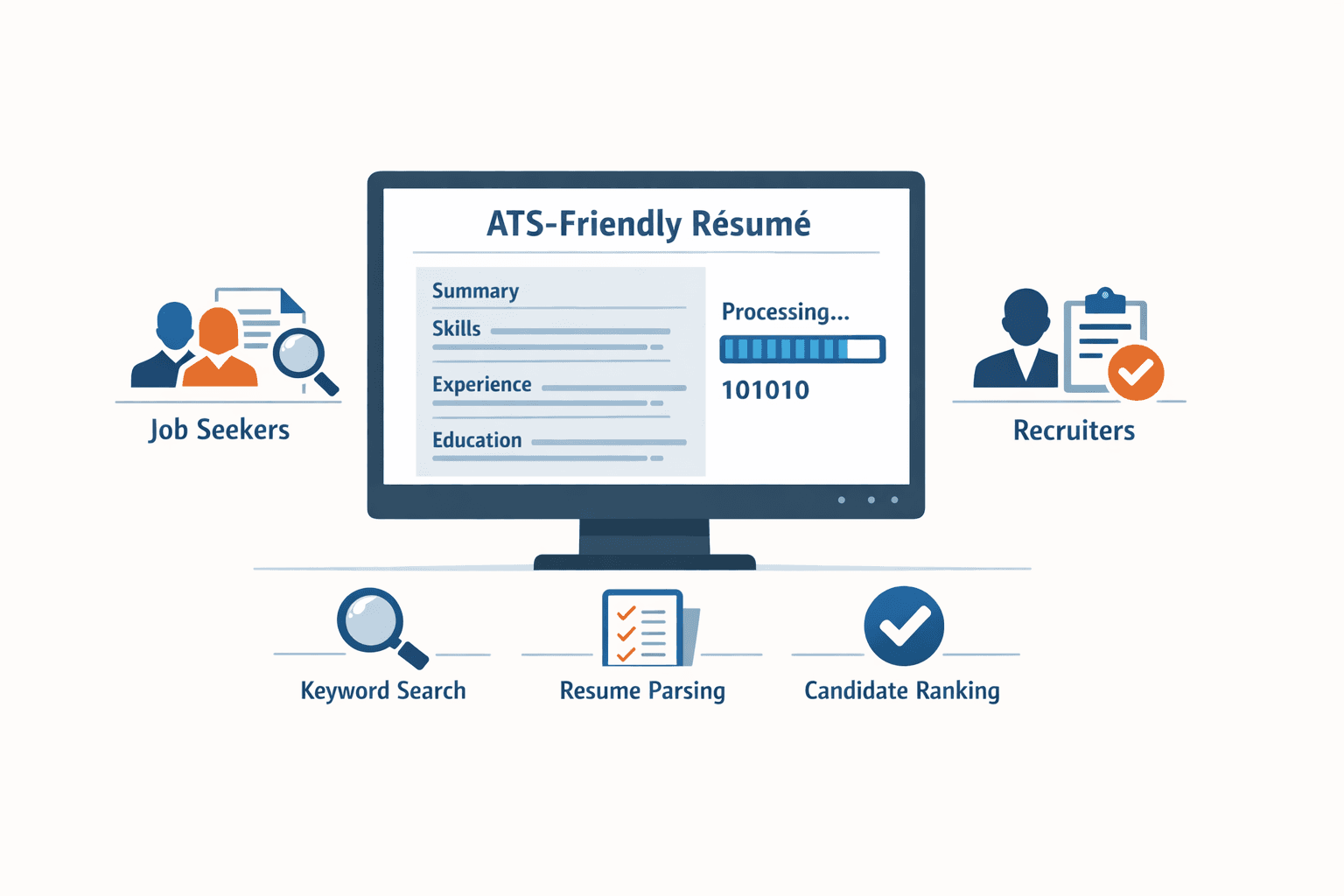
Learn what an ATS-Friendly Résumé is and how to create one that passes applicant tracking systems and meets recruiters' standards.

Honest Resume Score: Why I'd Prefer a 35% Score Over a 92%
Learn why an honest resume score of 35% can be more valuable than a 92% score in certain contexts.

Software Engineer Resume: What Gets Past the Screen
Software Engineer Resume guide reveals best practices for creating an effective, tailored resume that stands out to hiring managers and recruiters.