



How to Write a Professional Resume That Gets You Hired
Learn how to write a professional resume that stands out and gets you hired with practical tips from a seasoned recruiter with 25 years of experience.
 John Cronin
Introduction
When it comes to crafting a professional resume, clarity and precision are your best allies. Having spent 25 years in talent acquisition, including my time as a Principal Technical Recruiter at Meta, countless resumes have crossed my desk. At that hiring volume, you learn to scan rather than read. The key is to make sure your resume stands out in those first few seconds.
A professional resume is more than a list of jobs you've held. It's a concise document that presents your relevant skills, experiences, achievements, and qualifications in a compelling way. Think of it as an advertisement for your professional value, not a biography. The best resumes answer one question quickly: can this person do the job I need done?
Focus on tailoring your resume to the specific role you're applying for. Highlight relevant skills and experiences that align with the job description. During my tenure at Meta, I recruited machine learning and AI engineers, and specificity in your technical skills can make or break your chances. Generic resumes get generic results—or no results at all.
Additionally, remember that many companies use ATS systems to filter resumes. Use keywords from the job posting naturally within your resume to ensure it passes through these systems. At Imgur, where I averaged 70 technical hires per year, I valued candidates who could clearly articulate their achievements and contributions. A well-structured resume that reflects your professional journey accurately will always catch the eye of a recruiter.
In this guide, I'll walk you through what makes a professional resume work, why it matters in today's hiring landscape, and how to build one that gets you interviews. You'll learn the practical steps that separate resumes that get read from those that get discarded, and you'll see the common mistakes that trip up even experienced candidates.
Learn how to write a professional resume that stands out and gets you hired with practical tips from a seasoned recruiter.
What is a Professional Resume?
A professional resume is a concise document that presents your relevant skills, experiences, achievements, and qualifications in a compelling way. Think of it as a targeted advertisement for your candidacy — one that speaks directly to what a hiring manager needs to see in those first few seconds of review.
At its core, a professional resume answers three questions: What have you done? What can you do? Why does it matter to this employer? When resumes are screened, it's often possible to tell within ten seconds whether a candidate understands this distinction. The resumes that landed interviews weren't the longest or the fanciest — they were the ones that made relevance obvious.
Core Components of a Professional Resume
Every professional resume includes these essential elements: contact information, a summary or objective statement, work experience, education, and skills. These aren't just boxes to check — each section serves a specific function in building your case.
Your contact information sits at the top: name, phone, email, and LinkedIn profile. Use a professional email address — not the one you created in high school. Your summary or objective statement comes next, a brief paragraph that positions you for the specific role. This is where you connect your background to what the employer is hiring for.
Work experience forms the backbone of your resume. List positions in reverse chronological order, with your most recent role first. For each position, include your title, the company name, dates of employment, and bullet points describing your responsibilities and achievements.
Education and skills round out the standard structure. List your degrees, certifications, and relevant coursework. In the skills section, include both technical competencies and soft skills that align with the job description. For technical roles, specificity matters — "Python, TensorFlow, PyTorch" tells me more than "machine learning."
What Makes a Resume "Professional"
The term "professional" refers to both presentation and substance. A professional resume is clean, scannable, and free of errors. It uses consistent formatting, clear headings, and plenty of white space. But formatting alone won't save a resume that lacks substance.
Professional content means tailoring every line to the role you're pursuing. Generic resumes get generic results. When recruiting AI engineers, it was possible to spot the candidates who had read the job description carefully — their resumes spoke the language of the job and highlighted the exact skills needed. The others got a polite "no thank you" email.
Many companies use applicant tracking systems to filter resumes before a human ever sees them. A professional resume accounts for this reality by incorporating keywords from the job posting naturally throughout the document. This isn't about gaming the system — it's about demonstrating alignment with what the employer actually needs.
Why a Professional Resume Matters
Your resume is the first impression a hiring manager or recruiter gets of you, and in most cases, it's the only chance you'll have to make it count. Employers spend an average of 7.4 seconds reviewing a resume before deciding whether to keep it or discard it. That's less time than it takes to read this paragraph. If your resume doesn't immediately communicate your value, it's gone.
The stakes are higher than most candidates realize. Approximately 70% of employers say that certain resume deal-breakers would cause them to reject a candidate before they've even finished reading the application. A typo, a formatting inconsistency, or a vague job description can end your candidacy before it begins. The resume isn't just a formality—it's a filter, and it's designed to eliminate candidates who can't present themselves clearly.
The Resume Is Your Marketing Document
Think of your resume as a marketing document, not a biography. Its job is to get you an interview, not to tell your life story. Every line should answer the question: why should this company talk to me? If a bullet point doesn't strengthen that case, it's taking up space that could be used for something that does.
In technical roles especially, specificity matters. A resume that says "worked on machine learning projects" tells me nothing. A resume that says "built a recommendation engine that increased user engagement by 18% using collaborative filtering in Python" tells me you can deliver results and articulate how you did it. The difference between those two lines is the difference between a phone screen and a pass.
ATS Systems Amplify the Importance of Structure
Most companies use Applicant Tracking Systems to filter resumes before a human ever sees them. These systems parse your resume for keywords, job titles, and formatting cues. If your resume doesn't match the job description's language, or if it's formatted in a way the ATS can't read, it won't make it to the recruiter's inbox. Understanding how ATS systems work is essential if you want your resume to be seen at all.
This isn't about gaming the system—it's about writing clearly. Use the job posting's terminology. If the role asks for "data analysis," don't write "information synthesis." If it lists "Python" as a requirement, don't bury it under "various programming languages." The ATS is looking for exact matches, and so is the recruiter who reviews the ATS output.
A Strong Resume Opens Doors You Didn't Know Existed
A well-crafted resume doesn't just help you get the job you applied for—it positions you for opportunities you didn't anticipate. Recruiters share strong resumes internally. Hiring managers remember candidates who presented themselves well, even if the timing wasn't right. A professional resume is an asset that compounds over time, because it's a reusable representation of your value that you can refine and adapt as your career grows.
The inverse is also true. A weak resume closes doors. If a recruiter sees a resume with inconsistent formatting, unexplained gaps, or generic descriptions, they assume the candidate's work will reflect the same lack of attention. Fair or not, that's the reality. Your resume is a signal of how you approach professional communication, and employers use it to predict how you'll perform on the job.
How to Write a Professional Resume
Writing a professional resume is a process, not a one-shot event. You start with structure, then you fill it with facts that match the job you want. Here's how to do it step by step.
Choose the Right Format
There are three standard resume formats: chronological, functional, and combination. Each one highlights different parts of your background.
- Chronological lists your jobs in reverse order, most recent first. Use this when your work history is steady and relevant.
- Functional groups your skills by category, not by employer. Use this when you're changing careers or have gaps.
- Combination blends both — skills up top, then a shorter work history. Use this when you want to lead with what you can do, then back it up with where you did it.
Pick the format that shows your strengths and doesn't draw attention to weaknesses. If you've been in the same field for years, chronological is cleanest. If you're pivoting, functional or combination keeps the focus on transferable skills.
Include Your Name and Contact Information
Put your full name at the top in a larger font. Right below, list your phone number, email, city and state (no full address), and LinkedIn URL if you have one. Skip the headshot — it's not standard in the US and some ATS systems choke on images.
Make sure your email address is professional. Firstname.lastname@domain works. Nicknames and numbers from high school do not.
Write a Brief Summary or Objective (Optional)
A two- to three-sentence summary can anchor your resume if you're applying for a specific role. State what you do, what you're good at, and what you're looking for. Skip it if your experience speaks for itself or if you're applying to multiple types of roles — you don't want a generic summary that says nothing.
Example: "Backend engineer with five years building distributed systems in Python and Go. Led migration to microservices at a 200-person SaaS company. Looking for senior IC roles in infrastructure."
Detail Your Work Experience
This is the section that matters most. List your jobs in reverse chronological order: most recent first. For each role, include the job title, company name, location (city and state), and dates (month and year).
Under each job, use bullet points to describe what you did and what you achieved. Start each bullet with an action verb. Focus on results, not just responsibilities. Quantify when you can — numbers make impact concrete.
Start each bullet with a strong verb: built, led, reduced, launched, designed, automated. Avoid weak verbs like "responsible for" or "assisted with."
Whenever possible, attach a number. "Reduced deployment time by 40%" is stronger than "improved deployment process." If you don't have exact figures, estimate reasonably.
Read the job posting. Pull out the skills and responsibilities they emphasize. Make sure your bullets reflect those same skills using similar language. This helps you pass ATS keyword filters and shows the hiring manager you match what they need.
During the time recruiting machine learning engineers at Meta, hundreds of resumes were seen that listed technologies but never explained what the candidate built with them. The ones that got interviews were the ones that said "trained a model that improved click-through rate by 12%" instead of just "experience with TensorFlow."
List Your Education
Put your degree, major, school name, and graduation year. If you're early in your career, you can include GPA (if it's strong) and relevant coursework. If you've been working for more than a few years, skip those details — your work experience carries more weight.
If you have certifications relevant to the role, list them here or in a separate Certifications section. AWS, PMP, CPA — those matter. Online course completion certificates usually don't.
Add a Skills Section
List the technical and professional skills that match the job. For technical roles, break them into categories: languages, frameworks, tools, platforms. For non-technical roles, list software proficiency, languages spoken, and hard skills like data analysis or project management.
Don't pad this section with skills you used once in a tutorial. If you can't do the work in that skill today, leave it off. Recruiters and hiring managers will ask you about anything listed here, and if you can't speak to it, you've damaged your credibility.
For more on how ATS systems parse and rank skills, see ATS Meaning Resume: Understanding ATS and What Applicant Tracking.
Use a Clean Layout
Your resume should be easy to scan. Use clear section headers, consistent formatting, and enough white space so the page doesn't look crowded. Stick to one or two fonts. Avoid tables, text boxes, and graphics — they confuse ATS parsers.
Save your resume as a PDF unless the job posting specifically asks for a Word doc. PDFs preserve formatting across systems.
Best Practices for Crafting a Professional Resume
Once you understand the structure and content of a professional resume, the next step is refining your approach with practices that consistently work. These aren't theoretical tips—they're what actually moves resumes from the "maybe" pile to the "interview" pile.
Tailor Every Resume to the Role
Generic resumes don't get callbacks. Before you hit submit, read the job description carefully and identify the skills, tools, and qualifications the employer emphasizes. Then adjust your resume to highlight those exact elements where you have genuine experience.
This doesn't mean lying or manufacturing skills you don't have. It means prioritizing the parts of your background that align with what the hiring manager is looking for. If the job description mentions "Python" three times and you've used Python extensively, make sure it's prominent in your skills section and appears in context within your work history.
Clarify Your Job Search Goals First
Before you write a single bullet point, get clear on what you're actually targeting. Write down your ideal job duties, the type of company you want to work for, and the work environment that suits you best. This clarity shapes every decision you make about what to include and what to leave out.
When your goals are fuzzy, your resume becomes a laundry list of everything you've ever done. When your goals are sharp, your resume becomes a focused argument for why you're the right person for this specific role. That focus is what gets you noticed.
Use Concrete Numbers and Outcomes
Recruiters and hiring managers want to see impact, not just responsibilities. Instead of "Managed a team," write "Managed a team of 8 engineers through a 6-month product launch that increased user engagement by 22%." The numbers give context and credibility.
Even if your role wasn't quantitative, you can still describe outcomes. "Redesigned onboarding process, reducing new hire ramp-up time from 4 weeks to 2 weeks" tells a clearer story than "Improved onboarding process."
Keep Formatting Clean and Scannable
Your resume needs to work for both ATS systems and human eyes. That means:
- Use standard section headings (Work Experience, Education, Skills)
- Stick to common fonts like Arial, Calibri, or Times New Roman
- Avoid tables, text boxes, and graphics that confuse parsing software
- Use consistent formatting for dates, job titles, and company names
- Keep margins reasonable (0.5 to 1 inch) and don't cram text to fit more in
A clean, well-organized resume signals professionalism before anyone reads a word of your actual experience.
Proofread Ruthlessly
Typos and grammatical errors are resume killers. They suggest carelessness, and hiring managers assume that if you can't proofread a one-page document about yourself, you won't be detail-oriented on the job.
Read your resume out loud. Use spellcheck. Then have someone else review it. Fresh eyes catch mistakes you've read past a dozen times.
Consider What Works Broadly, Not Just for One Recruiter
You'll find plenty of advice from individual recruiters about what they personally prefer. Some of it is useful, some of it is idiosyncratic. The best resume practices are the ones that work across the majority of hiring contexts, not just for one person's taste.
Focus on clarity, relevance, and measurable impact. Those principles hold up whether you're applying to a startup, a Fortune 500 company, or a nonprofit. If you want to understand how ATS systems evaluate resumes, that knowledge will help you write a resume that passes both automated and human screening.
Update Your Resume Regularly
Don't wait until you're job hunting to update your resume. Add new accomplishments, skills, and projects as they happen. This makes it easier to recall details and ensures you're not scrambling to reconstruct six months of work when you need to apply somewhere quickly.
Keep a running document with all your achievements, even the ones that don't make the final cut. When you tailor your resume for a specific role, you'll have a full inventory to pull from.
Common Mistakes to Avoid When Writing a Resume
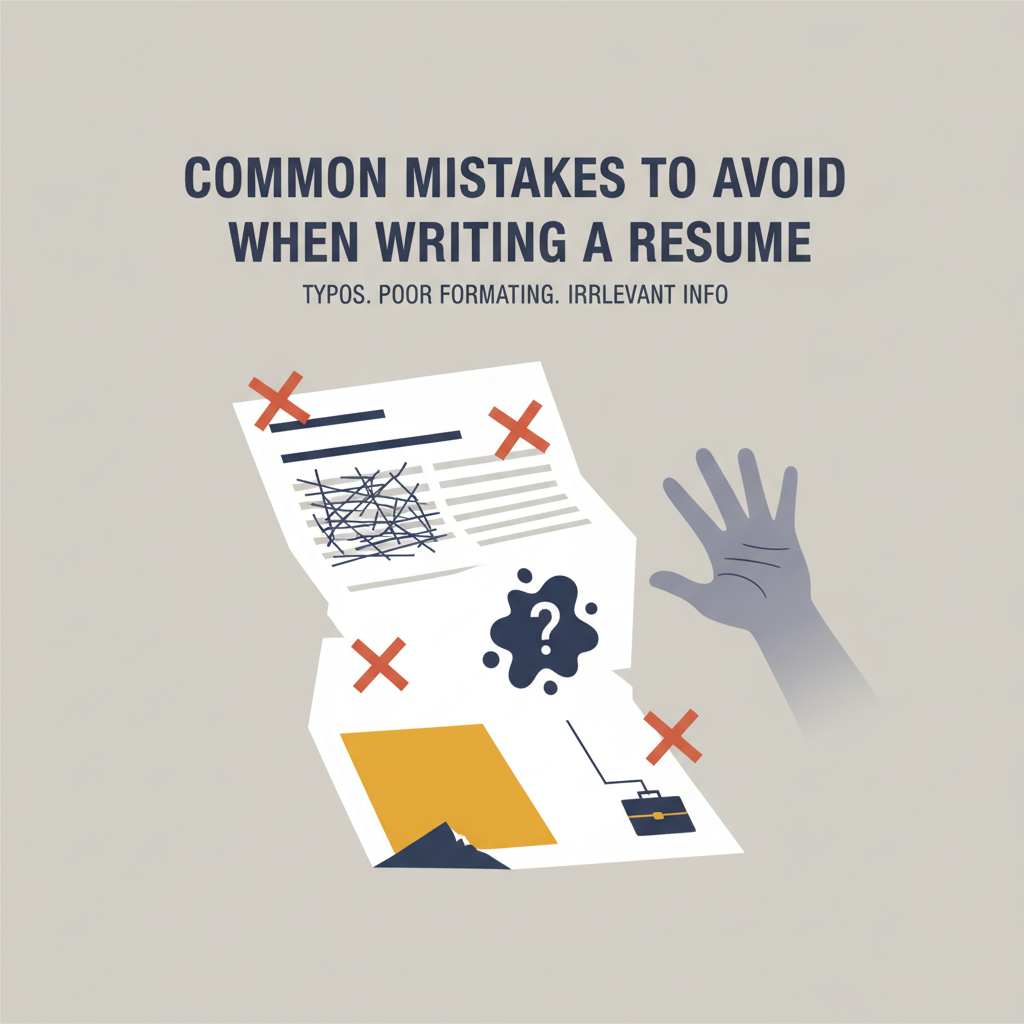
Approximately 70% of employers reject resumes before they finish reading them. That's not hyperbole—it's what happens when common mistakes trigger an instant pass. In 25 years screening candidates, the same errors have been seen that kill strong applications over and over. The good news: these mistakes are fixable, and once you know what to watch for, you can avoid them entirely.
Incorrect or Outdated Contact Information
This sounds basic, but it happens more than you'd think. A typo in your email address or an old phone number means you can't be reached—even if you're the perfect fit. Double-check every digit and character before you hit submit. Make sure your voicemail is set up and professional. If a call is made and gets a full mailbox or a joke greeting, the next candidate will be considered.
Unprofessional Email Addresses
Your email address is part of your first impression. If it's something like "partyguy87@email.com" or "hotchick2025@email.com," you won't be taken seriously. Create a clean, professional address: firstname.lastname@domain is the standard. It takes five minutes and it matters.
Spelling and Grammar Errors
Typos signal carelessness. When "manger" is seen instead of "manager" or "their" instead of "there," it suggests that proofreading was not done—or worse, that there is a lack of care about details. Run spell-check, then read your resume out loud. Better yet, have someone else review it. Fresh eyes catch what you miss.
Using Clichés Instead of Specifics
Phrases like "team player," "results-oriented," and "hard worker" don't tell anything. Every candidate claims those qualities. Instead, show what was done: "Led a cross-functional team of five to deliver a product feature two weeks ahead of schedule" is concrete. "Team player" is not. If you want to understand how vague language gets flagged by automated systems, read more about what the ATS resume checker actually checks.
Clichés blend you into the pile. Specifics pull you out of it.
Listing Duties Instead of Achievements
Your resume isn't a job description—it's a record of what was accomplished. "Responsible for managing social media accounts" tells what was supposed to be done. "Grew Instagram engagement by 40% in six months through targeted content strategy" tells what was delivered. Frame every bullet as an outcome, not a task.
Including Irrelevant Information
Your high school GPA, your hobbies, your photo (unless you're applying internationally where it's standard)—none of that belongs on a professional resume. Keep it focused on skills, experience, and results that relate to the job you want. If it doesn't support your case for this specific role, cut it.
Inconsistent Formatting
Mismatched fonts, random bolding, inconsistent bullet styles—these make your resume hard to scan and suggest a lack of detail orientation. Pick one font (a clean sans-serif like Arial or Calibri works well), one bullet style, and one heading format. Stick with it throughout. Visual consistency signals professionalism.
Overloading with Buzzwords
Stuffing your resume with every keyword from the job posting makes it unreadable. Yes, you need relevant terms to pass ATS filters, but they have to fit naturally into your sentences. If your resume reads like a keyword salad, a human reviewer will toss it even if the system let it through.
Ignoring the Job Description
Sending the same generic resume to every employer is a waste of your time and theirs. Tailor your resume to the role. Highlight the experience and skills that match what the job posting asks for. If the role emphasizes Python and cloud architecture, those should be front and center—not buried at the bottom under "Other Skills."
Leaving Gaps Unexplained
If you have a gap in your employment history, address it briefly. A one-line note like "Career break to care for family" or "Freelance consulting during transition" is enough. Leaving it blank makes others wonder, and wondering usually doesn't work in your favor.
Frequently Asked Questions about Professional Resumes
Should I include an 'About Me' section on my resume?
A short introductory paragraph at the top of your resume can highlight your most relevant skills and achievements, potentially showing that you're the most suitable person for the job. This is called a professional summary, and when done right, it gives context before the rest of your resume is read. Keep it to 2–3 sentences. Focus on what you bring to the role, not what you're looking for.
How long should my resume be?
For most candidates, one page is ideal. If you have 10+ years of relevant experience or you're applying for a senior technical role, two pages is acceptable. Three-page resumes are rarely seen that couldn't be cut to two without losing anything important. Remember, scanning is what happens first.
Do I need to tailor my resume for every job?
Yes. A generic resume rarely makes it past the first screen. Tailor your skills section and your bullet points to match the job description. If the role emphasizes machine learning and your resume leads with front-end frameworks, you've already lost. This doesn't mean rewriting from scratch—it means adjusting emphasis and keywords to align with what the hiring manager is looking for.
What if I have employment gaps?
Be honest. List the dates accurately. If you took time off for caregiving, education, or a career transition, you can include a brief one-line explanation in your work history. What you did during the gap (freelance projects, coursework, open-source contributions) matters more than the gap itself. Trying to hide gaps with creative formatting usually backfires.
Should my resume be in a narrative or bullet-point format?
Bullet points. Always. Different opinions exist about what makes a good resume, especially from those in positions of power, but these views may not reflect what is effective for the majority of job seekers. Narrative resumes are hard to scan, and scanning is what happens first. Bullet points let accomplishments be pulled out in seconds. Start each bullet with a strong action verb and quantify your impact wherever possible.
Do I need to include references on my resume?
No. "References available upon request" is outdated and wastes space. If references are needed, they will be asked for usually after the first or second interview. Use that space for another achievement or skill instead.
Can I use color or creative formatting?
For most technical roles, stick to a clean, simple layout with standard fonts. Creative formatting can break ATS parsing, and many resumes have been seen where the design overshadowed the content. If you're applying for a design role, a bit of visual polish is expected—but even then, readability comes first.
How do I handle a career change on my resume?
Lead with transferable skills. If you're moving from project management into product management, emphasize stakeholder communication, roadmap planning, and cross-functional collaboration. Your job titles will show the transition, but your bullet points should show why you're qualified for the new role. A strong professional summary at the top helps frame the narrative.
Conclusion
Writing a professional resume isn't about perfection—it's about clarity, relevance, and making the recruiter's job easier. If your resume forces others to hunt for your qualifications or decode vague job titles, it's already lost. The goal is simple: show what was done, how it was done, and why it matters to the role being hired for.
Start with the basics. Use a clean format, lead with your most relevant experience, and tailor every section to the job description. Skip the objective statements and focus on achievements with numbers. If efficiency was increased, say by how much. If a team was led, say how many people. Specificity beats generality every time.
Don't ignore the ATS. Use keywords from the posting naturally, stick to standard section headings, and avoid tables or graphics that confuse the parser. A resume that never reaches human eyes can't get you hired, no matter how polished it looks. For a deeper look at how these systems work, see ATS Meaning Resume: Understanding ATS and What Applicant Tracking.
Common mistakes—like listing duties instead of results, using inconsistent formatting, or including irrelevant experience—are easy to fix once you know what to look for. Proofread carefully, keep it to one or two pages, and remember that your resume is a marketing document, not a career autobiography.
Having spent 25 years in talent acquisition, including my time as a Principal Technical Recruiter at Meta, the resumes that stand out are the ones that respect the recruiter's time. They answer questions before they are asked. They show, rather than tell. And they make it obvious why this candidate, for this role, right now.
Take the time to get it right. Clarify your goals, highlight what matters, and cut everything else. A strong resume opens doors—but only if it's built to do the job.
Related reading
Honest Résumé Score Example: What It Looks Like and How to Improve
Sources(36)
- Ask a Manager (2012)
- interviewing.io (2025)
- Ask a Manager (2019)
- Ask a Manager (2016)
- Ask a Manager (2023)
- Ask a Manager (2020)
- Ask a Manager (2012)
- Ask a Manager (2025)
- Zenodo (CERN European Organization for Nuclear Research) (2026)
- Zenodo (CERN European Organization for Nuclear Research) (2026)
- Ask a Manager (2011)
- Ask a Manager (2011)
- Ask a Manager (2013)
- Ask a Manager (2013)
- Ask a Manager (2014)
- Ask a Manager (2014)
- Ask a Manager (2015)
- Ask a Manager (2013)
- interviewing.io (2025)
- interviewing.io (2026)
- DR-NTU (Nanyang Technological University) (2026)
- Zenodo (CERN European Organization for Nuclear Research) (2026)
- Ask a Manager (2012)
- Ask a Manager (2014)
- Ask a Manager (2015)
- Ask a Manager (2015)
- Ask a Manager (2010)
- Ask a Manager (2016)
- Open MIND (2026)
- Ask a Manager (2023)
- Ask a Manager (2018)
- Ask a Manager (2013)
- Ask a Manager (2017)
- Ask a Manager (2014)
- Ask a Manager (2022)
- Ask a Manager (2015)

Written by
John Cronin
Published November 2, 2026 · 22 min read
John Cronin is a talent-acquisition leader with 25 years in recruiting, most recently as a Principal Technical Recruiter at Meta hiring machine-learning and AI engineers. He has been a founding recruiter at GoPro and Chipper Cash and led talent acquisition at Imgur. He writes about what recruiters actually do with your resume.
Want this kind of read on your résumé?
We'll tell you what's actually working, what's holding you back, and what to fix — in plain English.
Get My Job Match ScoreYou Might Also Like
More articles to help you advance your career
Skills to Put on Your Resume: What Skills Should You Put
Learn what skills to put on your resume to stand out to employers and get noticed during the hiring process.

ATS Meaning Resume: Understanding ATS and What Applicant Tracking
Learn what ATS meaning resume entails and how Applicant Tracking Systems work in 2026 to streamline your hiring process and recruitment workflows.

Honest Résumé Score Example: What It Looks Like and How to Improve
Learn what an honest résumé score looks like with this real walkthrough. See actual examples and discover how to improve your résumé evaluation results with an honest

Why a Generic Cybersecurity Resume Won't Work and What Will
Discover why a generic cybersecurity resume won't cut it and learn how to tailor your application for success in the tech industry.