


Skills to Put on Your Resume: What Skills Should You Put
Learn what skills to put on your resume to stand out to employers and get noticed during the hiring process.
 John Cronin
Introduction
Resume skills are the filter that decides whether a hiring manager reads your application or moves to the next candidate. After 25 years screening resumes — most recently as Principal Technical Recruiter at Meta — thousands of candidates lose interviews because they treated the skills section like a checklist instead of a proof point.
Your resume isn't a LinkedIn profile. It's not a skills inventory or a personality quiz. The question isn't really "what skills should you put on your resume." It's "how do I show I can do what this job requires without sounding like everyone else?"
Most job descriptions list skills: integrity, professionalism, excellent judgment, attention to detail, strong communication. Candidates see that list and think they need to mirror it word-for-word in a skills section. That's backwards. If your resume just repeats the job posting, you haven't told me anything. I need to see where you actually used those skills and what happened as a result.
The resume skills that matter are the ones you can prove. The rest is noise. In the sections ahead, I'll walk through how to identify which resume skills actually belong on your application, how to present them so they survive ATS screening, and how to make sure every skill you list connects to something you've done.
This isn't about gaming the system. It's about making your resume do its one job: get you the interview where you can explain the work in detail.
What Resume Skills Mistakes Cost You Interviews
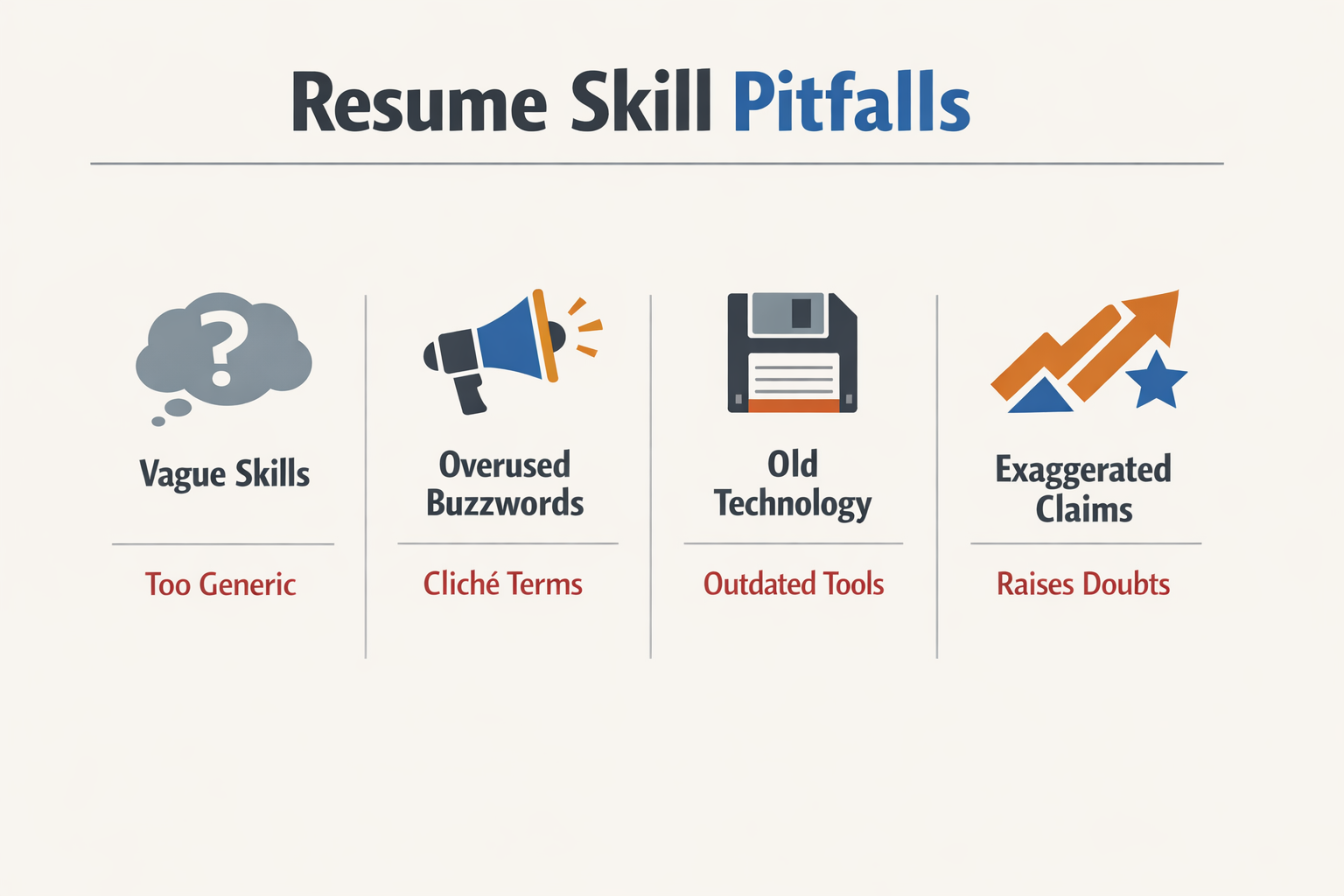
Most candidates approach resume skills the wrong way. They either copy-paste generic skill lists from templates or mirror every soft skill mentioned in the job description. Both approaches backfire.
The Generic Skills Trap
You've seen them: "excellent communication skills," "team player," "detail-oriented." These phrases appear on thousands of resumes because candidates believe listing them proves they possess them. They don't. A hiring manager scanning your resume doesn't care that you claim to be detail-oriented — they want evidence you caught errors that mattered, in a context they recognize.
When you list soft skills without backing them up, you're asking the recruiter to take your word for it. That's not how screening works. I'm looking at results, projects, and outcomes that demonstrate the skill without naming it.
The Job Description Mirror Problem
The opposite mistake is just as common: you read a job posting that asks for "integrity, professionalism, excellent judgement, dependability, attention to detail, and excellent communication skills," so you add all six to your resume. You worry that if the posting lists them and your resume doesn't, you'll be filtered out.
Here's what actually happens: if the role uses an ATS (Applicant Tracking System), the system isn't scoring you on whether you wrote "excellent communication skills" in a bullet. It's parsing your entire work history for signals — job titles, tools, responsibilities, measurable outcomes. The human reviewer who sees your resume after that wants proof, not assertions.
What Candidates Fear vs. What Recruiters Actually Do
Candidates fear being overlooked if they don't explicitly name every skill in the posting. The real risk is the opposite: when your resume is a list of claims with no supporting evidence, it signals you don't understand what hiring managers are screening for.
I've reviewed thousands of resumes where the candidate listed "attention to detail" in a skills section, then submitted a document with inconsistent formatting, typos in dates, or a phone number missing a digit. The claim and the execution contradicted each other. The resume went into the no-pile.
A skill you name but can't demonstrate is worse than a skill you demonstrate but never name.
The hiring manager isn't checking boxes on a soft-skills wishlist. They're asking: can this person do the work? Your resume answers that question through what you've built, fixed, shipped, or improved — not through adjectives you've assigned yourself.
How to Identify the Right Resume Skills for Your Application
Most candidates approach resume skills backward. They list what they learned instead of what they delivered. Hiring managers don't care that you "learned to manage your workload efficiently" — they care that you shipped three product releases on time while managing a backlog of 200 tickets.
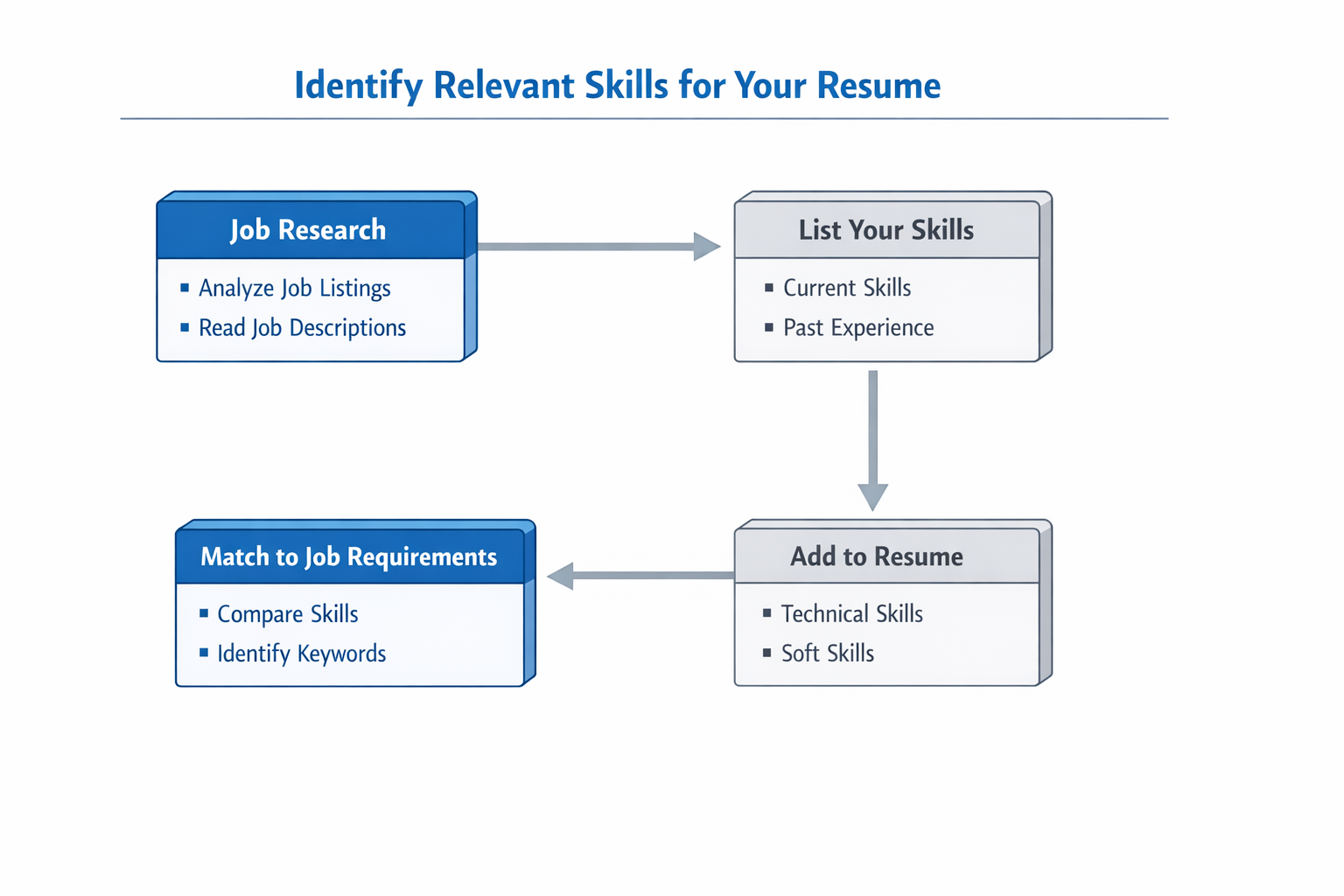
Here's how to identify and frame resume skills the way recruiters actually read them.
Step 1: Start with the Job Description
Every job posting contains the employer's vocabulary. Read it carefully and note the specific skills they name. If they say "Python," don't write "programming languages." If they say "stakeholder management," don't write "communication."
Highlight every skill or tool mentioned in the posting. Copy the exact wording. ATS systems and recruiters both scan for these terms, and synonyms don't always match.
When a posting asks for "experience with Salesforce" and you've used it, write "Salesforce" in your skills section and tie it to a concrete outcome in your work history.
Step 2: Tie Skills to Accomplishments
A skill without context is a claim without proof. Instead of listing "project management" as a standalone skill, attach it to something you actually managed.
For example:
- Weak: "Project management"
- Strong: "Led cross-functional project team of 8 to deliver new customer portal 3 weeks ahead of schedule"
The second version shows the skill in action. It answers the recruiter's next question before they ask it.
Step 3: Separate Technical Skills from Soft Skills
Technical skills belong in a dedicated section. Soft skills belong in your accomplishment bullets, not as a list.
List software, programming languages, certifications, and tools here. Keep it scannable: "Python, SQL, Tableau, AWS, Jira." If you're applying to technical roles, this section is non-negotiable.
For soft skills like leadership or communication, skip the list entirely. Instead, demonstrate them:
- Don't write: "Strong communication skills"
- Do write: "Presented quarterly business reviews to C-suite, resulting in approval for $2M budget increase"
The second version proves communication without claiming it.
Step 4: Match Skills to Resume Skills That Matter in Your Field
Not every skill you have belongs on every resume. A data analyst doesn't need "Microsoft Word" in their skills section — it's assumed. They do need "Python, R, SQL" because those are differentiators.
Ask yourself: does this skill make me more qualified for this specific role? If the answer is no, cut it. If the posting mentions it or if it's standard in your field, keep it.
For more on how recruiters and ATS systems evaluate your resume, see What the ATS Resume Checker Actually Checks in 2025.
Step 5: Update Skills for Every Application
Your resume isn't static. Each job you apply to has different priorities, and your skills section should reflect that.
Before submitting, compare your skills section to the job posting. Reorder your skills so the most relevant ones appear first. Add any critical skills you have but initially left out. Remove skills that don't apply.
This doesn't mean lying. It means emphasizing what matters for that role. If one job prioritizes SQL and another prioritizes stakeholder management, your resume should reflect that shift.
Tips and Tricks for Highlighting Resume Skills Effectively
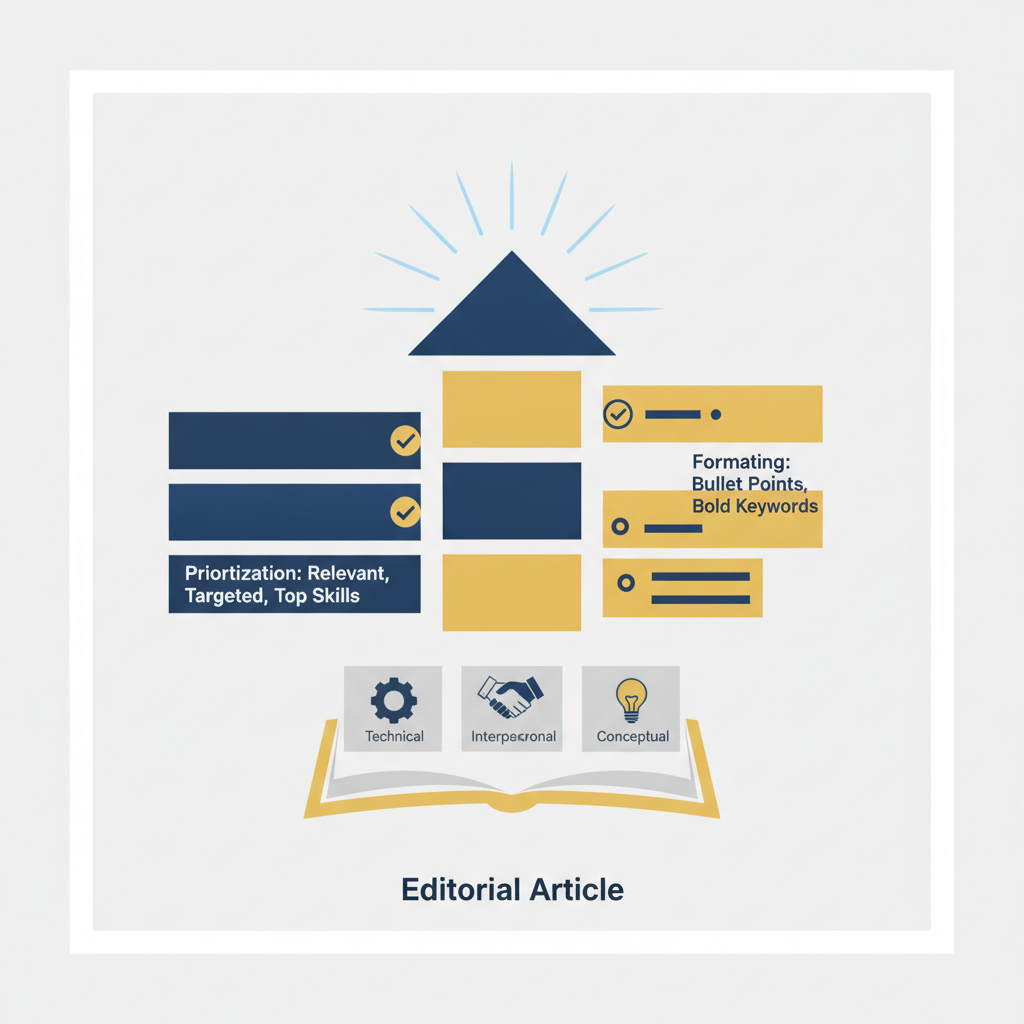
Knowing which resume skills to include is only half the battle. How you present them determines whether a recruiter stops scrolling or moves on to the next candidate. The difference between a strong skills section and a weak one often comes down to a few simple formatting and prioritization choices.
Show What You Built, Not Just What You Know
Skills mean nothing without context. Instead of listing "Python" or "project management" in isolation, attach each skill to a concrete outcome. Describe what you actually built or owned using that skill. A bullet that reads "Led migration of legacy system to cloud infrastructure, reducing deployment time by 40%" tells me you know cloud architecture and can deliver results. A standalone "AWS" in a skills list tells me almost nothing.
This approach works across all resume sections. In your work experience, lead with the impact and weave the skill into the description. In a dedicated skills section, group related skills under headers like "Languages & Frameworks" or "DevOps Tools," but always back them up with usage examples in your experience bullets.
Prioritize Skills the Job Description Asks For
Not all skills deserve equal prominence. If the job description mentions "Kubernetes" three times and "Docker" twice, those tools should appear high in your skills section and in at least one experience bullet. Don't make a recruiter work to find your qualifications.
Rank your skills by relevance to the role. Put the must-haves first. If you're applying for a data engineering position that emphasizes Spark and Airflow, those belong at the top of your skills section, not alphabetized somewhere in the middle. Save the nice-to-haves for the end or leave them off entirely if space is tight.
The skills a hiring manager cares about should be impossible to miss. If I have to scroll or squint to find them, you've already lost momentum.
Keep Your Resume Clean and Error-Free
Presentation matters more than most candidates realize. Typos and formatting inconsistencies signal carelessness. Research shows that the number of typos is one of the most important attributes of a resume — aim for fewer than two errors total. A single misspelled skill name or inconsistent bullet style can derail an otherwise strong application.
Use a clean, scannable format. Short paragraphs, consistent bullet styles, and clear section headers make it easy for a recruiter to extract the information they need in thirty seconds. Avoid dense blocks of text, creative fonts, or graphics that confuse applicant tracking systems. If your resume is hard to read, it won't get read.
For a detailed walkthrough of how resume quality affects your chances, see What an Honest Resume Score Looks Like.
Write an About Section That Sounds Like You
Your summary or "About" section should read like it was written by a smart person who cares, not copied from a template. This is your chance to frame your skills in a narrative that connects your background to the role. A strong summary might read: "Backend engineer with five years building scalable APIs for fintech platforms. Experienced in Python, Go, and distributed systems design. Looking to apply expertise in high-throughput data pipelines at a growth-stage company."
Avoid generic phrases like "results-driven professional" or "team player." Instead, name the skills and domains where you've done real work, and signal what you're looking for next. A thoughtful summary gives context to the skills list that follows and helps a recruiter understand how the pieces fit together.
Conclusion
Your resume skills section isn't decoration — it's the filter that decides whether a human ever reads the rest of your application. The difference between "reviewed" and "rejected" usually comes down to whether the candidate showed resume skills the role actually requires, in language the hiring manager recognizes.
The strongest resumes I see follow a pattern: they match the job description without copying it verbatim, they prioritize technical capabilities over soft skill buzzwords, and they prove each skill with context — a project, a tool, a measurable outcome. Candidates who do this work get callbacks. Candidates who list "team player" and "detail-oriented" without evidence don't.
Start with the job posting. Pull the technical requirements and the recurring action verbs. If you have those skills, list them. If you don't, either build them or apply elsewhere — inflating your skillset to pass an ATS only creates problems in the interview. Then structure your resume so the skills appear in multiple places: a dedicated section near the top, woven into your bullet points, and reflected in your job titles or project names when accurate.
If you're still unsure whether your resume will pass initial screening, understanding how ATS systems parse and score applications can clarify what's happening behind the scenes and where to focus your edits. For practical guidance on what free tools can and can't do, see Free ATS Resume Checker: What's Useful and What's Not.
Refine your skills section now. Match it to the role, prove it with examples, and keep the language specific. That's what gets you to the next round.
Sources(37)
- Ask a Manager (2012)
- interviewing.io (2025)
- Ask a Manager (2019)
- Ask a Manager (2016)
- Ask a Manager (2023)
- Ask a Manager (2020)
- Ask a Manager (2012)
- Ask a Manager (2025)
- Zenodo (CERN European Organization for Nuclear Research) (2026)
- Zenodo (CERN European Organization for Nuclear Research) (2026)
- Ask a Manager (2011)
- Ask a Manager (2013)
- Ask a Manager (2015)
- Ask a Manager (2013)
- Ask a Manager (2016)
- Ask a Manager (2014)
- Ask a Manager (2017)
- Ask a Manager (2012)
- Ask a Manager (2015)
- Ask a Manager (2018)
- Ask a Manager (2011)
- Ask a Manager (2012)
- Ask a Manager (2011)
- Ask a Manager (2012)
- Ask a Manager (2016)
- Ask a Manager (2014)
- Ask a Manager (2015)
- Clarify Capital
- Ask a Manager (2013)
- Revelio Labs (2026)
- Ask a Manager (2019)
- Ask a Manager (2023)
- Ask a Manager (2016)
- Ask a Manager (2012)
- Ask a Manager (2012)
- Ask a Manager (2013)
- Zenodo (CERN European Organization for Nuclear Research) (2026)

Written by
John Cronin
Published November 3, 2026 · 11 min read
John Cronin is a talent-acquisition leader with 25 years in recruiting, most recently as a Principal Technical Recruiter at Meta hiring machine-learning and AI engineers. He has been a founding recruiter at GoPro and Chipper Cash and led talent acquisition at Imgur. He writes about what recruiters actually do with your resume.
Want this kind of read on your résumé?
We'll tell you what's actually working, what's holding you back, and what to fix — in plain English.
Get My Job Match ScoreYou Might Also Like
More articles to help you advance your career

ATS Meaning Resume: Understanding ATS and What Applicant Tracking
Learn what ATS meaning resume entails and how Applicant Tracking Systems work in 2026 to streamline your hiring process and recruitment workflows.

Why a Generic Cybersecurity Resume Won't Work and What Will
Discover why a generic cybersecurity resume won't cut it and learn how to tailor your application for success in the tech industry.

Free ATS Resume Checker: What's Useful and What's Not
Discover what Free ATS Resume Checker tools can and can't do. Learn which features actually help optimize your resume for applicant tracking systems.

What the ATS Resume Checker Actually Checks in 2025
Learn what an ATS resume checker actually checks and what it overlooks, helping you craft a resume that passes automated screening systems.