


Physical Therapist Resume: Ultimate Guide to Simple Success
Master your Physical Therapist Resume with expert strategies that help you stand out from the competition and land your ideal healthcare position.
 Emily Johnson
Introduction
The physical therapy field is experiencing remarkable growth, with the Bureau of Labor Statistics projecting a 14% increase in opportunities through 2032—well above the national average. With median salaries reaching $101,020 annually, the competition for the best positions has never been fiercer. Your Physical Therapist Resume isn't just a career summary; it's your first clinical assessment by hiring managers who are evaluating whether you can deliver results in their specific setting.
After reviewing thousands of healthcare resumes as a recruiter, I've seen talented clinicians miss opportunities simply because their resumes failed to communicate their value effectively. The difference between a resume that lands interviews and one that gets overlooked often comes down to a few critical elements: demonstrating specialty-specific competence, quantifying patient outcomes, and tailoring content to match the exact role you're pursuing.
Hiring managers want proof of clinical competence in the setting they're hiring for, and evidence of outcomes showing that patients got better, faster, and with fewer visits than average. Generic statements about "providing quality patient care" or "working collaboratively with healthcare teams" don't differentiate you from dozens of other applicants. Instead, successful resumes showcase concrete achievements—reduced recovery times, improved patient satisfaction scores, or specialized certifications that align with the employer's patient population.
Many physical therapists struggle with common resume pitfalls that undermine their qualifications. These include using outdated formatting that confuses applicant tracking systems, failing to customize content for each application, and burying the most impressive accomplishments in dense paragraphs. Understanding these mistakes—and how to avoid them—is the first step toward crafting a document that truly represents your clinical expertise. For additional insights on optimizing your professional documents, explore our guide on How ATS Reads Resumes: The Ultimate Guide to Surprising Success.
This guide will walk you through the essential components of an effective Physical Therapist Resume, from structural best practices to content optimization strategies. You'll learn how to highlight your clinical strengths, format your document for both human readers and automated systems, and tailor your application to stand out in a crowded field. Whether you're a new graduate entering the job market or an experienced clinician seeking your next opportunity, these strategies will help you present your qualifications with clarity and impact.
Understanding the Importance of a Tailored Resume
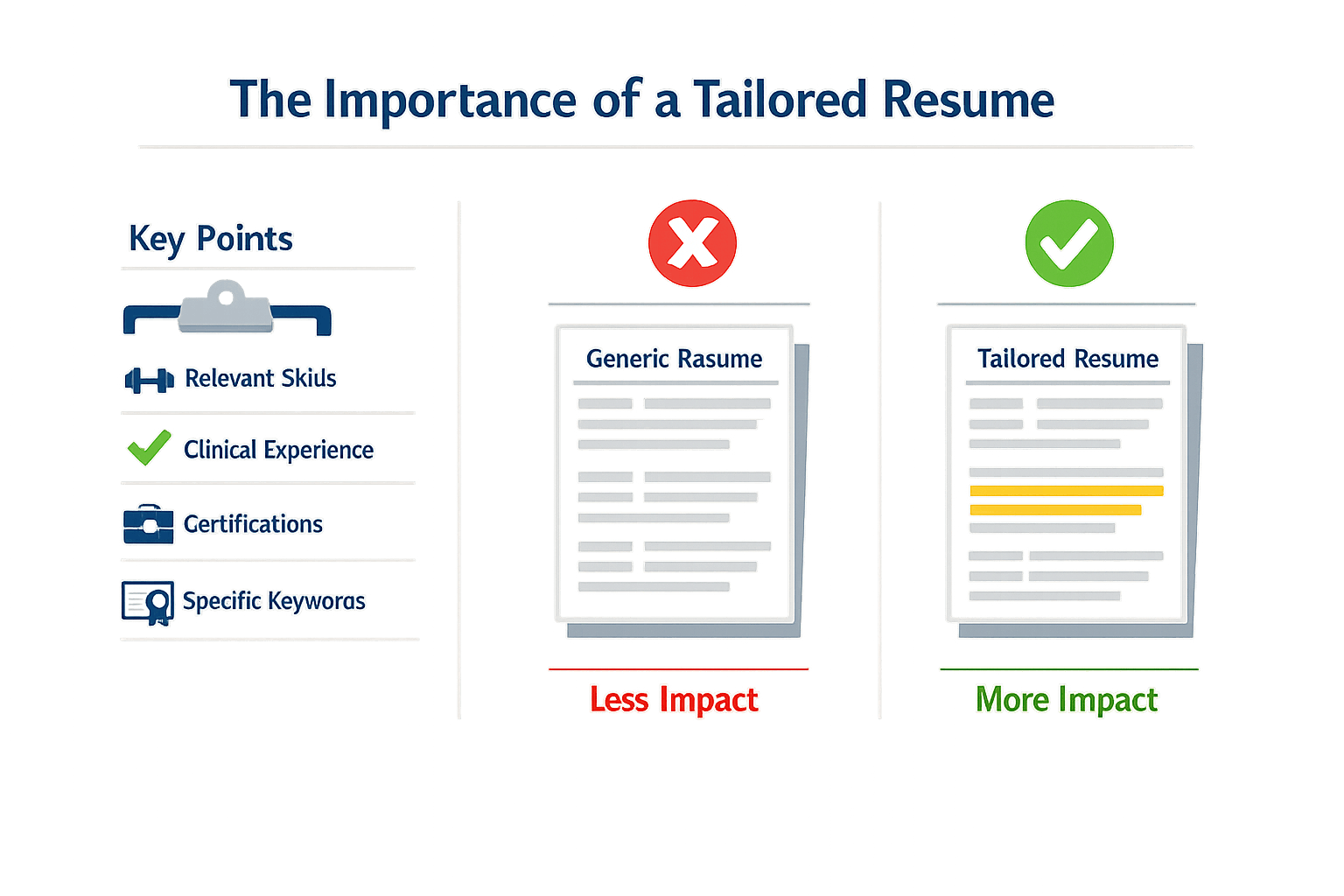
A generic resume won't cut it in today's competitive physical therapy job market. Hiring managers spend mere seconds scanning each application, and applicant tracking systems filter out resumes that don't match specific job requirements. Your resume needs to speak directly to each position you're targeting, demonstrating that you understand what that particular employer values most.
Physical therapy roles vary significantly across settings—outpatient clinics prioritize patient education and rehabilitation protocols, while acute care facilities need therapists skilled in mobility assessments and discharge planning. A one-size-fits-all resume fails to highlight the specific competencies each employer seeks. When you tailor your document, you're showing hiring managers that you've done your homework and understand their unique needs.
Why Generic Resumes Fail
Generic resumes typically list duties rather than outcomes. They describe what you were responsible for instead of what you actually achieved. Hiring managers in healthcare settings want to see measurable impact—how you improved patient outcomes, reduced treatment times, or enhanced departmental efficiency. Without these specifics, your resume blends into the stack of other applications that all say essentially the same thing.
The healthcare field also moves quickly, with evolving treatment modalities and compliance requirements. A tailored resume demonstrates that you're current with industry standards and can adapt your skills to the specific patient populations and treatment philosophies of each potential employer. This adaptability signals that you'll integrate smoothly into their existing team and contribute from day one.
The Strategic Advantage of Customization
When you customize your resume for each application, you're essentially translating your experience into the language that specific employer uses. If a job posting emphasizes geriatric care and fall prevention, your resume should prominently feature your relevant experience in those areas—even if you've worked across multiple patient demographics. This doesn't mean fabricating experience; it means strategically emphasizing the most relevant aspects of your background.
Tailoring also helps you navigate applicant tracking systems that scan for keywords matching the job description. These systems rank candidates based on how well their resumes align with the posting. By mirroring the terminology and priorities in the job description, you increase your chances of making it past the initial screening to a human reviewer.
A strong physical therapist resume highlights your skills, experience, and patient-centered approach to stand out in a competitive healthcare field.
The investment in tailoring pays dividends. Employers can immediately see that you're not mass-applying to every opening—you're genuinely interested in their specific opportunity. This attention to detail reflects the same care and precision they expect you to bring to patient treatment plans.
Common Pitfalls in Physical Therapist Resumes

Even experienced physical therapists can sabotage their job search with resume mistakes that seem minor but carry significant consequences. Understanding these pitfalls helps you avoid the traps that keep qualified candidates from landing interviews.
The ATS Rejection Problem
The numbers tell a sobering story: 70% of physical therapist resumes are rejected by applicant tracking systems before a human ever sees them. With over 97% of healthcare organizations now using ATS to filter applications, your resume must clear this digital gatekeeper first. The difference between landing an interview and disappearing into a black hole often comes down to technical formatting choices rather than your actual qualifications.
Generic Content That Blends In
One of the most common mistakes is submitting the same resume to every position. Generic statements like "dedicated physical therapist with excellent patient care skills" appear on thousands of applications. Hiring managers skim dozens of resumes daily—they need specific evidence of your capabilities, not vague claims that could apply to anyone.
Without concrete examples of your clinical specializations, patient outcomes, or treatment modalities, your resume becomes invisible in a sea of similar applications. The solution isn't adding more words; it's adding more relevance to each specific role you're pursuing.
Employment Gaps Without Context
Unexplained gaps in your work history create unnecessary red flags. A gap longer than six months without explanation can lower your ATS ranking and raise questions during human review. Whether you took time for continuing education, family care, or professional development, addressing these gaps directly shows transparency and professionalism.
Many candidates make the mistake of trying to hide employment gaps with creative date formatting or by listing only years instead of months. This approach backfires when reviewers notice the omission, creating doubt where a simple explanation would have built trust. For more guidance on avoiding common resume mistakes across industries, see our guide on how ATS reads resumes.
Overloading With Irrelevant Information
Physical therapist resumes often suffer from information overload. Including every rotation from graduate school, listing outdated certifications, or detailing responsibilities from positions held a decade ago dilutes your strongest selling points. Hiring managers spend an average of six seconds on an initial resume scan—every line must earn its place.
The same principle applies to skills sections. Listing "Microsoft Office" alongside advanced manual therapy techniques suggests you don't understand what matters in your field. Focus your resume on the clinical competencies, specialized training, and patient population experience that align with the target position.
Your resume isn't a career autobiography—it's a strategic marketing document that should highlight only what's relevant to the job you want right now.
Key Elements of an Effective Physical Therapist Resume
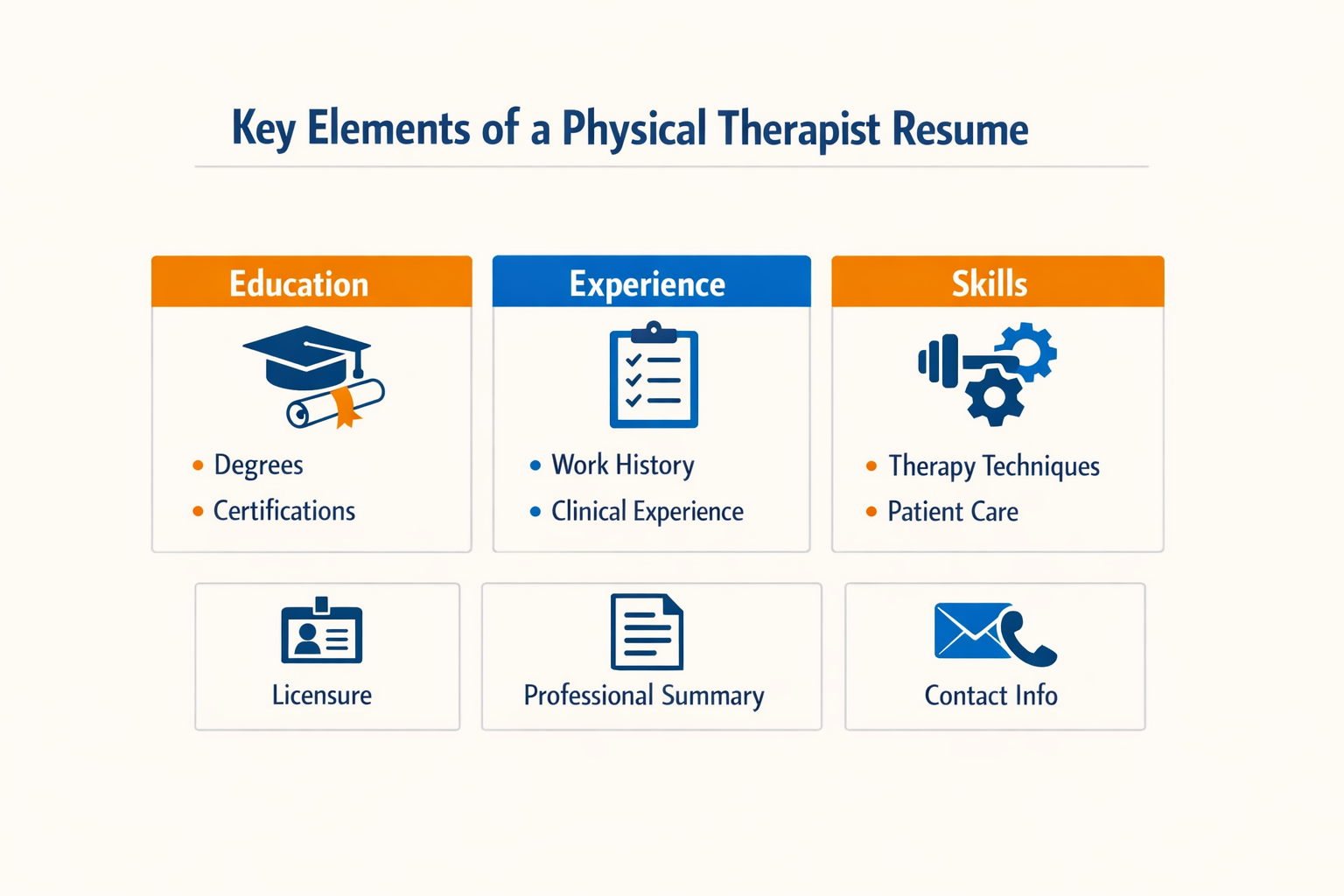
A strong Physical Therapist Resume requires specific components that demonstrate both your clinical qualifications and professional readiness. Unlike general healthcare positions, PT roles demand clear evidence of licensure, specialized training, and hands-on clinical competency. Understanding which elements hiring managers prioritize helps you structure a document that passes initial screening and earns interview callbacks.
The essential sections form the backbone of your resume, each serving a distinct purpose in presenting your professional story. Missing even one critical element can raise questions about your readiness or attention to regulatory requirements.
Core Resume Sections Every PT Must Include
Your resume should open with a clear header containing your full name, contact information, and professional credentials. Immediately following, include a professional summary that captures your clinical focus and years of experience in two to three sentences.
The licensure and certifications section comes next and carries significant weight. List your active state license with the license number and expiration date, your Doctor of Physical Therapy (DPT) degree, and any specialty certifications from the American Board of Physical Therapy Specialties (ABPTS). If you hold an NPI number, include it here as well.
Your clinical experience section forms the heart of the resume. For each position, specify the clinical setting (outpatient orthopedic, acute care hospital, pediatric clinic, etc.), demonstrate your ability to manage a full caseload, and highlight your documentation compliance. These details signal operational readiness to employers.
The education section should list your DPT program, graduation date, and institution. If you completed notable clinical rotations or specialized coursework, mention them briefly. Finally, include a professional development section showcasing continuing education courses, workshops, or additional certifications that keep your skills current.
Building a Resume That Reflects Clinical Competency
Each section should work together to paint a picture of a licensed, competent clinician who understands the demands of patient care. When you organize these elements clearly, you make it easy for hiring managers to verify your qualifications quickly. For additional guidance on structuring professional documents, see our Recruiter Resume Template: The Ultimate Guide to Best Results, which covers similar organizational principles.
Step 1
Verify your credentials before writing
Gather your license number, certification dates, and NPI number before drafting your resume. Having these details at hand ensures accuracy and prevents delays when employers request verification.
Step 2
Prioritize regulatory requirements
Place licensure and certifications near the top of your resume, immediately after your professional summary. This positioning signals compliance and professionalism from the first glance.
Step 3
Quantify your clinical experience
Where possible, specify caseload size, patient populations served, and treatment settings. These concrete details demonstrate scope of practice more effectively than generic descriptions.
The difference between a resume that earns interviews and one that gets passed over often comes down to how clearly you present these essential elements. Employers need to verify your qualifications quickly, and a well-organized document makes that process effortless.
Formatting and Structure Tips
A well-formatted Physical Therapist Resume creates an immediate impression of professionalism and attention to detail. Recruiters spend an average of six seconds on an initial scan, so your document must guide their eyes to the most important information without friction. Clean structure and strategic formatting ensure that both human reviewers and automated systems can quickly identify your qualifications.
Lead with Credentials and Contact Information
Your header should immediately establish your professional identity. Place your name at the top in a slightly larger font, followed by your DPT degree, state PT license number, and any specialty certifications like OCS or NCS. Recruiters verify these credentials before scheduling interviews, so front-loading them saves everyone time and signals that you understand hiring priorities.
Below your credentials, list your phone number, professional email address, city and state (full street address is unnecessary), and LinkedIn profile if current. Avoid personal details like date of birth or marital status, which are irrelevant to your clinical competence.
Use Standard Section Headers
Stick to conventional section labels that both recruiters and Applicant Tracking Systems recognize instantly: Professional Summary, Licenses & Certifications, Clinical Experience, Education, and Skills. Creative headers like "My Journey" or "What I Bring" may confuse parsing algorithms and force reviewers to hunt for basic information. Standard terminology ensures your resume is scannable in seconds.
Order sections by relevance to the role. For most physical therapist positions, credentials and clinical experience should appear before education, since your hands-on work matters more than where you earned your degree once you're licensed.
Keep Formatting Clean and Consistent
Choose a single professional font—Arial, Calibri, or Times New Roman work well—and use it throughout. Set body text at 10-12 points and section headers at 14-16 points for clear visual hierarchy. Maintain consistent spacing between sections and use the same bullet style throughout your experience entries.
The best resume format is the one that disappears—your accomplishments should be memorable, not your font choices.
Avoid tables, text boxes, graphics, or multi-column layouts. These elements often break when parsed by applicant tracking systems, causing your carefully crafted content to appear as gibberish to the recruiter. A single-column layout with left-aligned text ensures compatibility across all review platforms.
Prioritize White Space and Readability
Dense blocks of text signal that your resume will be work to read, and busy hiring managers will skip to the next candidate. Break information into short paragraphs or bullet points, and leave adequate margins (at least 0.5 inches on all sides). White space isn't wasted space—it creates breathing room that helps key details stand out.
Limit your resume to two pages maximum for experienced therapists, one page for new graduates. If you're struggling with length, cut older or less relevant positions rather than shrinking margins or font size below readability thresholds.
Front-Load Important Information
Within each experience entry, lead with your most impressive accomplishments and exact-match phrases from the job posting. Recruiters read top-to-bottom and left-to-right, so the first line of each bullet point carries the most weight. Starting with action verbs and specific outcomes—"Reduced patient fall incidents by implementing targeted balance protocols"—captures attention better than generic duties.
This front-loading principle applies at every level: most important sections at the top, most relevant roles listed first within experience, and strongest accomplishments leading each position's bullet list.
Optimizing Your Resume for ATS
Most Physical Therapist resumes never reach human eyes. Applicant Tracking Systems (ATS) filter applications before recruiters even glance at them, parsing your document into structured fields like contact information, work history, and skills. If your resume doesn't speak the language these systems understand, it gets buried—no matter how qualified you are.
The good news? ATS optimization isn't about gaming the system. It's about clarity, structure, and strategic keyword placement that helps both software and humans recognize your value quickly.
Use Keywords That Match the Job Description
ATS software scans for specific terms that align with the role. For physical therapists, that means incorporating industry-standard phrases like "plan of care," "manual therapy," "therapeutic exercise," and "ICD-10" throughout your resume. These aren't just buzzwords—they're the language of your profession.
Pull keywords directly from the job posting. If the employer mentions "orthopedic rehabilitation" or "geriatric care," mirror that exact phrasing in your skills section and work experience. Don't force it, but don't be vague either. "Helped patients recover" is weaker than "Designed individualized therapeutic exercise programs for post-surgical orthopedic patients."
Choose ATS-Friendly Formatting
Fancy graphics, tables, and text boxes confuse ATS parsers. Stick with a clean, single-column layout using standard fonts like Arial, Calibri, or Times New Roman. Use conventional section headings: "Work Experience," "Education," "Certifications," and "Skills." Creative labels like "My Journey" or "Where I've Been" may sound appealing, but they break the parser's logic.
Avoid headers and footers for critical information—some systems skip those areas entirely. Place your contact details at the top of the page in plain text. Save your resume as a .docx or PDF (check the application instructions; some older systems prefer .docx).
Bullet points work better than dense paragraphs. Start each bullet with a strong action verb and include measurable outcomes when possible: "Reduced patient fall incidents by implementing balance training protocols" beats "Responsible for patient safety."
Test Your Resume Before Submitting
Before you hit send, run your resume through a free ATS checker or paste it into a plain text editor. If the formatting falls apart or keywords disappear, the ATS will struggle too. You can also learn how ATS reads resumes to understand the technical side of what these systems prioritize.
The best ATS-optimized resume is one that's just as readable for a recruiter as it is for the software parsing it.
Remember: passing the ATS is just the first gate. Your resume still needs to impress the hiring manager on the other side. Balance keyword optimization with genuine storytelling about your clinical impact, patient outcomes, and professional growth. The goal isn't to trick the system—it's to make sure your qualifications get the attention they deserve.
Tailoring Your Resume for Job Applications
Every physical therapy position is different. A resume that works for an acute care hospital role won't necessarily land you an outpatient sports clinic interview. Tailoring your Physical Therapist Resume to match each specific job posting is the single most effective way to move from the "maybe" pile to the "interview" pile.
The hiring manager scanning your resume wants to see their exact needs reflected back at them. When you customize your document, you're not fabricating experience—you're strategically highlighting the skills and accomplishments that matter most for that particular role.
Match Your Summary to the Job Description
Your resume summary sits at the top of the page, making it prime real estate for customization. Read the job posting carefully and identify the top three requirements. If the role emphasizes pediatric experience and family-centered care, your summary should lead with those strengths. If it's a geriatric rehabilitation position focused on fall prevention, adjust your opening statement to spotlight that expertise.
This doesn't mean rewriting your entire summary for every application. Keep a master version with your core qualifications, then swap out one or two key phrases to align with each opportunity.
Reorder Your Experience Bullets
You don't need to change what you've accomplished—just the order in which you present it. If a job posting prioritizes manual therapy techniques and outcome measurement, move those achievements to the top of your bullet points. Hiring managers often skim resumes in under 30 seconds, so front-load the most relevant information.
Emphasize Relevant Skills
Your skills section should mirror the language in the job description. If the posting mentions "gait training," "EMR documentation," or "interdisciplinary collaboration," use those exact phrases if they accurately describe your abilities. This approach helps your resume pass through Applicant Tracking Systems while also speaking directly to human reviewers.
Avoid listing every skill you've ever acquired. A focused list of 8–12 highly relevant competencies is far more powerful than a sprawling inventory of 20+ generic terms. For more insights on optimizing your resume for automated screening, check out our guide on How ATS Reads Resumes: The Ultimate Guide to Surprising Success.
Adjust Your Certifications and Specializations
If you hold multiple certifications, lead with the ones most relevant to the role. Applying for a position that values orthopedic expertise? List your OCS (Orthopedic Clinical Specialist) credential prominently. Targeting a neurological rehabilitation role? Highlight your NCS (Neurologic Clinical Specialist) or stroke rehabilitation training first.
The same principle applies to continuing education. If you've completed coursework in vestibular rehabilitation and the job posting specifically requests that background, make sure it's visible in your education or professional development section.
Tailor Your Action Verbs
The verbs you choose carry weight. A job posting that emphasizes leadership and program development calls for action words like "spearheaded," "designed," and "implemented." A clinical role focused on direct patient care benefits from verbs like "evaluated," "treated," and "collaborated."
Scan the job description for tone and priorities, then select verbs that echo that language. This subtle alignment reinforces the impression that you're a natural fit.
Customization isn't about inventing new credentials—it's about strategically showcasing the experience you already have in a way that speaks directly to each employer's needs.
Create a Job-Specific Achievements Section
For highly competitive roles, consider adding a short "Relevant Achievements" or "Key Contributions" section near the top of your resume. Pull two or three accomplishments from your full work history that directly address the employer's stated priorities. This targeted snapshot immediately demonstrates your value before the reviewer even reaches your detailed experience section.
Keep a Master Resume for Reference
Maintain a comprehensive master document that includes every role, responsibility, certification, and accomplishment from your career. When you're ready to apply for a new position, copy this master file and trim it down to the most relevant 10–15 years of experience and the achievements that align with the job description. This workflow prevents you from losing track of valuable details while keeping each submitted resume focused and concise.
Review and Refine Before Submitting
After tailoring your resume, read it one more time with the job posting open side-by-side. Ask yourself: if I were the hiring manager, would I immediately see why this candidate is a strong match? If any section feels generic or disconnected from the role's requirements, revise it. The extra 10 minutes spent refining your document can be the difference between a rejection and an interview invitation.
Real-World Examples
Seeing how other physical therapists structure their resumes can clarify what works—and what doesn't. The examples below illustrate how to present clinical experience, quantify outcomes, and tailor content for different career stages.
Entry-Level Physical Therapist Resume
New graduates often worry they lack professional experience, but clinical rotations provide valuable material. An effective entry-level resume highlights clinical affiliation hours, specific treatment modalities, and patient population exposure.
Step 1
Professional summary for entry-level candidates
An entry-level physical therapist's professional summary might highlight clinical affiliation experience across various settings and a focus on post-surgical rehabilitation. Keep it concise—two to three sentences that establish your clinical foundation and treatment interests.
Your education section should be prominent, listing your DPT degree, GPA (if 3.5 or higher), and relevant coursework. The clinical experience section replaces traditional work history: list each rotation site, patient population, treatment techniques, and supervising PT credentials.
Mid-Career Physical Therapist Resume
With several years of practice behind you, your resume should emphasize measurable patient outcomes and specialized competencies. The professional summary evolves to showcase your treatment philosophy, specialty areas, and career trajectory.
Your experience bullets should follow the outcome-focused formula: what you did, how you did it, and what resulted. For instance: "Evaluated and treated a 14-patient daily caseload in outpatient orthopedics, designing individualized plans of care that returned 85% of post-op ACL patients to sport within target timelines."
This structure demonstrates clinical volume, specialty focus, treatment approach, and quantified success—all elements hiring managers prioritize. Mid-career candidates can also include professional development: advanced certifications, continuing education in emerging techniques, and leadership roles within clinical teams.
Specialized Physical Therapist Resume
If you've developed expertise in a niche area—pediatrics, sports medicine, neurological rehabilitation, or geriatrics—your resume should reflect that specialization throughout every section. The headline and summary should immediately identify your specialty, and your experience bullets should demonstrate depth rather than breadth.
Specialized resumes benefit from a dedicated certifications section near the top, especially if you hold credentials like OCS (Orthopedic Clinical Specialist), NCS (Neurologic Clinical Specialist), or PCS (Pediatric Clinical Specialist). These signal advanced knowledge and commitment to your specialty area.
For those seeking guidance on structuring professional experience across different roles, reviewing account manager resume strategies can offer useful cross-industry insights on presenting client outcomes and relationship management—skills that translate well to patient-centered care documentation.
What Makes These Examples Work
Effective physical therapist resumes share common characteristics regardless of experience level: they quantify patient outcomes, specify treatment modalities, identify patient populations, and demonstrate clinical reasoning. They avoid vague statements like "provided quality care" in favor of concrete details: "Implemented evidence-based manual therapy techniques for 12 patients weekly with chronic cervical pain, achieving a 40% reduction in average pain scores over six weeks."
The strongest examples also tailor content to the target role. An outpatient orthopedic position requires different emphasis than a hospital-based acute care role, and your resume should reflect that specificity in both the summary and experience sections.
Final Tips for Success
Creating a standout Physical Therapist Resume requires more than listing credentials—it demands strategic thinking about how you present your unique value. As you finalize your document, keep these essential principles in mind to ensure your resume opens doors rather than ending up in the rejection pile.
Balance Technical and Interpersonal Skills
Physical therapy is both a science and an art. Your resume should reflect this duality by showcasing hard skills like manual therapy techniques, treatment planning, and equipment proficiency alongside soft skills such as patient communication, empathy, and team collaboration. Including both dimensions demonstrates that you understand the holistic nature of patient care and can deliver results while building trust.
Quantify Your Impact Whenever Possible
Numbers transform vague claims into credible achievements. Rather than stating you "improved patient outcomes," specify that you "increased patient satisfaction scores by 18% through personalized treatment protocols" or "reduced average recovery time by two weeks for post-surgical knee patients." These concrete metrics give hiring managers a clear picture of what you can accomplish in their facility.
When quantification isn't possible, focus on scope: the number of patients treated weekly, the range of conditions managed, or the diversity of treatment modalities you've mastered. Even rough figures add substance to your narrative.
Proofread Ruthlessly
A single typo can undermine your professionalism and attention to detail—qualities essential in healthcare. Read your resume multiple times, use spell-check tools, and ask a trusted colleague to review it with fresh eyes. Pay special attention to medical terminology, license numbers, and dates to ensure absolute accuracy.
Your resume is a patient chart for your career—errors suggest carelessness that no hiring manager wants to see translate into clinical practice.
Keep Your Document Current
Treat your resume as a living document. After completing continuing education courses, earning new certifications, or achieving notable patient outcomes, update your resume immediately. This habit ensures you're always ready when unexpected opportunities arise and prevents the frustrating scramble to remember accomplishments from months ago.
For more strategies on crafting compelling professional documents across industries, explore our Account Manager Resume Template: The Ultimate Stress-Free Guide, which offers transferable formatting and achievement-framing techniques.
Understand the Competitive Landscape
The physical therapy field is both rewarding and competitive, with typical US salaries ranging from $80,000 to $110,000 and a median near $99,000. Understanding this context helps you position yourself strategically—emphasizing specializations, advanced certifications, or experience with high-demand patient populations that justify premium compensation.
Tailor Without Starting From Scratch
While customization is crucial, you don't need to rewrite your entire resume for each application. Maintain a master document with all your experiences and achievements, then create targeted versions by emphasizing the most relevant 60-70% of that content for each role. This approach balances efficiency with personalization.
Conclusion
Creating a standout Physical Therapist Resume is more than listing credentials—it's about presenting your clinical expertise, patient outcomes, and professional story in a way that resonates with hiring managers and passes ATS filters. The physical therapy field is experiencing robust growth, with the Bureau of Labor Statistics projecting 14% expansion through 2032, making this an excellent time to position yourself competitively in the job market.
Throughout this guide, we've covered the essential elements: tailoring your resume to each role, avoiding common formatting pitfalls, optimizing for applicant tracking systems, and showcasing measurable achievements that demonstrate your impact on patient care. Each section of your resume—from your professional summary to your certifications—should work together to tell a cohesive story of your qualifications and value.
After reviewing hundreds of resumes throughout my recruiting career, I've seen firsthand how small refinements can transform a good application into an interview-winning document. The difference often comes down to specificity, clarity, and strategic customization for each opportunity.
Take the time to implement these strategies before your next application. Review your current resume against the guidelines we've discussed, update your achievements with quantifiable results, and ensure every word earns its place on the page. For additional guidance on crafting professional documents that stand out, explore our Recruiter Resume Template: The Ultimate Guide to Best Results for complementary insights on industry best practices.
Your resume is your professional introduction—make it count. With a well-crafted Physical Therapist Resume that highlights your unique strengths and aligns with employer needs, you'll be well-positioned to secure the healthcare role that advances your career.
Related reading
ATS Résumé Format: What Recruiters Actually Look For
Related reading

Written by
Emily Johnson
Published September 2, 2026 · 23 min read
Emily Johnson is a seasoned career strategist with over a decade of experience in recruitment and talent acquisition. With a background in human resources, she excels at helping professionals refine their job search strategies, from crafting compelling resumes to mastering interview techniques. As an expert in Applicant Tracking Systems (ATS), Emily is dedicated to guiding individuals toward their dream careers.
Want this kind of read on your résumé?
We'll tell you what's actually working, what's holding you back, and what to fix — in plain English.
Get My Job Match ScoreYou Might Also Like
More articles to help you advance your career

ATS Meaning Resume: Understanding ATS and What Applicant Tracking
Learn what ATS meaning resume entails and how Applicant Tracking Systems work in 2026 to streamline your hiring process and recruitment workflows.

Honest Résumé Score Example: What It Looks Like and How to Improve
Learn what an honest résumé score looks like with this real walkthrough. See actual examples and discover how to improve your résumé evaluation results with an honest

Why a Generic Cybersecurity Resume Won't Work and What Will
Discover why a generic cybersecurity resume won't cut it and learn how to tailor your application for success in the tech industry.

Free ATS Resume Checker: What's Useful and What's Not
Discover what Free ATS Resume Checker tools can and can't do. Learn which features actually help optimize your resume for applicant tracking systems.