
Best Resume Format Guide: Which Layout Gets You Interviews
Discover which best resume format gets you interviews. Learn chronological, functional, and combination layouts to showcase your experience effectively.
 John Cronin
Introduction
When it comes to choosing the best resume format, it's crucial to understand what recruiters like me actually do with your resume. Having spent 25 years in talent acquisition, including roles as a Principal Technical Recruiter at Meta, I've read resumes from every angle. At that hiring volume, you scan rather than read.
This means the format of your resume can significantly impact whether it catches a recruiter's eye. A hiring manager skimming fifty resumes before lunch doesn't have time to decode creative layouts or hunt for basic information. They need to see your relevant experience and accomplishments immediately, or they move on.
The challenge isn't just making your resume look professional—it's structuring information so the most important details jump out in those critical first seconds. Resume Formatting: 9 Essential Best Practices for ATS Success covers the technical requirements, but this guide focuses on choosing the right structural approach for your career story.
Why Resume Format Matters More Than You Think
Most hiring managers spend only a few seconds scanning resumes initially. If your resume is several pages long or uses dense paragraph blocks, the highlights you want them to see simply won't register. A long resume can make you come across as unable to tell what information is important and what's less important.
Your format choice determines whether a recruiter sees your strongest qualifications or gets lost in a wall of text. The right layout creates a visual hierarchy that guides their eye to your most relevant achievements. The wrong one buries those same achievements under formatting choices that work against you.
A clean, well-organized layout allows key skills and experiences to stand out. Whether you're applying for a technical role or a creative one, clarity and relevance are your best allies. Remember, your resume is often the first impression you make, so make sure it highlights your strengths in a way that aligns with the job you're targeting.
Problem Statement
Most job seekers think their resume is fine. They've had friends look at it, maybe a career counselor gave it a thumbs-up, and they keep sending it out. But the interviews don't come. The real problem isn't effort—it's that the feedback they got was wrong.
This pattern occurs frequently. Someone tells me their materials are solid, then I look at the resume and it's a list of job duties with no outcomes, or it's in a format that makes recruiters work too hard to find what they need. The people who reviewed it didn't have the hiring experience to know what actually works. So candidates keep applying with mediocre materials and can't figure out why nothing's happening.
The Format Traps That Kill Your Chances
The biggest mistake is choosing a best resume format to hide something instead of to showcase your work. Functional resumes—the kind that list skills without tying them to specific jobs and dates—are the classic example. Employers know exactly why candidates use them: to disguise limited experience, outdated skills, or job-hopping. When I see a functional resume, my first thought is "What are they hiding?" It's a red flag before I've read a single bullet point.
Even if your skills are strong, a functional format makes it nearly impossible to understand your career progression or how recent your accomplishments are. At high hiring volume, I'm not going to email you to ask for clarification when I have a stack of chronological resumes that answer those questions up front.
The Outdated Rules That Still Circulate
Then there are the format rules that used to matter but don't anymore—or never did. The one-page resume rule is the most persistent. If you only have a few years of experience, one page is fine. But if you've been working for a decade and you're cramming everything into one page with microscopic fonts, you're making your resume harder to read, not easier. Two pages are completely normal now.
Another relic: the resume objective. "Seeking a challenging position where I can leverage my skills..." No hiring manager cares about your objective. We care about what you've done and whether it maps to what we need. Objectives waste space at the top of your resume—the most valuable real estate you have. A skills summary or a few achievement highlights would serve you better, but most objectives do nothing except push your actual experience further down the page.
For more on what actually matters in resume structure, see our guide on Resume Formatting: 9 Essential Best Practices for ATS Success.
Why Format Choices Matter More Than You Think
When you're applying to a company that gets hundreds of resumes per opening, recruiters scan rather than read. Your format determines whether the scan finds what we're looking for. A clean, reverse-chronological layout puts your most recent and relevant experience at the top. A cluttered or unconventional format forces us to hunt for basic information—and when we're moving fast, we just move on to the next resume instead.
The format problem isn't cosmetic. It's structural. If your resume doesn't answer "What did you do, when, and what happened as a result?" in the first ten seconds of scanning, it doesn't matter how qualified you are. The format already lost the interview for you.
Solution Steps
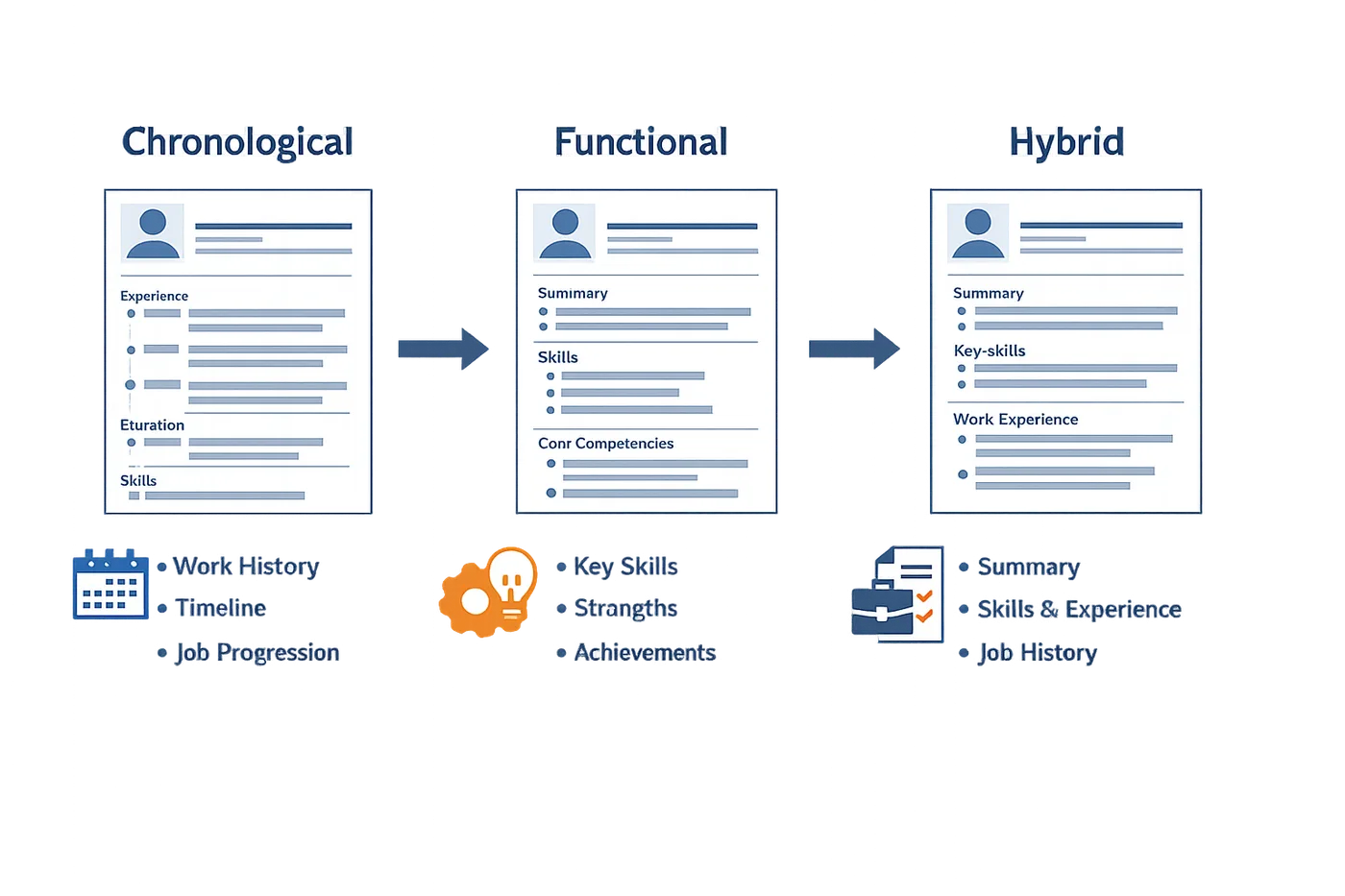
Choosing the right best resume format isn't about following trends—it's about presenting your experience in a way that recruiters can scan quickly. Here's how to pick the layout that works for your situation.
Step 1: Start with Reverse Chronological Order
The standard format that works for most candidates includes these sections in this order:
- Name and contact info
- Work history (most recent job first)
- Education
For each job, list your title, the employer's name, dates you worked there, and bullet points describing what you achieved. This structure lets recruiters see your career progression at a glance.
List each position in reverse chronological order—newest first. Under each role, use bullet points to describe accomplishments, not just duties. Recruiters skim, and bullets are easier to absorb than paragraphs.
Step 2: Add Optional Sections Only If They Strengthen Your Case
Some candidates benefit from a short profile or summary section before their work history. This has become more common and can frame your candidacy—but it's optional. Include it only if it adds context that isn't obvious from your job titles.
You might also add sections for volunteer work or special skills if they're directly relevant to the job. Don't pad your resume with every seminar you've attended or every conference you've been to—keep it substantial.
Step 3: Avoid Functional Resumes
Functional resumes group skills instead of showing job-by-job history. They scream "I'm hiding something" to hiring managers. Even if you have employment gaps or are changing careers, stick with the chronological format and address gaps honestly in your cover letter.
Tailor Content, Not Structure
Some people keep a master resume—a long document listing every achievement from every job. Then they pull the strongest pieces into a one- or two-page version tailored to each application. This approach lets you highlight the experience most relevant to the role without rewriting your entire resume from scratch.
When you're applying to different types of roles, modify the bullet points under each job to emphasize how that work relates to the position. Don't stick to generic job duties—show how your past work connects to what the employer needs. For more guidance on making your resume work with applicant tracking systems, see our ATS formatting best practices.
Review the job description and pull out the skills or outcomes they emphasize. Then adjust your bullet points to highlight times you delivered similar results. Keep the same structure, but shift the focus.
Keep It to Two Pages Maximum
The one-page rule is dead for experienced candidates, but that doesn't mean you can go long. Two pages is the ceiling. If you're a recent graduate, stick to one page. The longer your resume, the less likely a recruiter is to see the parts you most want them to notice.
Tips and Tricks
Beyond choosing the right format, a few practical habits will keep your resume working for you across different application systems and hiring contexts.
Keep Two Resume Versions Ready
Maintain two versions of your resume: one formatted in Word or PDF for emailing, and another unformatted in plain text for online applications. Many companies still ask you to email a resume directly to a hiring manager or recruiter. That's where your formatted version shines—clean layout, readable fonts, proper spacing. But when you're filling out an online application, you'll often need to copy and paste sections into different form fields. A plain-text version makes that process much faster and cleaner, without formatting artifacts cluttering the fields.
Write in Normal Language, Not Corporate Jargon
The most compelling resumes are written in real language, without jargon or stiffness. Write your resume in normal language, like the way you would describe your achievements to a friend. Don't suck the life out of it with stuffy corporate-speak. When I'm scanning resumes at high volume, the ones that sound human stand out. If I have to decode what you actually did through layers of buzzwords, I'm moving to the next candidate.
Understand That Two Pages Are Now Acceptable
While you might have heard the one-page resume rule, times have changed and two-page resumes are common now. If you only have a few years of experience, you should still stick to one page, but two pages are fine for everyone else. I'd rather see a well-spaced two-page resume that tells a clear story than a cramped one-pager where I have to squint to read eight-point font. The goal is clarity, not arbitrary length limits.
The most useful resume advice isn't about formatting; it's about the content of your resume.
Focus on Content Over Format
No amount of clever layout will save a resume that doesn't clearly show what you've accomplished. Content still matters—don't get lulled into thinking that it's just about keywords. Formatting helps recruiters find your accomplishments quickly, but the accomplishments themselves need to be there. That's why understanding what ATS systems actually check matters more than obsessing over margins and fonts.
Test Your Resume in Multiple Contexts
Before you start applying, send your formatted resume to yourself and open it on a different device. Does it still look clean? Then copy a section into a plain email or a web form. Does it paste cleanly, or does it turn into a mess of symbols and broken bullets? These small tests catch formatting issues before a recruiter sees them.
Conclusion
Choosing the right best resume format isn't about following a template—it's about making your experience readable at scanning speed. After 25 years in talent acquisition, including roles as a Principal Technical Recruiter at Meta and a founding recruiter at companies like GoPro and Chipper Cash, I can tell you that at high hiring volume, recruiters scan rather than read. The format you choose determines whether your achievements register in that three-second window.
The content of your resume matters more than any formatting trick. Focus on outcomes you achieved at each job rather than just listing duties. A chronological format works when your job history tells a clear story. A functional format helps when you're changing fields or have gaps to navigate. A combination format lets you lead with skills while still showing progression. But no format saves a resume that only recites responsibilities without showing impact.
Keep two versions ready: a formatted PDF for email applications and plain text for online systems. Most application portals strip formatting anyway, so your content needs to work without bold headers or careful spacing. That's why understanding what ATS systems actually check helps you write content that survives both human scanning and machine parsing.
Your resume is the first impression you make. Make it count by choosing a format that highlights your strengths in a way that aligns with the role you're targeting. Clarity and relevance beat creativity every time. Start with the format that best matches your career story, then focus on writing achievement-driven content that works whether a person or a system reads it first.
Sources(33)
- Ask a Manager (2012)
- interviewing.io (2025)
- Ask a Manager (2019)
- Ask a Manager (2016)
- Ask a Manager (2023)
- Ask a Manager (2020)
- Ask a Manager (2012)
- Ask a Manager (2025)
- Zenodo (CERN European Organization for Nuclear Research) (2026)
- Zenodo (CERN European Organization for Nuclear Research) (2026)
- Ask a Manager (2011)
- Ask a Manager (2013)
- Ask a Manager (2015)
- Ask a Manager (2013)
- Ask a Manager (2016)
- Ask a Manager (2014)
- Ask a Manager (2017)
- Ask a Manager (2012)
- Ask a Manager (2014)
- Ask a Manager (2020)
- Ask a Manager (2018)
- Ask a Manager (2014)
- Ask a Manager (2017)
- Ask a Manager (2011)
- Ask a Manager (2011)
- interviewing.io (2025)
- Ask a Manager (2012)
- Ask a Manager (2011)
- Ask a Manager (2023)
- Ask a Manager (2012)
- interviewing.io
- interviewing.io
- interviewing.io

Written by
John Cronin
Published November 14, 2026 · 11 min read
John Cronin is a talent-acquisition leader with 25 years in recruiting, most recently as a Principal Technical Recruiter at Meta hiring machine-learning and AI engineers. He has been a founding recruiter at GoPro and Chipper Cash and led talent acquisition at Imgur. He writes about what recruiters actually do with your resume.
Want this kind of read on your résumé?
We'll tell you what's actually working, what's holding you back, and what to fix — in plain English.
Get My Job Match ScoreYou Might Also Like
More articles to help you advance your career

How to Choose the Best Resume Builder That Gets You Hired
Learn how to choose the best resume builder that enhances your chances of getting hired with practical tips, ATS optimization insights, and expert guidance.

What Skills Should You Actually Put on Your Resume?

What Hiring Managers Actually Look for in Resume Skills Sections