



Why the Generic QA Engineer Resume Won't Work
Discover why a generic QA engineer resume won't get you noticed and learn how to craft a standout version that highlights your skills and experiences.
 John Cronin
Introduction
When it comes to crafting a QA engineer resume, one thing is clear: a generic version simply won't cut it. Throughout 25 years in talent acquisition, countless resumes have been reviewed, and the ones that stand out are those tailored to the specific role and company. At Meta, where I sourced and recruited machine learning and AI engineers, I learned that hiring managers are looking for candidates who can demonstrate a clear understanding of the role's unique challenges and requirements.
The problem with generic resumes is simple: they read like everyone else's. When screening applications, a template resume can be spotted in seconds. It lists responsibilities instead of achievements, uses vague language like "responsible for testing" or "ensured quality," and fails to show what makes you different from the other fifty QA engineers who applied. A resume that could belong to anyone will interest no one.
Research confirms this reality. Generic resumes that resemble those of many other candidates will not attract the attention of employers — you need to demonstrate that you're an exceptional candidate, not just a qualified one. Candidates with strong FAANG experience and niche skills can get overlooked simply because they buried their most valuable assets under generic job descriptions. One candidate increased his interview invitations by 8X after restructuring his resume to highlight what actually mattered.
Tailoring your resume isn't about rewriting it from scratch for every application. It's about understanding what the employer is looking for and making sure your most relevant skills, experiences, and achievements are front and center. If you're applying to a role that emphasizes automation, your Selenium framework experience should be prominent. If the job description mentions CI/CD integration, lead with your Jenkins pipeline work. The goal is to make the recruiter's job easy — they should see within ten seconds that you match what they need. For more on what recruiters actually look for when screening resumes, see our guide on ATS Résumé Format: What Recruiters Actually Look For.
The sections that follow will break down exactly why generic resumes fail and what you need to include to make yours stand out. We'll cover the specific frameworks and metrics that catch a recruiter's eye, why CI integration experience matters, and what the reality of manual-only QA roles means for your career trajectory. By the end, you'll know how to position your experience so hiring managers see you as the solution to their problem, not just another applicant in the pile.
The Importance of Tailoring Your Resume
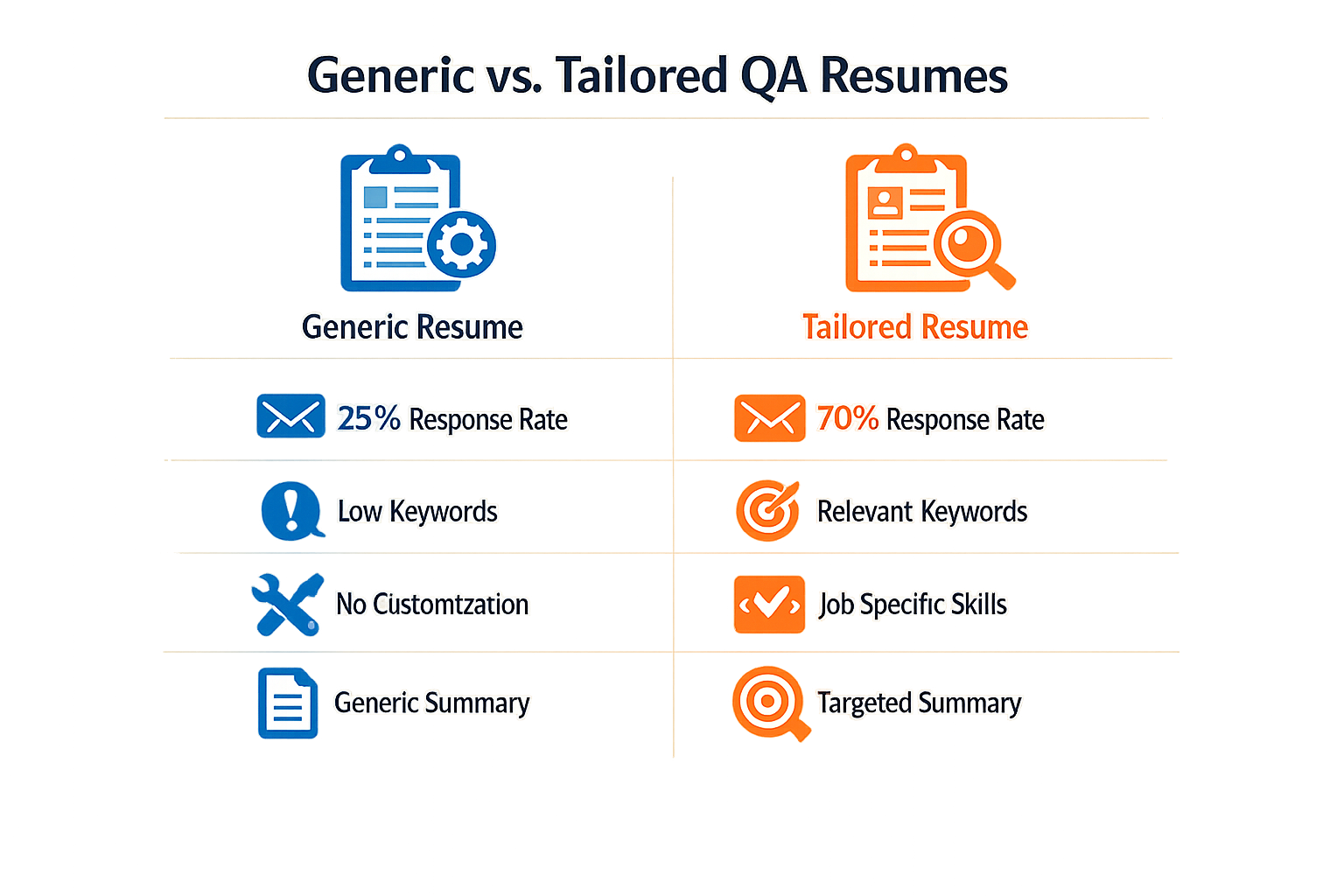
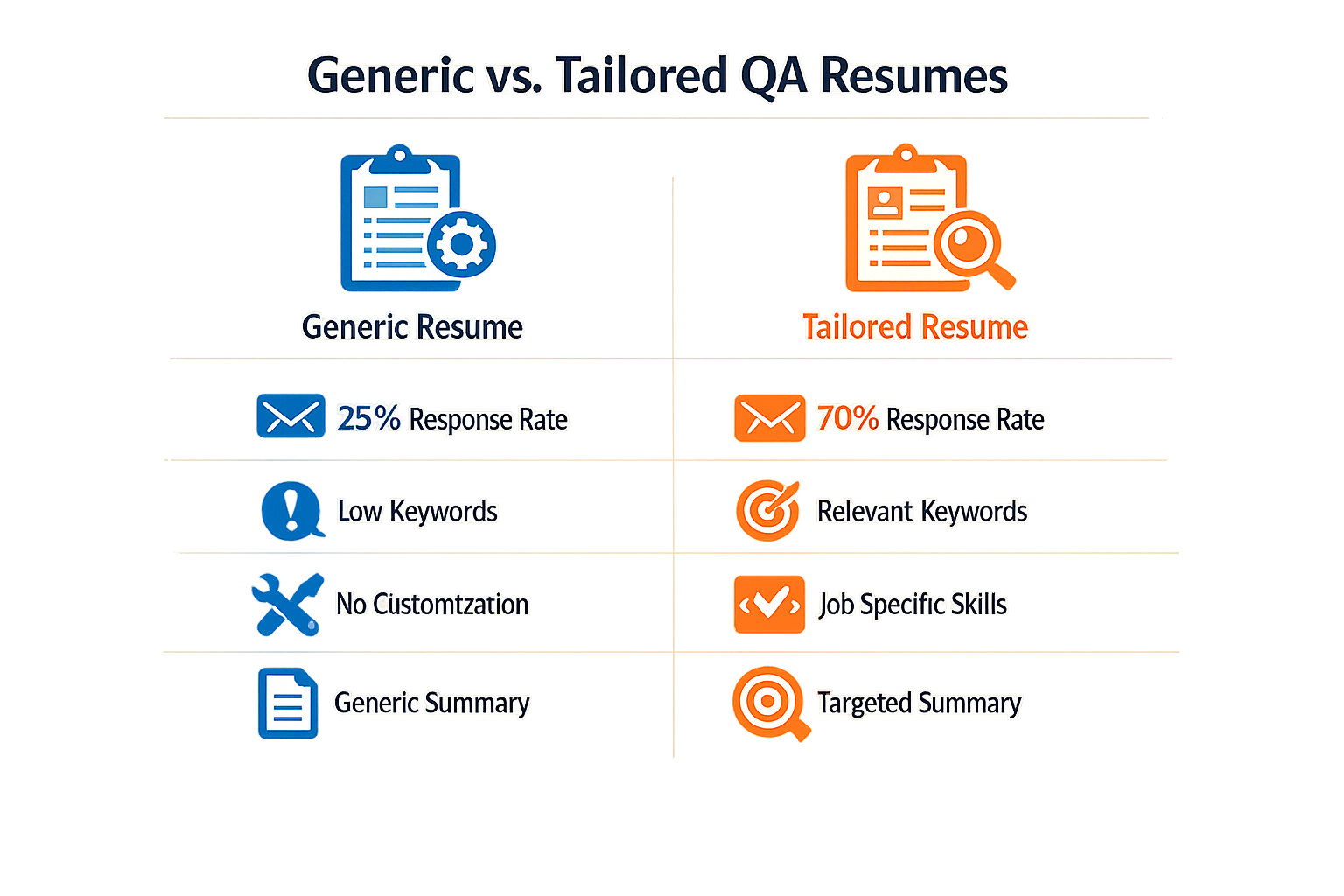
Here's the reality: your generic QA engineer resume looks exactly like 95% of the other resumes crossing my desk. When screening candidates, that sameness is the problem. A resume that just lists responsibilities — "performed regression testing," "documented bugs," "collaborated with developers" — tells me nothing about what you actually accomplished or why I should care.
Why Generic Resumes Get Ignored
Generic resumes fail because they don't answer the hiring manager's core question: can this person solve our specific problems? When your resume reads like a job description instead of a track record, it forces me to guess whether your experience maps to our needs. I don't have time to guess — I'm moving to the next candidate who made it obvious.
The other trap is self-assessment fluff. Declaring that you're "detail-oriented" or have "excellent problem-solving skills" without evidence doesn't convince anyone. Every candidate claims these things. What separates you is showing how you applied those skills to drive measurable results.
The Case for Customization
Tailoring your resume means restructuring it so the most relevant experience jumps out immediately. Candidates with strong backgrounds — FAANG experience, niche automation skills — can get passed over because they buried those details under generic headers or irrelevant early-career roles.
One candidate had exactly this problem. His resume listed FAANG experience and a specialized ML engineering title, but both were hidden in dense paragraphs. After restructuring it to lead with those credentials and quantify his impact, his interview invitations increased eightfold. Same experience, different presentation.
Customization doesn't mean rewriting your entire resume for every application. It means making sure the skills and achievements that align with the job description are front and center. If the role emphasizes CI/CD pipeline integration, your experience with Jenkins or GitHub Actions should be in the first third of the page, not buried in a tools list at the bottom.
What Tailoring Actually Looks Like
Start by reading the job description like a blueprint. What frameworks do they mention? What metrics matter to them — test coverage, defect escape rate, automation percentage? Then mirror that language in your resume, but only where you have genuine experience to back it up.
For example, if the posting asks for Selenium experience, don't just list "Selenium" in a skills section. Show: "Automated 200+ UI test cases using Selenium WebDriver, reducing regression cycle time from 3 days to 6 hours." That's specific. That's tailored. That tells me you understand the value of automation beyond the tool itself.
For more on how to structure your resume so these details actually get noticed by both humans and systems, see our guide on ATS Résumé Format: What Recruiters Actually Look For.
A resume that mirrors the job description's language — backed by real evidence — is the one that gets the phone screen.
Key Frameworks to Highlight
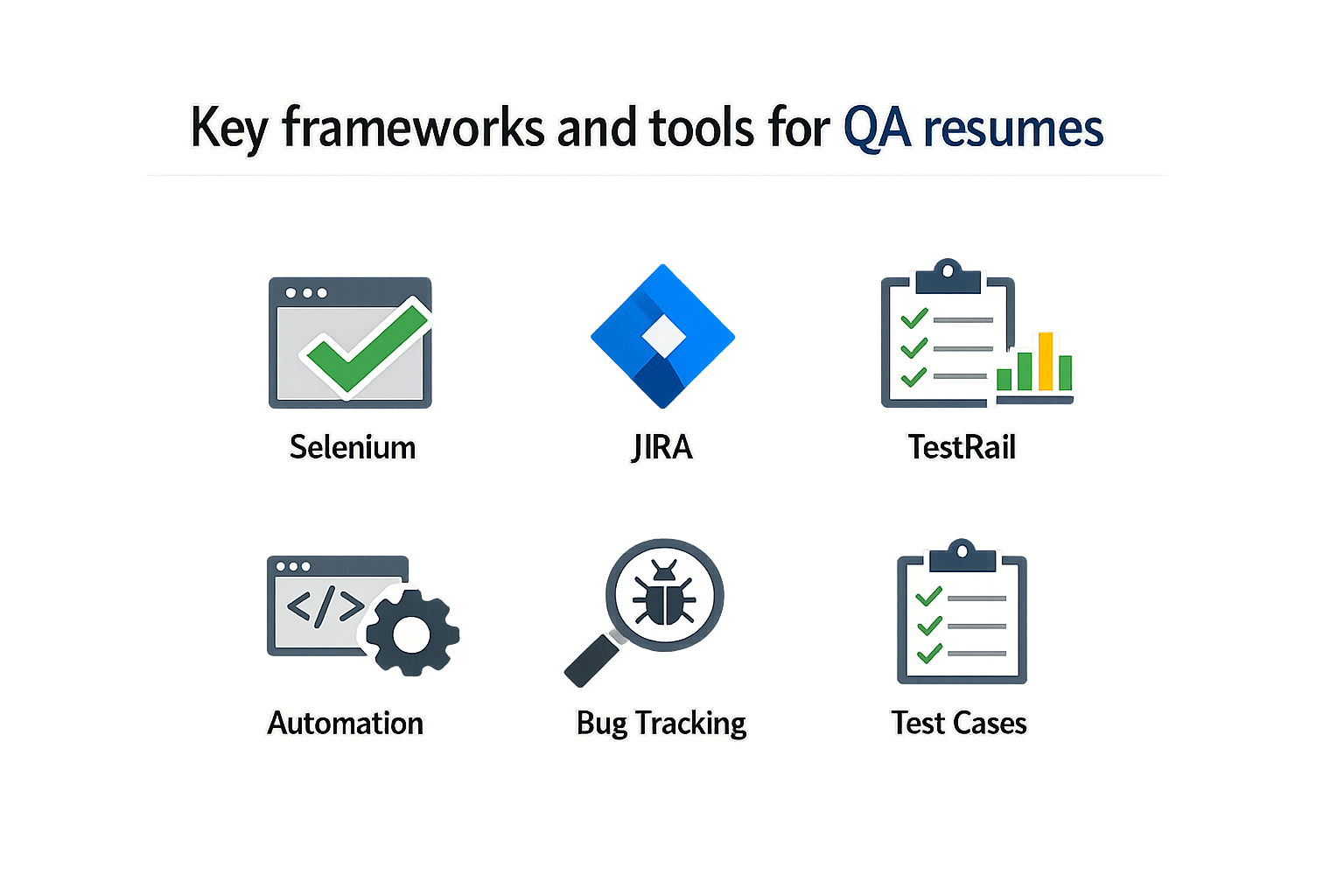
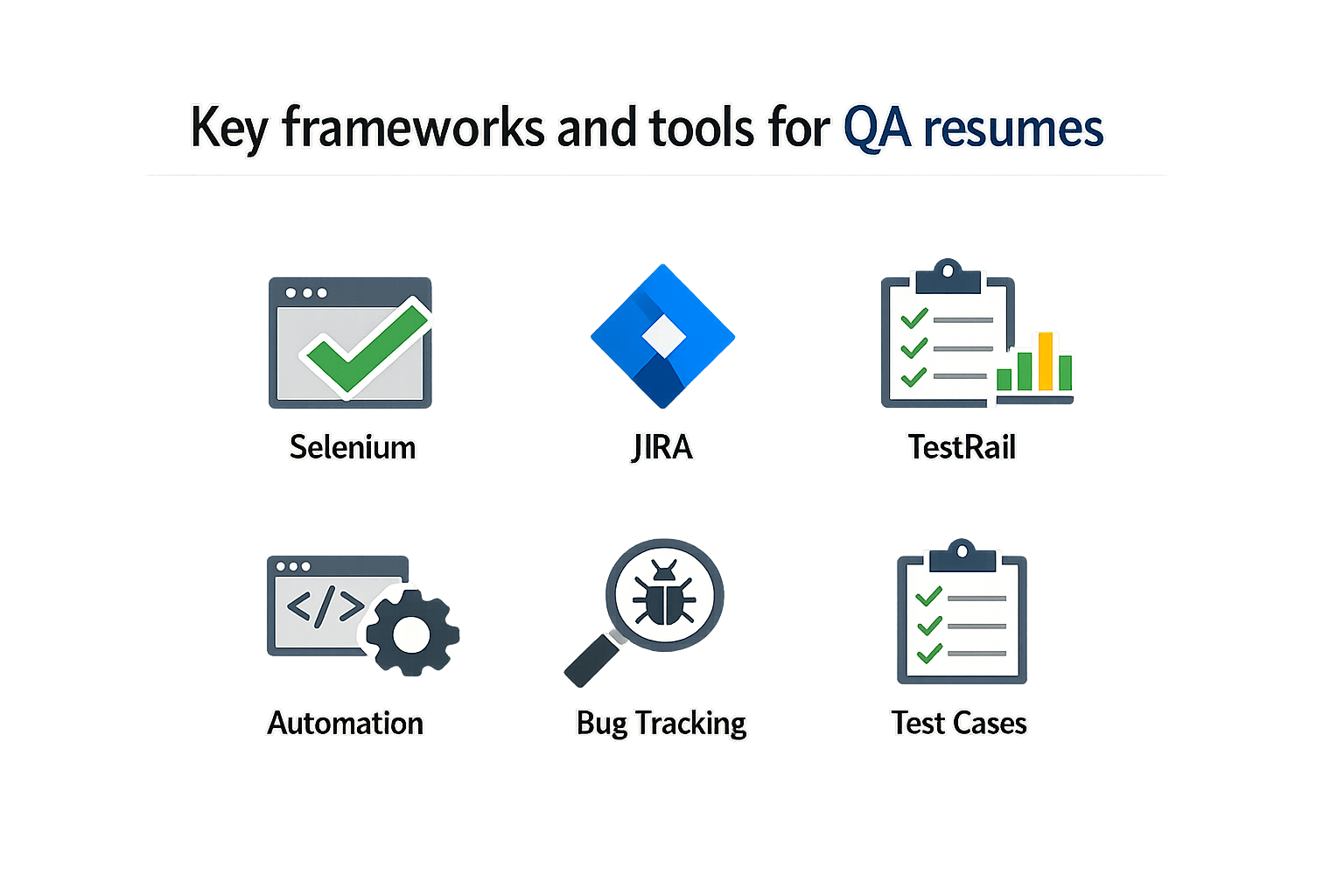
When screening QA engineer resumes, I'm not looking for a laundry list of every testing tool you've ever touched. I'm looking for evidence that you know how to apply the right framework to the right problem. The difference between a resume that gets passed to the hiring manager and one that doesn't often comes down to how clearly you demonstrate framework fluency — not just familiarity.
Show Framework Application, Not Just Names
Listing "Selenium, Cypress, Playwright" tells me nothing. What I want to see is which framework you chose for which context and why it mattered. Did you migrate a flaky Selenium suite to Playwright and cut test execution time in half? Did you choose Cypress for component testing because the team needed faster feedback loops? Those details signal judgment, not just tool exposure.
The same principle applies to mobile testing frameworks. If you've worked with Appium or Espresso, tell me what you automated and what coverage gap it closed. A resume that says "Appium for iOS and Android testing" is generic. A resume that says "Built Appium framework for cross-platform regression suite covering 200+ critical user paths" shows scope and impact.
API Testing Frameworks Matter More Than You Think
API testing is where a lot of QA engineers differentiate themselves, but most resumes bury it. If you've used REST Assured, Postman collections with Newman, or Pact for contract testing, make it visible. Hiring managers care about API coverage because it's where integration bugs hide — and it's often the first line of defense before UI tests even run.
For backend-heavy teams, seeing "Pact contract testing between microservices" or "REST Assured with data-driven test suites" signals that you understand testing at the service layer, not just the UI. That's the kind of specificity that moves a resume forward, especially when the role involves working with distributed systems or microservices architecture.
Recruiters prioritize specific experiences like FAANG roles and niche skills over generic awards or technologies listed on a resume.
Performance and Load Testing Tools
If you've done performance testing, call out the tools and the thresholds you validated. JMeter, Gatling, k6 — these aren't interchangeable, and the one you chose says something about the scale and complexity of what you tested. A line like "JMeter load tests validating 10,000 concurrent users at <2s response time" gives a concrete picture of your work. "Experience with JMeter" does not.
The same goes for observability and monitoring tools that feed into your testing strategy. If you've integrated testing with Datadog, New Relic, or Grafana dashboards to track performance regressions, that's worth highlighting. It shows you think beyond pass/fail and understand how testing ties into production health.
Avoid the Generic Skills Section Trap
One of the biggest mistakes is the skills section that lists 30 tools with no context. Engineers and recruiters are looking for different things in resumes, and a wall of technologies satisfies neither. Instead, organize your frameworks by category — test automation, API testing, performance testing, CI/CD integration — and tie each one to a specific role or project where you applied it.
If you're early in your career and don't have a deep bench of frameworks yet, focus on the ones you know well and describe what you built with them. A single well-explained framework with measurable results beats a dozen name-drops with no substance. For more on how to structure your technical experience effectively, see our guide on Software Engineer Resume: What Gets Past the Screen.
CI Integration and Its Significance
When screening QA engineer resumes, one detail separates candidates who understand modern testing from those still working in isolation: CI integration experience. Continuous Integration isn't just a buzzword—it's the backbone of how quality gets baked into the development process rather than tacked on at the end.
Why CI Experience Matters on Your Resume
Hiring managers want to see that you've worked in environments where tests run automatically on every commit. A resume that lists "Jenkins" or "GitHub Actions" without context tells me nothing. What I'm looking for is evidence that you built pipelines, configured test triggers, and owned the feedback loop between code commits and test results.
If you've set up automated test suites that gate deployments, say so explicitly. "Configured Selenium tests to run in Jenkins pipeline, blocking merges on failures" is concrete. "Familiar with CI/CD tools" is not. The difference is whether you've actually done the work or just read about it.
The Pipeline Owner vs. the Pipeline User
There's a meaningful distinction between engineers who configure CI pipelines and those who simply run tests within them. Both are valid roles, but if you've done the former, make it visible. Hiring managers at companies with mature engineering practices expect QA engineers to collaborate with DevOps on pipeline architecture, not just consume what's handed to them.
List the specific CI platforms you've worked with—Jenkins, CircleCI, GitLab CI, Azure DevOps—and describe what you built. Did you parallelize test execution to cut run time? Did you implement flaky test detection? Did you integrate test results into pull request status checks? These are the details that demonstrate real CI fluency.
A QA engineer who can't explain their CI pipeline is a QA engineer who hasn't owned the quality feedback loop.
Connecting CI to Quality Outcomes
The strongest resumes don't just list CI tools—they connect CI integration to measurable improvements in quality or velocity. If your automated test suite caught regressions before they reached production, quantify it. If pipeline optimization reduced build times and accelerated release cycles, include the numbers.
For example: "Integrated Playwright E2E tests into GitHub Actions, reducing production incidents by 40% over six months" tells a complete story. It shows you understand that CI isn't about running tests—it's about preventing defects from reaching users.
If you're newer to QA and haven't built pipelines from scratch, focus on what you have done within existing CI systems. Maintaining test suites that run reliably in CI, triaging failures, and improving test stability are all legitimate contributions. Just be specific about your role rather than claiming ownership of work you didn't do.
Want to see how other technical roles frame their tooling experience? Check out the Software Engineer Resume: What Gets Past the Screen guide for parallel examples of how to present pipeline and automation work.
Understanding Escaped-Defect Metrics
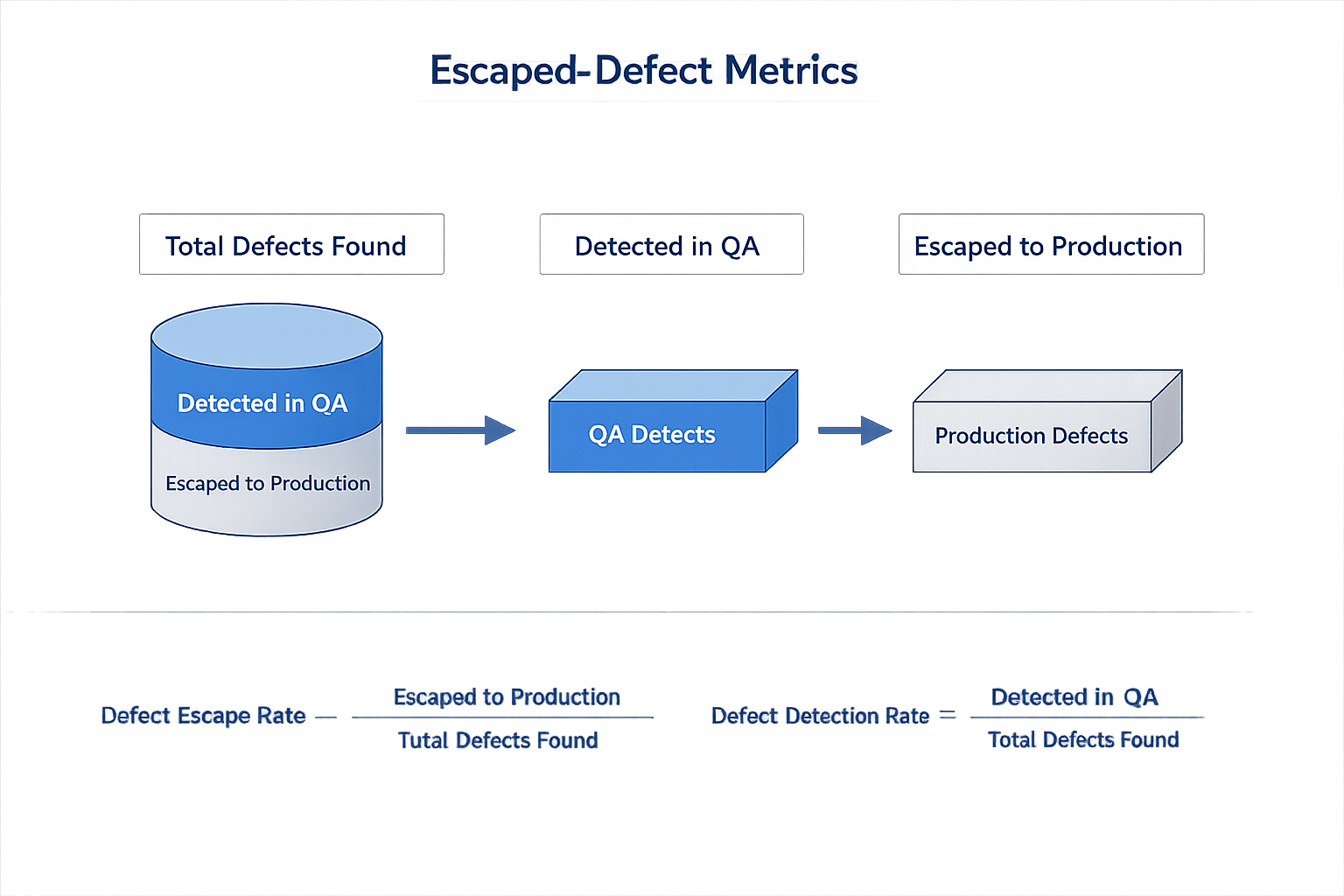
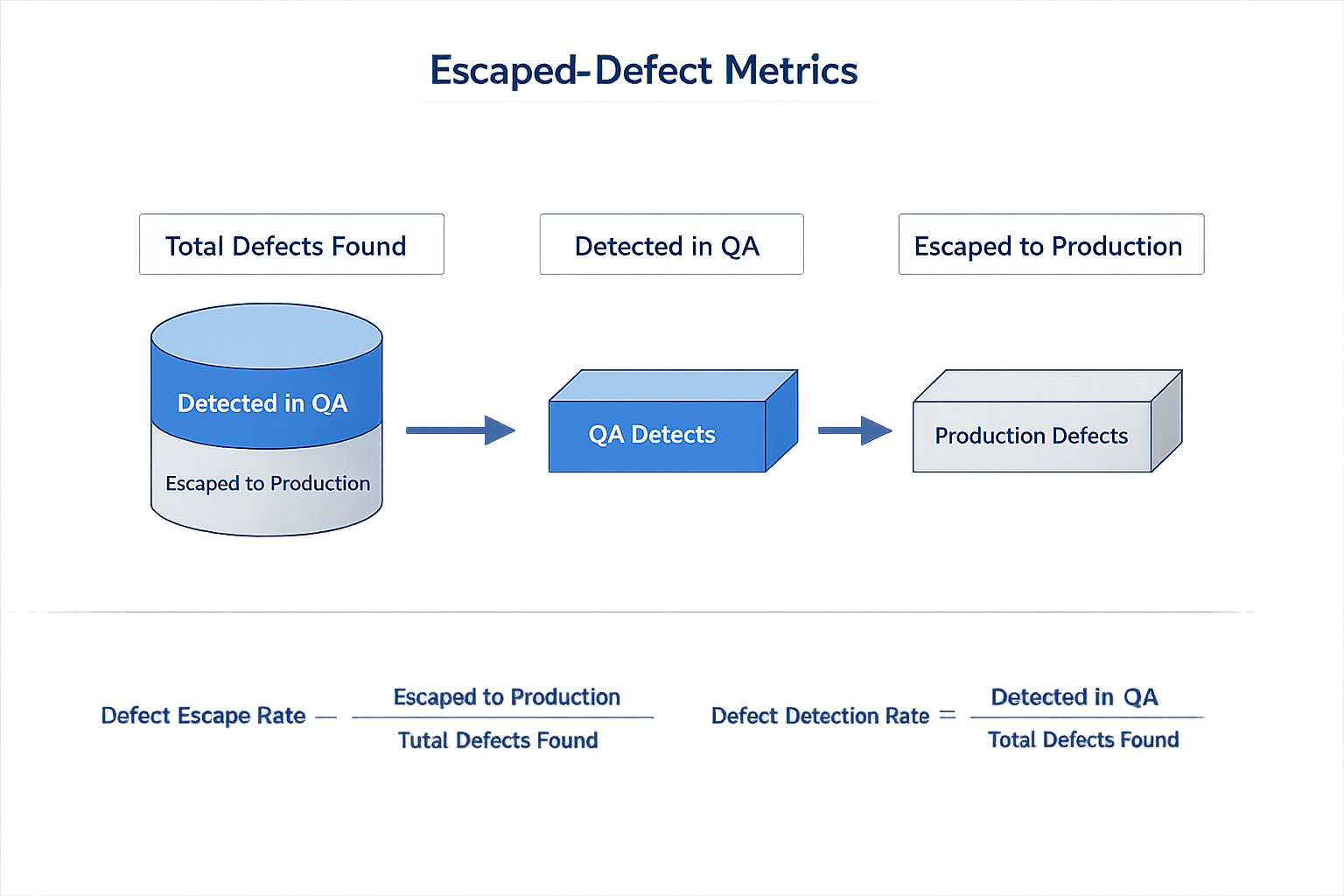
Escaped-defect metrics measure bugs that your testing didn't catch before they reached production. It's the single most telling number about a QA engineer's effectiveness, yet most resumes never mention it. When screening candidates, it's important to see how many defects made it past your testing process and into the hands of real users.
Think of it this way: if you tested 100 features and 15 bugs surfaced in production within the first month, your escaped-defect rate is 15%. Lower is better. The metric matters because it quantifies the real-world impact of your testing strategy. A generic resume lists "thorough testing" as a skill; a strong resume states "reduced escaped defects by 40% over six months by implementing risk-based test prioritization."
Why Hiring Managers Care About This Number
Escaped defects cost money and erode user trust. Every bug that reaches production requires emergency fixes, customer support overhead, and potential reputation damage. When a QA engineer can demonstrate they've driven this number down, they're showing they understand the business impact of quality—not just the mechanics of running tests.
During years screening technical candidates, the engineers who tracked and improved their escaped-defect rates were the ones who got callbacks. They understood that testing isn't about finding every possible bug in a lab environment; it's about preventing the bugs that matter from reaching customers. That's the mindset hiring managers want.
How to Present Escaped-Defect Data on Your QA Engineer Resume
Don't just drop a percentage without context. Frame it as a story of improvement. For example: "Inherited a 22% escaped-defect rate; implemented exploratory testing sessions and edge-case checklists, reducing rate to 9% within two release cycles." That tells me you diagnosed a problem, took action, and measured the result.
If you worked on multiple projects, pick the one with the clearest improvement trajectory. Hiring managers aren't looking for perfection—they're looking for evidence that you can identify weak spots in a testing process and systematically address them. A trend line from 18% down to 6% over a year is far more compelling than a static "maintained 95% test coverage" claim that doesn't connect to outcomes.
Escaped-defect metrics translate testing effort into business value—show the trend, not just the number.
When you tie your testing work to measurable quality improvements, you're speaking the language hiring managers understand. Generic resumes talk about "ensuring quality"; strong resumes prove it with the metrics that matter most.
The Reality of Manual-Only QA Roles
If your resume shows only manual testing experience, you're facing an uphill battle in today's market. The shift has been observed over 25 years in recruiting: manual-only QA roles are shrinking, and the candidates who get through screening are the ones who demonstrate they're moving beyond click-through scripts.
Why Manual-Only Experience Limits Your Options
Recruiters and hiring managers aren't looking at manual testing as a dead skill — it's still necessary — but they need to see evidence that you understand where the role is heading. When reviewing a QA engineer resume, a list of manual test cases executed tells what you did yesterday, not what you can do tomorrow.
The rejection reasons for manual-only candidates often fall into a pattern: "projects not extensive enough" or "lack of core computer science." These aren't about your ability to find bugs. They're about whether you've demonstrated the technical depth to grow with the team. A resume that shows only manual work raises a question: can this person handle automation when needed?
What Hiring Managers Actually Want to See
The candidates who get past the screen are the ones who show they're already moving in the right direction. That might be a section on your resume about exploratory testing paired with basic Python scripts you wrote to speed up data setup. It might be a bullet point about working with developers to improve testability in the codebase. It doesn't have to be full CI/CD pipeline ownership, but it has to show forward motion.
Recruiters prioritize relevant experience over generic task lists. If your resume reads like a job description — "executed test plans, logged defects, participated in standups" — you're not differentiating yourself. I need to see what you contributed that someone else in that role wouldn't have. Did you identify a gap in test coverage and propose a solution? Did you reduce regression time by organizing test suites differently? Those details matter.
Positioning Yourself for the Future
If you're currently in a manual-only role, your resume needs to show you're preparing for what's next. That could mean listing any exposure to automation tools, even if it's not your primary responsibility. It could mean highlighting collaboration with automation engineers or participation in tool evaluations. The goal is to demonstrate awareness of where the discipline is going and a willingness to get there.
For more guidance on how recruiters evaluate technical resumes, see our Software Engineer Resume: What Gets Past the Screen guide — many of the principles apply across technical roles.
Don't bury your technical growth under generic headings. If you've taken courses, built side projects, or contributed to open-source testing tools, put that front and center. Recruiters spend seconds on each resume, and we're scanning for signals that you're not standing still.
Conclusion
A generic QA engineer resume is a missed opportunity. Throughout this article, we've covered why tailoring matters: hiring managers want to see framework proficiency, CI integration experience, and metrics that show you prevent defects before they ship. When your resume buries those details under generic job descriptions, you're making the screener's job harder — and they'll move on to the next candidate who made it easy.
During 25 years in talent acquisition, resumes that looked identical on the surface but performed wildly differently have been observed. At Imgur, where an average of 70 technical hires a year were made, the candidates who got interviews were the ones who restructured their bullets to highlight what the role actually required. One candidate had FAANG experience but buried it under vague project descriptions — after repositioning his automation work and CI contributions at the top, his interview invitations increased 8X. The content didn't change; the presentation did.
The reality is straightforward: if your resume doesn't speak directly to the job description, someone else's will. Manual-only QA roles are shrinking, automation expectations are rising, and hiring managers are filtering for candidates who can show — not just claim — that they've built maintainable test suites and tracked escaped-defect rates. Your resume is your first test case. Make it pass.
If you're reworking your resume and want to understand what recruiters actually look for in ATS-friendly formats, start there. The mechanics of getting past the screen are simpler than most candidates think — but only if you tailor the content to the role you're chasing.
Related reading
Cover Letter Alternative: Cover Letter Truth: What Hiring Managers
Sources(26)
- interviewing.io (2014)
- interviewing.io (2025)
- interviewing.io (2024)
- DR-NTU (Nanyang Technological University) (2026)
- john-cronin-quote-integration — John Cronin
- interviewing.io (2025)
- World Economic Forum (2023)
- OpenAlex (2017)
- World Economic Forum (2020)
- Ask a Manager (2012)
- Ask a Manager (2023)
- Ask a Manager (2015)
- Ask a Manager (2007)
- Ask a Manager (2017)
- Ask a Manager (2010)
- Ask a Manager (2026)
- Ask a Manager (2017)
- interviewing.io (2013)
- interviewing.io (2026)
- World Economic Forum (2025)
- aam-59b90992a9e0019f (practitioner_guidance)
- aam-307b8f5e79fc9114 (practitioner_guidance)
- aam-56d3522da348ca83 (practitioner_guidance)
- aam-71a8706ed434d410 (practitioner_guidance)
- aam-515e94e01c76a696 (practitioner_guidance)
- aam-49904f9b98c0ca8e (practitioner_guidance)

Written by
John Cronin
Published October 18, 2026 · 16 min read
John Cronin is a talent-acquisition leader with 25 years in recruiting, most recently as a Principal Technical Recruiter at Meta hiring machine-learning and AI engineers. He has been a founding recruiter at GoPro and Chipper Cash and led talent acquisition at Imgur. He writes about what recruiters actually do with your resume.
Want this kind of read on your résumé?
We'll tell you what's actually working, what's holding you back, and what to fix — in plain English.
Get My Job Match ScoreYou Might Also Like
More articles to help you advance your career

ATS Meaning Resume: Understanding ATS and What Applicant Tracking
Learn what ATS meaning resume entails and how Applicant Tracking Systems work in 2026 to streamline your hiring process and recruitment workflows.

Honest Résumé Score Example: What It Looks Like and How to Improve
Learn what an honest résumé score looks like with this real walkthrough. See actual examples and discover how to improve your résumé evaluation results with an honest

Why a Generic Cybersecurity Resume Won't Work and What Will
Discover why a generic cybersecurity resume won't cut it and learn how to tailor your application for success in the tech industry.

Free ATS Resume Checker: What's Useful and What's Not
Discover what Free ATS Resume Checker tools can and can't do. Learn which features actually help optimize your resume for applicant tracking systems.