



CSM Resume Template: The Ultimate Guide to Stress-Free Success
Discover the best CSM resume template strategies and what to include for landing your customer success role with confidence and ease.
 Emily Johnson
Introduction
You've spent hours perfecting your customer success manager resume, but the responses aren't coming. The problem isn't your experience—it's that your resume looks exactly like everyone else's. After reviewing thousands of resumes as a recruiter, I've seen talented CSM candidates repeatedly overlooked because they relied on generic templates that don't speak the language hiring managers need to hear.
A generic customer success manager resume won't work in today's competitive market. Applicant tracking systems scan for specific keywords and phrases that match job descriptions, and recruiters spend an average of six seconds deciding whether your resume deserves a closer look. Without tailored language that highlights your unique value proposition, your application gets lost in the pile—even when you're qualified for the role.
The good news? Once you understand why generic versions fail and what hiring teams actually look for, creating a compelling CSM resume template becomes straightforward. Whether you're an experienced customer success professional or transitioning from a related field like account management, the strategies in this guide will help you build a resume that gets noticed.
In this guide, we'll break down exactly why generic CSM resumes fail, what hiring managers prioritize when evaluating candidates, and how to structure your resume to pass both automated systems and human review. You'll learn which skills to emphasize, how to quantify your achievements, and what format works best for customer success roles at different career stages.
Understanding the Role of a Customer Success Manager
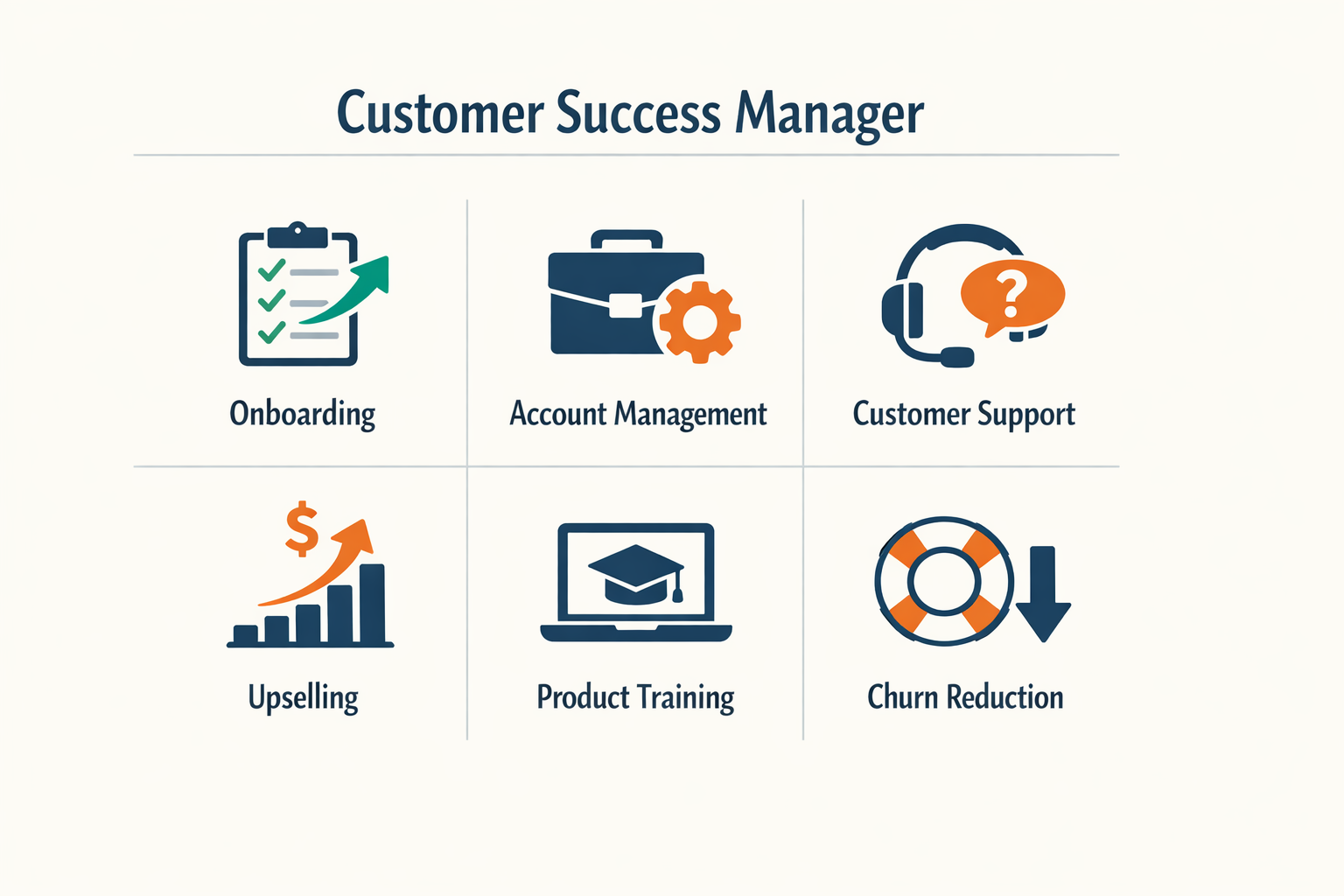
Before you can craft a standout CSM resume template, you need to understand what hiring managers actually look for in this role. A Customer Success Manager ensures customers find genuine value in a company's products and services by guiding them through every stage of their journey. This isn't a support role that waits for problems—it's a proactive partnership that drives retention, expansion, and long-term loyalty.
The position sits at the intersection of relationship management, strategic thinking, and data-driven decision-making. You're expected to anticipate customer needs, identify growth opportunities, and translate product features into measurable business outcomes. Generic resume templates miss this entirely because they treat customer success like any other client-facing role, when the reality is far more nuanced.
Core Responsibilities That Define the Role
Customer Success Managers own the post-sale relationship. You're responsible for onboarding new clients, ensuring smooth adoption of the product, and maintaining regular check-ins that keep accounts healthy. Renewals and upsells fall under your purview, but only when they genuinely serve the customer's goals—pushy sales tactics don't belong here.
You also act as the voice of the customer within your organization. Feedback you gather informs product development, marketing messaging, and support processes. When a customer hits a roadblock, you coordinate cross-functional teams to resolve it quickly. This means your resume needs to show collaboration skills alongside your ability to work independently.
Essential Skills Employers Prioritize
Technical proficiency matters more than most candidates realize. You'll work daily with CRM platforms, customer health scoring tools, and analytics dashboards. Familiarity with the specific software your target company uses gives you an edge, but demonstrating you can learn new systems quickly works almost as well.
Communication skills go beyond being friendly on calls. You need to present quarterly business reviews to C-level stakeholders, write clear documentation for diverse audiences, and negotiate contract renewals with confidence. Your resume should reflect this range—mention presentations delivered, training materials created, or complex issues resolved through written communication.
Problem-solving and strategic thinking separate good CSMs from great ones. Employers want to see how you've identified churn risks before they became cancellations, or how you've scaled your approach to manage a growing book of business without sacrificing quality. If you're building a recruiter resume template or transitioning from another field, focus on transferable examples that show this analytical mindset.
The Metrics That Matter
Customer success is a results-driven function, which means your resume needs quantifiable achievements. Retention rates, Net Promoter Scores, expansion revenue, and time-to-value metrics all tell hiring managers you understand what success looks like in this role. Even if you're early in your career, you can point to the number of accounts managed, onboarding completion rates, or customer satisfaction improvements you contributed to.
Avoid vague claims like "improved customer satisfaction." Instead, specify: "Increased NPS from 42 to 68 across a portfolio of 35 enterprise accounts within 12 months." This level of detail proves you think in terms of impact, not just activity—exactly what a strong CSM resume template should showcase.
Common Failures of Generic Resumes

Generic resume templates promise quick results, but they rarely deliver when you're pursuing a customer success manager position. The problem isn't the template itself—it's the one-size-fits-all approach that strips away the specific language and achievements hiring managers actually want to see.
When you download a generic CSM resume template and fill in the blanks, you're essentially creating a document that looks like everyone else's. Recruiters can spot these cookie-cutter resumes within seconds, and worse, applicant tracking systems often reject them before a human ever sees your application.
Missing the Language That Matters
The biggest failure of generic resumes is their lack of specific keywords and phrases that match the job description. Applicant tracking systems scan for exact terminology—words like "customer retention," "churn reduction," or "SaaS onboarding"—and generic templates rarely include the precise language that triggers a match.
Generic templates also fail to highlight the standout skills and characteristics that differentiate customer success managers from other roles. They treat all professional experience as equal, when hiring managers specifically want to see metrics around customer satisfaction scores, renewal rates, and cross-sell achievements.
The Professional Experience Trap
Most generic templates provide bland bullet points that could apply to any job: "Managed customer relationships" or "Provided excellent service." These phrases tell recruiters nothing about your actual impact. Customer success is a results-driven field, and generic descriptions don't showcase the quantifiable outcomes that prove your value.
Understanding how ATS reads resumes can help you avoid these common pitfalls and structure your content for both human and machine readers.
A resume that works for everyone works for no one—specificity is what separates callbacks from rejections.
The Skills Section Disconnect
Generic templates often include skills sections that list capabilities without context. "Communication" and "problem-solving" appear on thousands of resumes, but they don't demonstrate how you've applied those skills in customer success scenarios. Without tailored examples that connect your abilities to CSM-specific challenges, your resume blends into the background.
The failure isn't just about what generic resumes include—it's about what they omit. They miss opportunities to showcase your understanding of customer lifecycle management, your experience with specific CRM platforms, or your track record of turning at-risk accounts into advocates. These details matter, and templates designed for any role can't capture them effectively.
Creating an Effective Customer Success Manager Resume
Building a CSM resume template that actually works requires more than copying a generic format and swapping in your job titles. The strongest resumes tell a story of measurable impact—one that hiring managers can visualize in seconds. Start by thinking of your resume as a highlight reel, not a comprehensive job history. Every line should answer the question: "What did this person deliver?"
Lead with Quantifiable Achievements
Numbers transform vague claims into proof. Instead of "Improved customer satisfaction," write "Increased customer retention by 20% over 12 months." Instead of "Managed client accounts," try "Oversaw a $7.3M book with 94.6% gross revenue retention." Metrics like these give hiring managers a clear sense of scope and outcome in one line. Focus on achievements tied to customer satisfaction, retention rates, upsell percentages, referral growth, and adherence to key performance indicators. If you generated 15% new business through referrals, say so—it shows you don't just retain customers, you turn them into advocates.
Structure for Scanability
Recruiting teams spend an average of six seconds on an initial resume scan. Win those seconds by organizing your content into clean, labeled sections: Summary, Experience, Skills, and Education. Your summary should be a three-to-four-line snapshot of your value proposition—think "Customer Success Manager with five years driving retention and expansion in SaaS environments" rather than a generic objective statement. In the Experience section, use reverse chronological order and lead each bullet with a strong action verb: "Launched," "Reduced," "Expanded," "Designed." Keep bullets to one or two lines and group related accomplishments under each role.
For a deeper dive into optimizing resume structure for automated systems, check out our guide on how ATS reads resumes.
Tailor Every Application
A single master resume won't cut it. Read the job description carefully and mirror the language the employer uses. If they emphasize "onboarding," "customer health scoring," or "cross-functional collaboration," weave those exact phrases into your bullets—assuming you've actually done that work. This isn't about keyword stuffing; it's about speaking the same language as the hiring team. Create a master document with every achievement you've ever had, then pull the most relevant five to seven bullets for each application. This approach keeps your resume focused and ensures every line earns its place.
The best CSM resume template is the one you customize for every role—generic is the enemy of noticed.
Highlight Relevant Skills and Tools
Customer success is both strategic and technical. List the platforms you know—Gainsight, Salesforce, ChurnZero, Zendesk—and the skills that set you apart: stakeholder management, data analysis, process design, customer journey mapping. If you've built playbooks, led QBRs, or designed onboarding workflows, call that out. Avoid soft-skill fluff like "team player" or "excellent communicator" unless you can back it up with a concrete example in your Experience section. Instead, let your achievements demonstrate those qualities.
Tailoring Your Resume for ATS
Applicant Tracking Systems filter resumes before human eyes ever see them. If your customer success manager resume doesn't pass ATS screening, your qualifications never reach the hiring team. Understanding how these systems parse and rank resumes is the difference between landing an interview and disappearing into a digital black hole.
ATS software scans for keywords, evaluates formatting consistency, and flags resumes that match the job description. Generic resumes fail because they lack the specific terms and structure that ATS algorithms prioritize. A well-optimized resume speaks both languages—machine-readable for the ATS and compelling for the recruiter who reviews it afterward.
Where Keywords Belong in Your CSM Resume Template
Keyword placement determines whether ATS recognizes your qualifications. Scatter them randomly, and the system misses critical matches. Place them strategically, and you signal relevance at every decision point.
Include important keywords in three core areas: your professional summary, skills section, and experience bullets. Your summary should feature 6-10 keywords that align with the job posting—terms like "customer retention," "account expansion," "churn reduction," or "SaaS onboarding." Group related skills by category in your skills section: customer relationship tools (Salesforce, Gainsight, HubSpot) and methods (quarterly business reviews, success planning, stakeholder engagement). Embed keywords naturally in your experience bullets, paired with measurable results that prove impact.
Formatting Your Resume for Machine Readability
ATS parsing fails when resumes use complex formatting that confuses the algorithm. Tables, text boxes, headers, footers, and graphics create extraction errors—your carefully written content becomes garbled data the system can't interpret.
Use a clean, single-column layout with standard section headings: Professional Summary, Skills, Experience, Education. Stick to common fonts like Arial, Calibri, or Times New Roman. Save your resume as a .docx file unless the application specifically requests PDF; some older ATS versions struggle with PDF parsing. Avoid using images, logos, or creative design elements that look impressive to humans but are invisible to software.
Bullet points should start with strong action verbs followed by specific outcomes. Instead of "Responsible for customer success initiatives," write "Reduced churn by 18% through proactive health monitoring and personalized success plans." The ATS captures both the keyword (churn) and the quantifiable result, while the human reviewer sees demonstrated impact.
Testing Your Resume Against ATS Requirements
Before submitting, compare your resume against the job description line by line. Highlight every required qualification and preferred skill in the posting, then verify each appears somewhere in your resume using similar or identical language. If the posting emphasizes "cross-functional collaboration," make sure that phrase or a close variant appears in your experience section.
Read your resume as plain text to simulate how ATS sees it. Copy your content into a basic text editor—if the formatting breaks or sections become unreadable, the ATS will have the same problem. Adjust your layout until the plain-text version maintains logical flow and clear section divisions.
For deeper insight into how ATS systems evaluate resumes and what triggers common parsing errors, review How ATS Reads Resumes: The Ultimate Guide to Surprising Success.
An ATS-optimized resume isn't about gaming the system—it's about making your qualifications unmistakably clear to both software and humans.
Customer Success Resume Examples
Looking at real-world examples is one of the fastest ways to understand what hiring managers actually respond to. A strong CSM resume template doesn't just list responsibilities—it shows measurable outcomes, clear scope, and the ability to drive retention and growth. The difference between a resume that gets interviews and one that gets ignored often comes down to how you frame your achievements.
What Makes a Resume Example Effective?
Effective customer success manager resumes share a few key traits: they lead with leadership skills, highlight customer-focused achievements, and demonstrate a direct connection between your work and business growth. One standout example might showcase how you enhanced client relationships while driving revenue expansion, giving recruiters confidence that you understand both the relational and commercial sides of the role.
Another powerful approach is to quantify scope and results in a single, punchy line. For instance, a candidate's resume showing a $7.3M book and 94.6% GRR gives hiring managers a clear sense of scale and outcome immediately. That kind of specificity eliminates guesswork and positions you as someone who owns outcomes, not just tasks.
Structuring Your Achievements for Maximum Impact
The best examples don't bury results in dense paragraphs. Instead, they use bullet points that start with action verbs and end with numbers. Think "Increased net retention to 94.6% across a $7.3M portfolio" rather than "Responsible for customer retention activities." The former tells a story; the latter is forgettable.
If you're early in your career and don't have a large book of business yet, focus on the percentage improvements you drove, the number of accounts you managed, or the processes you built. Even without headline-grabbing revenue figures, you can demonstrate that you understand what success looks like in this role. For more insights on tailoring resumes for different career stages, check out our Account Manager Resume Template: The Ultimate Stress-Free Guide.
A single line that combines scope and outcome—like "$7.3M book, 94.6% GRR"—does more work than three paragraphs of vague responsibilities.
Adapting Examples to Your Own Experience
Don't copy examples verbatim. Instead, use them as blueprints. If an example highlights cross-functional collaboration, ask yourself: where did I work across teams to solve a customer problem? If it emphasizes onboarding efficiency, pull your own onboarding metrics. The goal is to capture the structure of what works—clear role, quantified result, business impact—and apply it to your unique experience.
When you see a resume example that resonates, reverse-engineer it. What makes the bullet points compelling? How does the candidate balance hard skills with soft skills? What's the ratio of metrics to narrative? Use those insights to refine your own CSM resume template, ensuring it reflects both your strengths and the expectations of the roles you're targeting.
Tips and Tricks for a Winning Resume
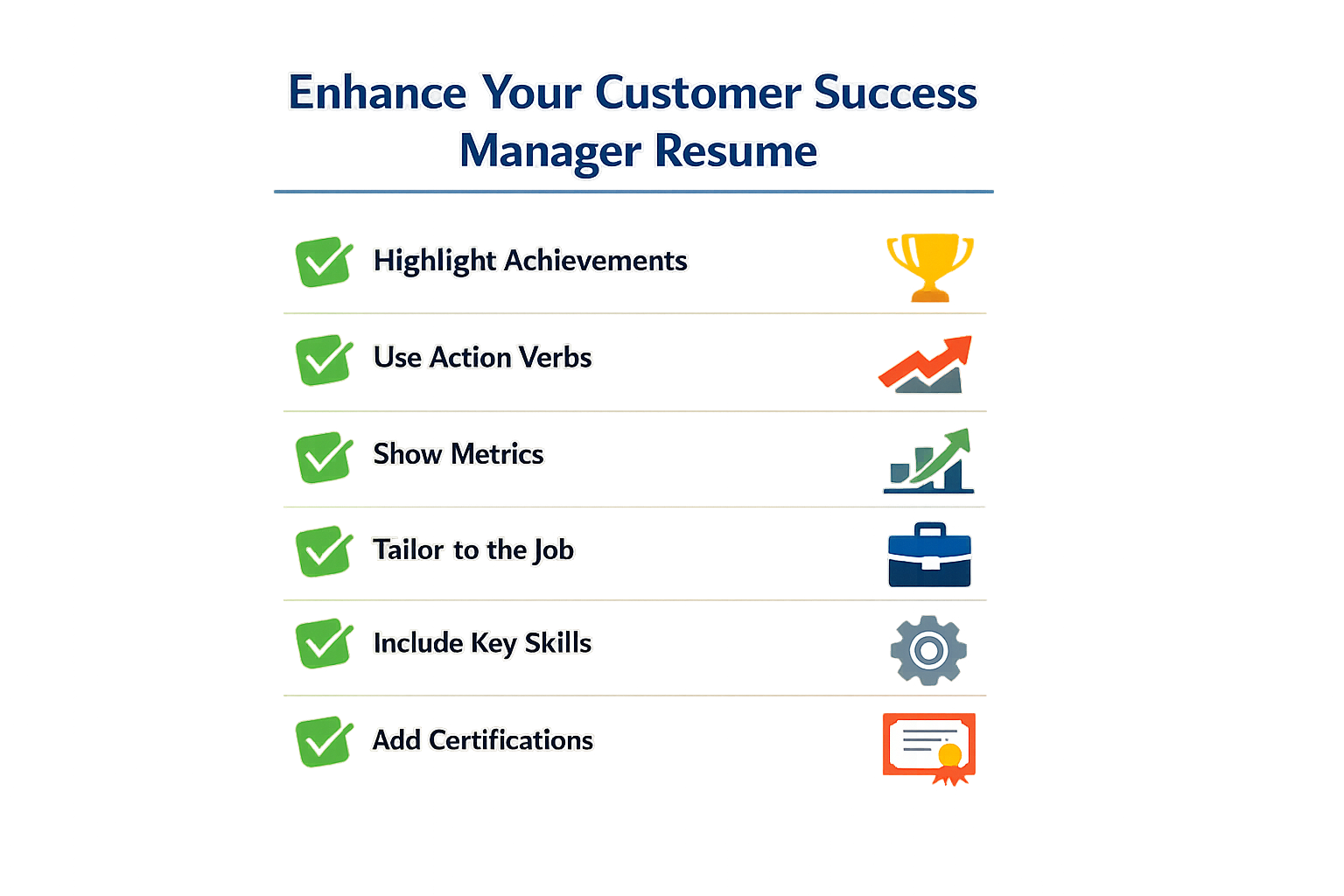
Crafting a standout customer success manager resume requires more than listing your job duties. The difference between a resume that lands interviews and one that gets overlooked often comes down to strategic presentation and smart optimization. These practical tips will help you transform a basic CSM resume template into a compelling career narrative that captures attention.
Lead with Metrics, Not Responsibilities
Recruiters reviewing customer success resumes want to see impact, not just effort. Instead of writing "Managed customer accounts and improved retention," quantify your achievements with specific numbers. Show customer retention rates you maintained or improved, revenue growth you influenced, or the size of the portfolio you managed. Concrete figures like "Increased customer retention by 18% over 12 months" or "Managed a book of business worth $2.3M annually" immediately demonstrate your value and give hiring managers a clear picture of your capabilities.
Weave Skills Into Your Experience
A common mistake is relegating all your technical proficiencies and soft skills to a dedicated skills section. While that section has its place, the most effective resumes integrate specific tools, platforms, and competencies directly into experience bullets. Rather than simply listing "Salesforce, Gainsight, Zendesk" in a skills box, demonstrate how you used them: "Leveraged Salesforce and Gainsight to track customer health scores and proactively identify at-risk accounts, reducing churn by 12%." This approach proves you didn't just use the tools—you drove results with them.
Customize Your CSM Resume Template for Each Application
No single version of your resume will be perfect for every customer success role. Take fifteen minutes before each application to review the job description and adjust your resume accordingly. If the posting emphasizes onboarding and implementation, move those experiences higher in your bullets. If they're looking for someone with SaaS expertise, make sure that context is clear. This targeted approach shows you understand what the company needs and helps your resume perform better when scanned by applicant tracking systems.
For more insights on optimizing your resume for automated screening, check out our guide on How ATS Reads Resumes: The Ultimate Guide to Surprising Success.
The best resumes don't just list what you did—they prove you understand what the hiring manager needs and show you've already delivered it.
Keep Formatting Clean and Scannable
Even the strongest content can be undermined by cluttered formatting. Use consistent heading styles, clear section breaks, and plenty of white space. Stick to standard fonts like Arial, Calibri, or Times New Roman in 10-12 point size. Avoid tables, text boxes, headers, and footers that can confuse ATS parsers. Your resume should be easy to skim in under 30 seconds—recruiters often spend less time than that on an initial review.
Proofread Ruthlessly
Typos and grammatical errors on a customer success manager resume send the wrong message about your attention to detail. Read your resume multiple times, use spell-check tools, and consider having a trusted colleague review it. Pay special attention to dates, job titles, and company names—small inconsistencies can raise red flags during background checks.
Who Should Choose What Resume Style?
Choosing the right resume format isn't about following trends—it's about presenting your career story in the way that best serves your goals. The three main resume styles each solve different problems, and understanding which one fits your situation can mean the difference between landing interviews and getting lost in the pile.
The Chronological Resume: For Steady Climbers
If you've built your customer success career through consistent progression—moving from support roles to CSM positions, or climbing from Associate CSM to Senior CSM—the chronological format is your strongest choice. This style lists your experience in reverse order, starting with your current or most recent role.
This format works because it tells a clear story. Hiring managers can see your growth trajectory at a glance, and ATS systems parse it easily because it follows the most common structure. Use this when your job titles show upward movement and your employment history doesn't have significant gaps.
The Functional Resume: For Career Changers
Transitioning into customer success from sales, account management, or technical support? The functional resume organizes your experience by skill category rather than job chronology. Instead of leading with job titles, you group achievements under headings like "Client Retention," "Product Adoption," or "Cross-Functional Collaboration."
This approach lets you highlight transferable skills that matter for CSM roles—relationship building, problem-solving, data analysis—even if those skills came from positions with different titles. The functional format works best when your previous job titles don't immediately signal customer success experience, but your actual responsibilities align perfectly with what CSM roles require.
The Combination Resume: For Complex Backgrounds
The combination (or hybrid) format merges both approaches: it leads with a skills summary organized by category, then follows with a condensed chronological work history. This style serves professionals who have both relevant experience and a compelling skills story to tell.
Use this format when you've held customer success roles but also want to emphasize specific competencies that set you apart—like SaaS platform expertise, enterprise account management, or renewal rate optimization. It's also effective if you have a few short-term contracts or consulting engagements mixed with traditional employment; the skills section anchors your expertise while the chronology provides context.
| Resume Style | Best For | Avoid If |
|---|---|---|
| Chronological | Steady career progression in CS roles | You have employment gaps or are changing industries |
| Functional | Career changers, skill-heavy backgrounds | You lack direct CS experience or have very short tenures |
| Combination | Experienced CSMs with specialized skills | You're entry-level or have a simple, linear career path |
Match Format to Job Description Signals
The job posting itself often hints at which format will resonate. If the description emphasizes years of experience and lists specific tools or platforms, chronological works well. If it focuses heavily on soft skills, strategic thinking, or cross-functional collaboration, functional or combination formats let you speak directly to those priorities.
For roles that mention ATS or applicant tracking systems explicitly, stick with chronological or combination—these parse most reliably. Purely functional resumes sometimes confuse older ATS platforms because they lack clear date ranges and employer names in prominent positions. If you need more guidance on how systems process different formats, check out our guide on how ATS reads resumes.
When in Doubt, Test Both
If you're genuinely torn between two formats, create both versions and use them strategically. Send the chronological version to roles where your job titles align perfectly. Use the functional or combination version for stretch opportunities where you're pivoting or stepping up a level. Track which version generates more responses over two weeks, then commit to the winner.
Your resume format isn't permanent. As your career evolves, so should your approach. The format that works when you're breaking into customer success may not be the same one you use five years later when you're pursuing director-level roles.
Final Checklist for Your Customer Success Manager Resume
Before you hit send on that application, walk through this final quality check. A polished customer success manager resume isn't just about what you include—it's about what you deliberately leave out and how you prioritize what stays.
Essential Elements on Page One
Your first page carries the heaviest weight. Make sure these components appear above the fold:
- Contact Information — Name, phone, email, LinkedIn URL, and city/state (no full address needed)
- Objective or Summary Statement — Two to three sentences connecting your CSM experience to the role
- Core Skills Section — Platform names, methodologies, and hard skills recruiters search for
- Tools and Certifications — List your CRM platforms, customer success software, and any relevant credentials
- Most Recent Work Experience — Your current or last role with quantified achievements
What to Remove Before Sending
Cutting the wrong details is just as important as adding the right ones. Remove these from your final draft:
- Support tickets handled — CSM roles focus on strategy, not ticket volume
- Feature requests logged — This signals a reactive support role rather than proactive success management
- Generic responsibilities — Phrases like "managed customer relationships" without outcomes
- Outdated tools — If you used a platform five years ago that's no longer industry-standard, drop it
If you're uncertain whether your resume passes ATS filters correctly, review how systems parse formatting and keywords before you apply.
Format and Structure Verification
Confirm your resume follows the reverse-chronological structure:
- Contact Information at the top
- Objective Statement summarizing your value
- Skills Section with platform names and methodologies
- Work Experience in reverse order with metrics
- Education with degrees and institutions
- Certifications relevant to customer success
Each work experience entry should start with a strong action verb and include at least one quantified result. If a bullet point doesn't show impact, rewrite it or remove it.
The best CSM resume template is the one that makes your metrics impossible to ignore and your irrelevant details invisible.
Final Quality Checks
Run through these last-minute verifications:
- Keyword density — Does your CSM resume template include the exact job title and required skills from the posting?
- Consistency — Are your date formats, bullet styles, and verb tenses uniform?
- White space — Can a recruiter scan your resume in under ten seconds and spot your top three achievements?
- File format — Save as a PDF unless the application explicitly requests a Word document
- File name — Use "FirstName_LastName_CSM_Resume.pdf" instead of "resume_final_v3.pdf"
Print your resume and read it on paper. Screen fatigue hides typos and formatting breaks that become obvious in hard copy.
Conclusion
Creating a standout customer success manager resume isn't about cramming every buzzword into a generic template—it's about crafting a document that speaks directly to the role you want and the value you bring. Throughout this guide, we've explored why generic resumes fail, how to structure your experience around measurable impact, and what it takes to pass ATS filters while still connecting with human readers.
The most effective CSM resume template is one you've tailored to reflect your unique journey: your customer retention wins, your ability to turn churn into loyalty, and your strategic approach to relationship management. Whether you're highlighting metrics like NPS improvements or showcasing cross-functional collaboration, every line should answer the hiring manager's core question: Can this person drive customer success outcomes?
After reviewing thousands of resumes in my recruiting career, I've seen firsthand that candidates who invest time in customization consistently outperform those who rely on one-size-fits-all formats. The difference isn't just in landing interviews—it's in the confidence you carry into those conversations.
Before you hit submit, revisit the final checklist: verify your contact information, ensure your metrics are specific and honest, and confirm your keywords align with the job description. Then take a moment to proofread with fresh eyes or ask a trusted colleague to review it. Small details—like consistent formatting and error-free language—signal professionalism and attention to the customer experience mindset that defines great CSMs.
If you're exploring other career paths or want to refine your overall job search strategy, check out our Account Manager Resume Template: The Ultimate Stress-Free Guide for complementary insights on relationship-driven roles.
Your resume is more than a document—it's your first customer success story. Make it count, make it yours, and approach your job search with the same strategic thinking you'd bring to any high-value customer relationship. You've got this.
Related reading
Accountant Resume: The Ultimate Guide to Stress-Free Success

Written by
Emily Johnson
Published September 3, 2026 · 22 min read
Emily Johnson is a seasoned career strategist with over a decade of experience in recruitment and talent acquisition. With a background in human resources, she excels at helping professionals refine their job search strategies, from crafting compelling resumes to mastering interview techniques. As an expert in Applicant Tracking Systems (ATS), Emily is dedicated to guiding individuals toward their dream careers.
Want this kind of read on your résumé?
We'll tell you what's actually working, what's holding you back, and what to fix — in plain English.
Get My Job Match ScoreYou Might Also Like
More articles to help you advance your career

ATS Meaning Resume: Understanding ATS and What Applicant Tracking
Learn what ATS meaning resume entails and how Applicant Tracking Systems work in 2026 to streamline your hiring process and recruitment workflows.

Honest Résumé Score Example: What It Looks Like and How to Improve
Learn what an honest résumé score looks like with this real walkthrough. See actual examples and discover how to improve your résumé evaluation results with an honest

Why a Generic Cybersecurity Resume Won't Work and What Will
Discover why a generic cybersecurity resume won't cut it and learn how to tailor your application for success in the tech industry.

Free ATS Resume Checker: What's Useful and What's Not
Discover what Free ATS Resume Checker tools can and can't do. Learn which features actually help optimize your resume for applicant tracking systems.