


7 RN Resume Template Tips: The Ultimate Guide to Stress-Free Success
Discover why generic RN resume template options fail and learn practical alternatives to create a standout registered nurse resume that works.
 Emily Johnson
Introduction
You've probably downloaded a registered nurse resume template, filled in your information, and wondered why you're not getting callbacks. The truth is, generic templates create generic results—and in a competitive nursing job market, generic doesn't cut it.
After reviewing thousands of nursing resumes as a recruiter, I've seen the same pattern: candidates with strong clinical backgrounds get overlooked because their resumes look identical to everyone else's. The issue isn't your qualifications—it's how you're presenting them. A template designed for "any nurse" can't possibly highlight what makes you the right fit for a specific ICU, pediatric, or med-surg position.
This guide breaks down why the standard RN resume template approach fails and what actually works. You'll learn how to create a resume that passes Applicant Tracking Systems, showcases your specialty expertise, and gets you interviews. We'll cover the differences between generic and role-specific resumes, examine real examples that work, and give you practical strategies to avoid the most common mistakes that cost nurses opportunities.
Understanding Generic Resumes
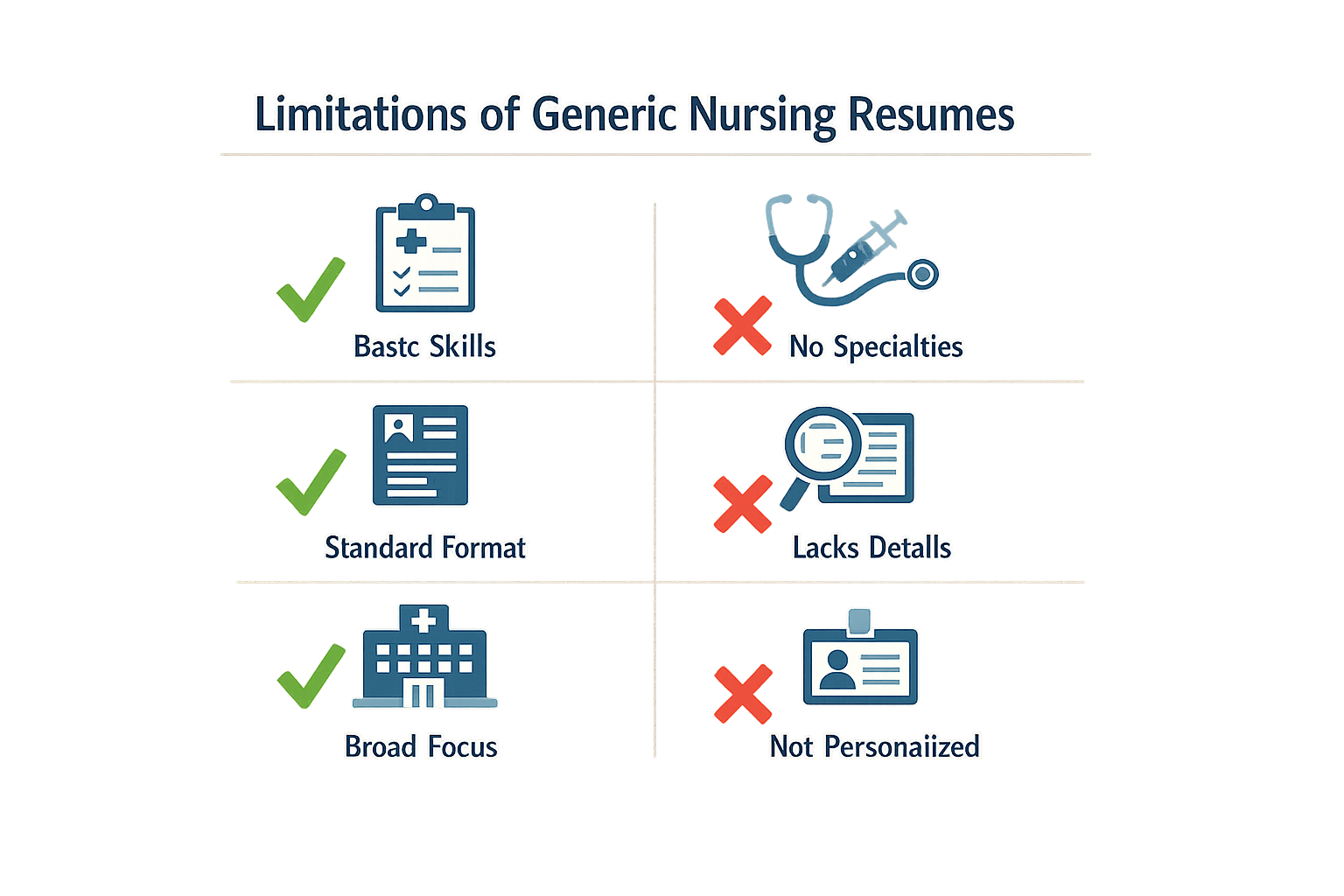
A generic resume template is a one-size-fits-all document designed to work across industries and roles. These templates typically feature broad sections like "Work Experience," "Education," and "Skills" without any customization for the specific demands of nursing positions. While they might seem convenient, they fail to address the unique requirements that hospital hiring systems and nurse recruiters expect.
The fundamental problem with generic templates is that they treat all professional experience as interchangeable. For registered nurses, this approach ignores critical elements like active licensure visibility, unit-specific keywords, and quantifiable patient care metrics that hiring managers actively seek. A template built for corporate roles simply doesn't speak the language of clinical environments.
Why Generic Templates Fall Short for Nurses
Hospital applicant tracking systems are built around clinical terminology and unit-type keywords. When you submit a generic resume, it lacks the specialized vocabulary that these systems scan for during initial screening. Terms like "patient ratios," "EMR proficiency," or specific unit designations (ICU, ER, Med-Surg) are often missing entirely from standard templates.
Beyond ATS compatibility, generic resumes fail to demonstrate the specificity that separates strong nursing candidates from weak ones. Hiring managers need to see concrete evidence of your clinical impact—patient outcomes you've improved, procedures you've mastered, or efficiency gains you've driven. A template that encourages vague bullet points like "provided patient care" won't differentiate you in a competitive applicant pool.
The Cost of Using Generic Formats
When your resume doesn't align with what recruiters expect to see, it creates friction in the review process. Hiring managers spend seconds scanning each document, looking for familiar patterns and key information in predictable locations. A generic layout forces them to hunt for your credentials, which often results in your application being passed over entirely.
The lack of role-specific structure also signals to employers that you haven't invested time in understanding what nursing positions require. In a field where attention to detail and protocol adherence are non-negotiable, a generic resume inadvertently suggests a lack of professional rigor. While other professions might tolerate broad-stroke applications, healthcare hiring operates under stricter standards.
A nursing resume is a specialized clinical document that must satisfy hospital ATS systems built around unit-type keywords and display active licensure visibly.
For nurses exploring different resume approaches, understanding how ATS reads resumes can clarify why specialized formatting matters so much in healthcare applications. The technical requirements of these systems aren't arbitrary—they reflect how hospitals organize and prioritize candidate information at scale.
The Importance of Role-Specific Resumes
A role-specific resume for registered nurses isn't just a nice-to-have—it's the difference between landing an interview and disappearing into the void. When hiring managers review dozens of applications for a single nursing position, they're looking for candidates who understand the exact demands of the role. A generic RN resume template simply can't communicate that level of precision.
Why Nursing Roles Demand Specialized Resumes
Every nursing specialty comes with its own clinical competencies, patient populations, and care protocols. An ICU nurse manages ventilators and titrates vasopressors; a pediatric nurse calms anxious families and administers weight-based medications. These aren't interchangeable skill sets, and your resume needs to reflect that specificity from the first line.
Nurse managers reviewing applications spend very little time on each resume, so it needs to communicate qualifications quickly. If your resume opens with vague statements about "providing quality patient care," you've already lost precious seconds. A role-specific resume leads with the certifications, clinical outcomes, and specialized skills that match the job description exactly.
Tailoring Shows Professional Judgment
When you customize your resume for a specific nursing role, you're demonstrating the same critical thinking skills you use at the bedside. You're assessing what matters most, prioritizing information, and communicating clearly under constraints. Hiring managers notice this. A tailored resume signals that you understand the position and have already begun thinking about how you'd contribute.
For example, if you're applying to a cardiac telemetry unit, your resume should emphasize your experience with cardiac monitoring, arrhythmia recognition, and post-cardiac surgery care. If you're targeting a community health role, shift the focus to patient education, care coordination, and population health outcomes. The core facts don't change—but the emphasis does, and that emphasis matters enormously.
If you're looking for guidance on how other healthcare professionals approach resume customization, check out our Recruiter Resume Template: The Ultimate Guide to Best Results for insights on tailoring documents to specific roles.
The Competitive Advantage of Specificity
In competitive nursing markets, role-specific resumes create separation. When ten candidates have similar experience levels, the one who took time to align their resume with the job posting stands out. This isn't about fabricating qualifications—it's about strategic presentation of the experience you already have.
A nursing resume in 2026 should highlight clinical competencies, patient care outcomes, and relevant certifications clearly and quickly. Generic templates can't do this effectively because they're built for breadth, not depth. Your resume needs to tell a focused story about why you're the right nurse for this particular role, not just any nursing job.
Nursing Resume ATS Considerations
Applicant Tracking Systems (ATS) act as the first gatekeeper between your RN resume template and a human recruiter. These software platforms scan, parse, and rank resumes based on keyword matching, formatting structure, and credential visibility. For registered nurses, understanding how ATS reads your resume isn't optional—it's the difference between landing an interview and disappearing into a digital black hole.
Most hospital systems and healthcare networks use ATS to manage high volumes of nursing applications. The software looks for specific markers: active RN license numbers, certifications like BLS and ACLS, clinical competencies, and role-specific keywords. If your resume buries these credentials in dense paragraphs or uses unconventional formatting, the system may fail to recognize them, even if you're perfectly qualified.
Why License and Certification Placement Matters
An active RN license number with BLS and ACLS up front clears the applicant tracking system fastest. Position these credentials prominently in a dedicated section near the top of your resume, not buried in a summary paragraph or footer. The ATS scans for structured data—license numbers, certification acronyms, and expiration dates—so clarity beats creativity here.
New grad RN resume needs to prove clinical rotation hours, acuity exposure, and BLS readiness for the unit. For new graduates, the ATS prioritizes clinical rotation details over unrelated work history. List each rotation by specialty (Med-Surg, ICU, Pediatrics), the facility name, and the number of hours completed. This structured approach helps the system match your experience to the job description's requirements.
Keyword Strategy for Nursing Roles
ATS algorithms rank resumes based on how closely they match the job posting's language. If the posting mentions "wound care," "IV insertion," or "electronic health records," those exact phrases should appear in your resume where truthful. Generic terms like "patient care" or "clinical duties" carry less weight than specific competencies.
Review the job description and identify 8-10 core skills or qualifications. Mirror that language in your experience bullets and skills section, but never fabricate credentials. If you have experience with Epic or Cerner, name the system. If you've managed post-op recovery or administered chemotherapy, use those precise terms.
Formatting Pitfalls That Confuse ATS
Many ATS platforms struggle with tables, text boxes, headers, footers, and graphics. A beautifully designed resume with columns and icons may render as gibberish to the parser. Stick to a single-column layout with standard section headings: Professional Experience, Education, Licenses & Certifications, Skills.
Avoid using images, logos, or creative fonts. Use standard headings and bullet points. Save your resume as a .docx or PDF (check the application instructions—some systems prefer one over the other). The goal is machine readability first, visual appeal second.
For a deeper look at how these systems process your application, see our guide on How ATS Reads Resumes: The Ultimate Guide to Surprising Success.
Nurse Resume Examples
Seeing concrete examples transforms abstract advice into actionable strategy. A well-crafted professional summary anchors your resume by immediately communicating your value proposition. The examples below illustrate how different experience levels and specializations can position themselves effectively—without resorting to generic language.
Entry-Level RN Resume Summary
New graduates often struggle to balance limited work experience with substantial clinical training. A strong entry-level summary highlights academic credentials and clinical rotation hours to demonstrate readiness.
For instance, an entry-level RN summary could state: "Registered Nurse with a BSN from the University of Michigan and 720+ clinical rotation hours across medical-surgical, pediatric, and emergency department settings." This approach positions clinical rotations as legitimate experience while establishing educational credibility.
Critical Care and Specialized RN Examples
Experienced nurses in specialized units benefit from emphasizing both years of service and technical competencies specific to their environment. A critical care summary might read: "Critical Care Registered Nurse (CCRN) with 6 years of experience in a 24-bed Cardiac ICU managing post-CABG patients."
For broader ICU experience, consider this structure: "Registered Nurse (BSN) with 5 years of ICU nursing experience in a 450-bed tertiary care hospital. Proficient in mechanical ventilator management, hemodynamic monitoring, and vasopressor titration." Notice how each example pairs credentials with environment-specific skills rather than generic nursing duties.
Tailoring Examples to Your Specialty
The most effective summaries mirror the language used in your target job description while maintaining authenticity. If you're applying to pediatric roles, emphasize family-centered care and developmental assessments. For emergency department positions, highlight triage expertise and rapid response protocols.
When reviewing how ATS reads resumes, you'll notice that keyword alignment matters—but only when those keywords genuinely reflect your experience. Forcing irrelevant specialties into your summary weakens rather than strengthens your candidacy.
Your professional summary should answer one question: Why are you the right nurse for this specific role?
Adapt these examples by replacing specific details with your own credentials, clinical settings, and technical skills. The structure remains consistent: credential + quantified experience + specialty-specific competencies.
Direct Comparison of Resume Types
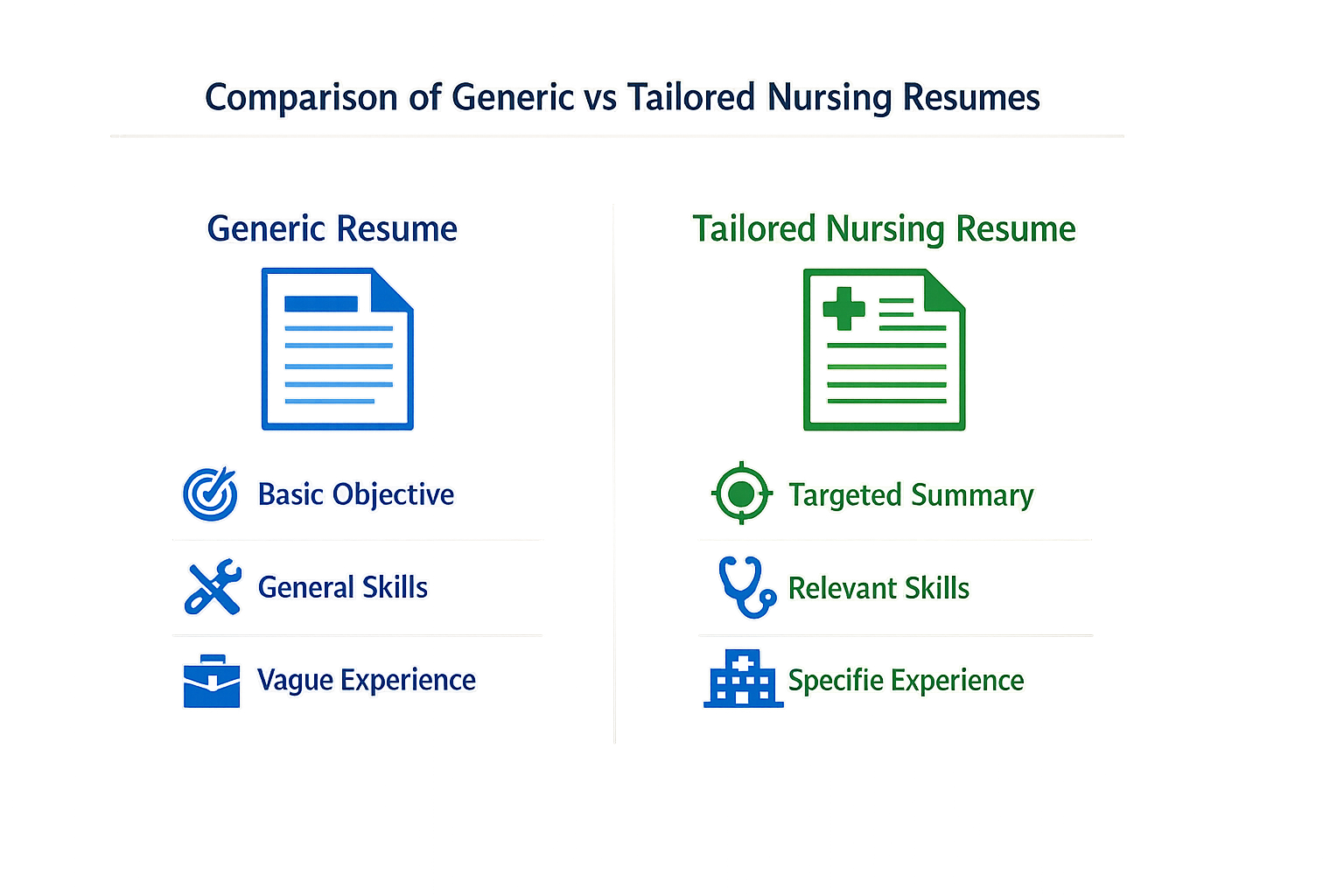
When you're deciding between a generic RN resume template and a tailored approach, the differences show up fastest in the interview callback rate. A generic template treats every nursing role the same way—med-surg, ICU, and pediatrics all get identical formatting and the same vague bullet points. A tailored resume speaks directly to the hiring manager's pain points by matching the posted role's requirements line by line.
What Generic Templates Miss
Generic templates skip the details that prove you can handle the unit's workload. They list "provided patient care" without specifying ratios, acuity levels, or the equipment you managed. Hiring managers in specialty units need to see BLS/ACLS dates, your state license number, and certifications that align with their posted opening. When those elements are buried or missing, your application looks like every other template download.
| Feature | Generic Template | Tailored Resume |
|---|---|---|
| Credentials block | Often absent or at bottom | Prominently placed above experience with license state and cert dates |
| Patient ratios | Rarely mentioned | Attached to every clinical role |
| Specialty alignment | One-size-fits-all language | Keywords and certifications matched to job posting |
| ATS compatibility | Hit-or-miss keyword density | Optimized with role-specific terms from job description |
| Hiring manager impact | Looks like 50 other applications | Demonstrates you understand the unit's needs |
The Three Elements That Matter Most
The RN resumes that get scheduled for interviews share three things: a credentials block above experience with license state and BLS/ACLS dates, patient ratios attached to every unit, and a specialty cert tied to the posted opening. Generic templates rarely prompt you to include these details because they're designed for maximum reusability, not maximum relevance.
Tailoring takes fifteen extra minutes per application, but it's the difference between a recruiter seeing "another ICU nurse" and seeing "the ICU nurse who can handle our 1:2 ratio with CRRT and swan-ganz experience." If you're applying to roles that require specific competencies—like understanding how ATS systems parse nursing credentials—the tailored approach ensures your qualifications land in the right keyword buckets.
Recommendations for Nurses
Choosing the right resume approach depends entirely on where you are in your nursing career and what you're trying to accomplish. A new graduate applying for their first hospital position needs a different strategy than an experienced ICU nurse pursuing a travel contract or a clinical educator transitioning into leadership. The key is matching your resume structure to your specific goals rather than forcing your experience into a one-size-fits-all template.
For New Graduates and Career Changers
If you're entering nursing for the first time or switching from another healthcare role, focus on education, clinical rotations, and transferable skills. Lead with your nursing degree, certifications, and any relevant clinical experience from school. Highlight skills gained during rotations that align with the job description—patient assessment, medication administration, care planning, and collaboration with interdisciplinary teams. Generic templates often bury this information under irrelevant work history; instead, create a targeted resume that positions your training as your strongest asset.
For Experienced Nurses Seeking Advancement
Nurses with several years of experience should prioritize measurable achievements and specialized competencies. Instead of listing duties, demonstrate impact: reduced patient fall rates, improved satisfaction scores, mentored new staff, or led quality improvement initiatives. If you're targeting a specialty role—such as oncology, pediatrics, or critical care—customize your resume to emphasize relevant certifications, continuing education, and direct patient care in that area. With the U.S. Bureau of Labor Statistics projecting approximately 189,100 registered nurse job openings per year through 2034, competition for specialized positions remains strong, making differentiation essential.
Your resume should tell the story of progression, not just employment—show how each role built the expertise the hiring manager needs.
For Travel Nurses and Contract Positions
Travel nursing recruiters move quickly and need to verify your flexibility, certifications, and adaptability across settings. Your resume should clearly list all active licenses by state, specialty certifications, and a chronological work history that demonstrates your ability to onboard rapidly in diverse environments. Include contract lengths and facility types to show breadth of experience. Avoid vague job descriptions; instead, specify unit types, patient populations, and any rapid-response or float pool experience that proves versatility.
For Nurses Transitioning to Non-Clinical Roles
If you're moving into case management, informatics, education, or administration, your resume must bridge clinical expertise with the new role's requirements. Emphasize leadership, project management, data analysis, or teaching experience gained during your clinical career. Reframe bedside skills in terms that resonate with the target role—critical thinking becomes strategic problem-solving, patient education becomes training and development, and care coordination becomes cross-functional collaboration. For more guidance on tailoring resumes for career transitions, see our Recruiter Resume Template: The Ultimate Guide to Best Results.
When to Use a Functional or Hybrid Format
Most nursing positions benefit from a reverse-chronological resume that clearly shows your career trajectory. However, if you have significant employment gaps, are returning to nursing after time away, or have a varied background that doesn't follow a linear path, a hybrid format can help. Lead with a strong skills summary that highlights clinical competencies, then follow with a streamlined work history. Avoid purely functional resumes—most hiring managers and ATS systems struggle with them, and they can raise red flags about what you're trying to hide.
Tips for Writing a Successful Nurse Resume
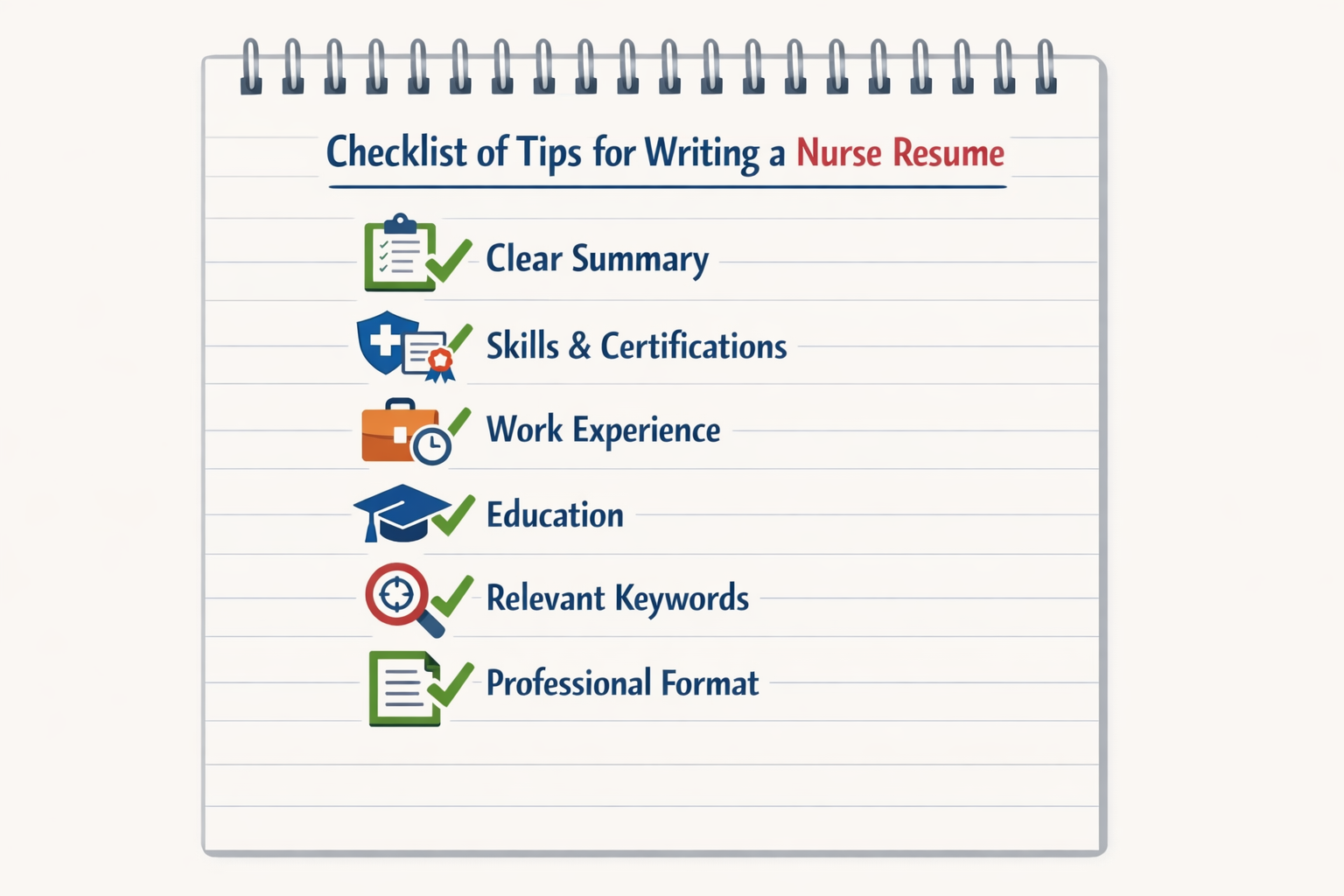
Writing a strong registered nurse resume requires balancing clinical expertise with smart formatting. The best RN resume template choices share common traits: they're scannable by both humans and machines, they highlight measurable patient outcomes, and they speak directly to the role you want.
Start with ATS-Friendly Formatting
Hospitals and health systems rely on applicant tracking systems to filter hundreds of applications. Your resume format must be parseable by these systems or it won't reach a hiring manager's desk. Use clean section headings like "Clinical Experience," "Certifications," and "Skills." Avoid tables, text boxes, headers, and footers—these confuse ATS parsers and can cause your qualifications to disappear.
Balance Clinical Skills with Patient Outcomes
Your resume should demonstrate both what you can do and what you've achieved. List certifications like BLS, ACLS, or specialty credentials prominently, but pair them with concrete examples. Instead of "Provided patient care," write "Managed care for 6-patient assignment in medical-surgical unit, reducing fall incidents by implementing hourly rounding protocols."
Measurable outcomes matter. Did you improve patient satisfaction scores? Reduce medication errors? Train new staff? Quantify your impact wherever possible—it's what separates a generic resume from one that gets interviews.
Tailor Every Application
No single resume works for every nursing role. A critical care position demands different emphasis than a school nurse or case management job. Read each posting carefully and mirror the language used. If the job description mentions "triage," "EMR documentation," or "patient education," those exact phrases should appear in your resume if you have that experience.
Many nurses find that understanding how ATS reads resumes helps them customize more effectively. The system looks for keyword matches—give it what it's searching for.
Lead with Your Strongest Credential
If you're a new graduate, your education section should sit near the top. If you have years of ICU experience, lead with your clinical work. Your resume's opening should immediately answer the question: "Why should we interview this person for this role?"
Step 1
Review the job posting
Highlight required skills, certifications, and keywords. Note any specialized patient populations or technologies mentioned.
Step 2
Audit your current resume
Identify where your experience aligns with the posting. Add missing keywords if you genuinely have that experience.
Step 3
Reorder and emphasize
Move the most relevant experience and skills toward the top of each section. Cut or condense anything unrelated to the target role.
Keep It Concise and Scannable
Hiring managers spend seconds on an initial resume scan. Use bullet points, not paragraphs. Limit your resume to one page if you have less than ten years of experience; two pages maximum for seasoned nurses. Every line should justify its presence—if it doesn't support your candidacy for the specific role, remove it.
Short, punchy bullets work best: start with strong action verbs ("Coordinated," "Administered," "Monitored") and include the outcome when possible.
Proofread Ruthlessly
A single typo can cost you an interview. Clinical roles demand precision—your resume should reflect that standard. Read it aloud, use spell-check, and ask a colleague to review it. Pay special attention to dates, certifications, and contact information.
Common Mistakes to Avoid
Even experienced registered nurses make critical errors that send their resumes straight to the rejection pile. After reviewing thousands of nursing applications, I've seen patterns emerge—small oversights that cost qualified candidates interviews they deserved. Understanding these pitfalls helps you build a resume that survives both automated screening and human review.
Burying Your License Information
One of the fastest ways to trigger an automatic rejection is failing to display your RN license prominently. Many applicants list licensure deep in a credentials section or omit the license number entirely, assuming the recruiter will ask later. ATS systems don't make assumptions—they scan for explicit license information in predictable locations. Place your license type, number, and state in your contact header or immediately below your name. Systems programmed to auto-reject missing licensure won't give you a second chance.
Using Vague Workload Descriptions
Generic statements like "provided patient care" or "managed multiple patients" tell hiring managers nothing about your actual capacity. Concrete numbers matter. Instead of saying you worked on a busy unit, specify that you handled 4 to 5 patients on a 36-bed medical-surgical floor. These details help recruiters picture your workload immediately and assess whether your experience matches their staffing model. Vague descriptions suggest you either lack meaningful experience or didn't pay attention to the operational realities of your role.
Ignoring Specialty-Specific Keywords
Many nurses create one master resume and send it everywhere, missing the opportunity to align their language with each role. If you're applying to a cardiac unit, your resume should reflect cardiac-specific terminology, certifications, and procedures. A pediatric position demands different keywords than an ICU role. How ATS Reads Resumes: The Ultimate Guide to Surprising Success explains why keyword alignment directly impacts whether your application reaches human eyes. Generic language signals a lack of specialization, even when you possess the exact skills the employer needs.
Overlooking Formatting Consistency
Inconsistent date formats, mixed bullet styles, and irregular spacing create visual chaos that undermines your professionalism. Use the same date format throughout (either "Jan 2020 – Dec 2022" or "01/2020 – 12/2022"), maintain uniform bullet points, and apply consistent spacing between sections. These details seem minor, but they signal attention to detail—a non-negotiable trait in nursing. Recruiters notice sloppy formatting immediately, and it raises questions about your clinical documentation habits.
Failing to Quantify Clinical Achievements
Listing responsibilities without outcomes makes your resume forgettable. Instead of "administered medications," write "administered medications to 5–6 patients per shift with zero medication errors over 18 months." Quantified achievements demonstrate competence and reliability. They also give hiring managers concrete evidence of your impact, making it easier to justify moving you forward in the selection process.
Conclusion
The difference between a generic RN resume template and a tailored, role-specific document isn't subtle—it's the difference between landing interviews and wondering why your applications disappear into the void. Throughout this guide, we've explored why cookie-cutter templates fail to capture the nuanced skills and experiences that make registered nurses valuable, and why hiring managers and ATS systems alike demand more specificity.
A standout registered nurse resume doesn't just list duties; it quantifies patient outcomes, highlights specialty certifications, and demonstrates measurable impact in your specific clinical setting. Whether you're applying for critical care, pediatrics, or community health, your resume must speak the language of that specialty with concrete examples and relevant keywords. With approximately 189,100 registered nurse job openings projected annually through 2034, the competition is real—but so is the opportunity for nurses who present themselves strategically.
The most successful nurse resumes share common traits: they're ATS-optimized without sacrificing readability, they showcase achievements with numbers and context, and they avoid the fatal flaws of vague language and irrelevant filler. After years of reviewing thousands of nursing applications, I've seen firsthand how a well-crafted, tailored resume opens doors that generic templates simply can't unlock.
Your next step is clear: audit your current resume against the principles in this guide, eliminate generic language, and rebuild each section with your specific clinical expertise front and center. If you're exploring other healthcare or professional roles, our Account Manager Resume Template: The Ultimate Stress-Free Guide offers similar strategic insights for tailoring your application materials to competitive fields.
The nursing profession rewards those who combine clinical excellence with clear communication. Your resume is your first chance to demonstrate both. Make it count.
Related reading
10 Essential UX Designer Resume Templates: The Ultimate Guide to Success
LPN Resume: The Ultimate Guide to Stress-Free Applications
Administrative Assistant Resume: The Ultimate Stress-Free Guide
Accountant Resume: The Ultimate Guide to Stress-Free Success

Written by
Emily Johnson
Published September 4, 2026 · 19 min read
Emily Johnson is a seasoned career strategist with over a decade of experience in recruitment and talent acquisition. With a background in human resources, she excels at helping professionals refine their job search strategies, from crafting compelling resumes to mastering interview techniques. As an expert in Applicant Tracking Systems (ATS), Emily is dedicated to guiding individuals toward their dream careers.
Want this kind of read on your résumé?
We'll tell you what's actually working, what's holding you back, and what to fix — in plain English.
Get My Job Match ScoreYou Might Also Like
More articles to help you advance your career

ATS Meaning Resume: Understanding ATS and What Applicant Tracking
Learn what ATS meaning resume entails and how Applicant Tracking Systems work in 2026 to streamline your hiring process and recruitment workflows.

Honest Résumé Score Example: What It Looks Like and How to Improve
Learn what an honest résumé score looks like with this real walkthrough. See actual examples and discover how to improve your résumé evaluation results with an honest

Why a Generic Cybersecurity Resume Won't Work and What Will
Discover why a generic cybersecurity resume won't cut it and learn how to tailor your application for success in the tech industry.

Free ATS Resume Checker: What's Useful and What's Not
Discover what Free ATS Resume Checker tools can and can't do. Learn which features actually help optimize your resume for applicant tracking systems.