



Social Worker Resume Template: The Ultimate Stress-Free Guide
Discover the best social worker resume template strategies and learn what actually works for your job applications in today's competitive market.
 Emily Johnson
Introduction
You've probably downloaded a dozen resume templates, tweaked the fonts, swapped in your job titles, and hit submit on application after application. Yet the callbacks aren't coming. Here's the uncomfortable truth: that polished generic template you're using is actually working against you.
Social work is a field where specificity matters. The difference between "provided client support" and "conducted biopsychosocial assessments for 45+ clients monthly, achieving 87% treatment plan adherence" isn't just stylistic—it's the difference between your resume landing in the interview pile or the rejection folder. Generic templates don't account for the specialized terminology, credentialing requirements, or outcome-focused language that social work hiring managers actively scan for.
After reviewing thousands of resumes as a recruiter, I've seen how even experienced social workers sabotage their applications by relying on one-size-fits-all formats. The templates that promise to work for "any profession" inevitably strip out the context that makes your social work experience compelling. They encourage vague descriptions when you need concrete examples, and they waste prime real estate on irrelevant sections while burying the credentials that matter most.
The good news? Once you understand why generic approaches fail and what actually works for social worker resume optimization, the path forward becomes remarkably clear. This guide will show you exactly what separates resumes that get interviews from those that get ignored—and how to build a resume that positions you as the candidate hiring managers can't afford to pass up.
The strategies ahead aren't theoretical. They're based on what actually moves resumes through applicant tracking systems and onto the desks of decision-makers in social services organizations. Whether you're applying for clinical positions, case management roles, or community outreach work, the principles remain consistent: specificity wins, metrics matter, and tailoring beats templating every single time.
The Problem with Generic Social Worker Resumes
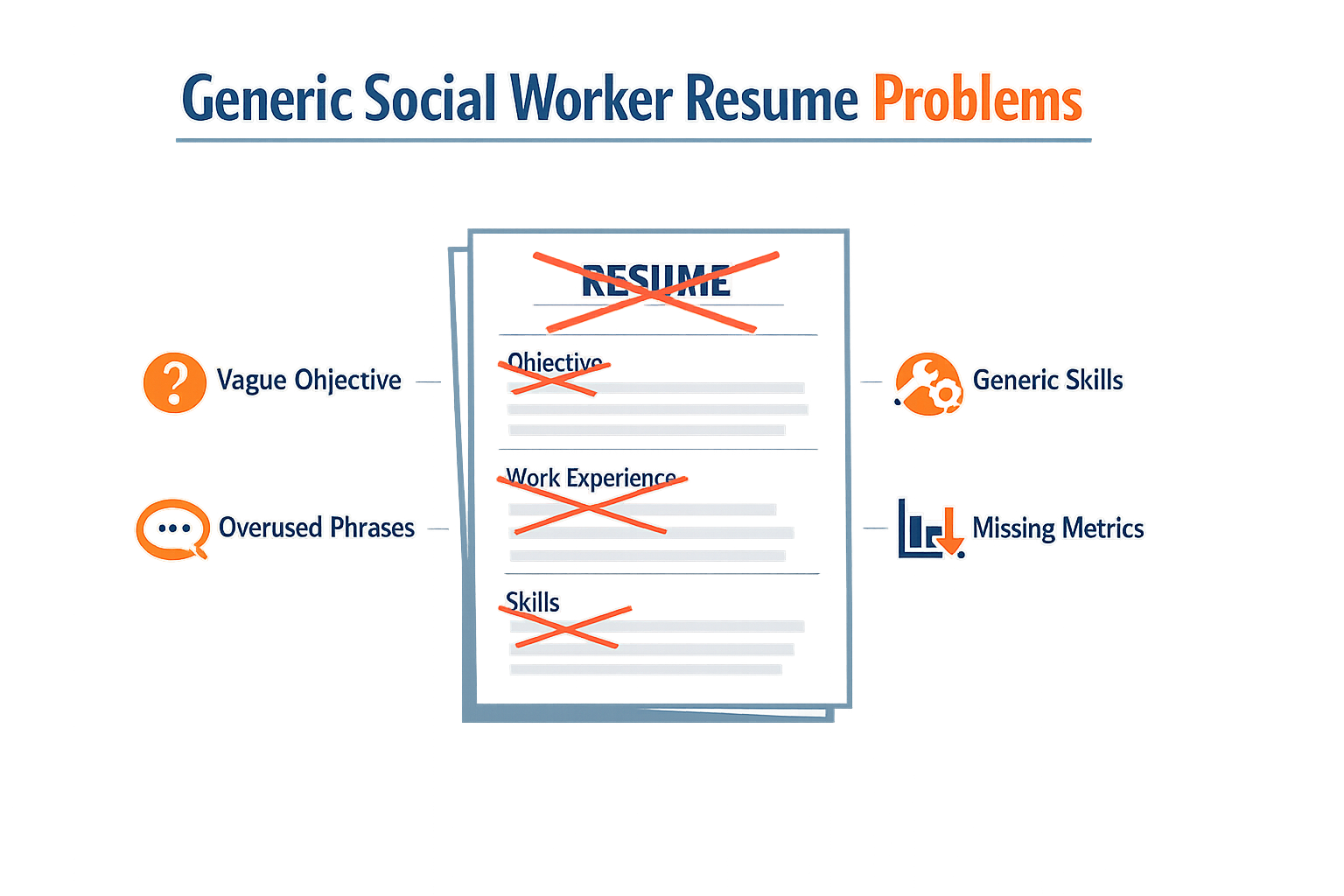
Generic resume templates promise convenience, but they consistently fail social workers in today's hiring landscape. The one-size-fits-all approach ignores the specialized nature of social work roles and the technical screening systems that evaluate your application before any human sees it.
Most social worker resumes never reach a hiring manager's desk. Applicant tracking systems filter out candidates who lack specific licenses, keywords, and clinical competencies that match the job description. A generic template can't anticipate these role-specific requirements, leaving your application buried in the rejection pile regardless of your actual qualifications.
Why Generic Templates Miss the Mark
Social work spans vastly different specializations — child welfare, healthcare, mental health, school-based services, and community outreach each demand distinct skill sets and credentials. A template designed for general use can't highlight the nuances that matter for your specific field. When your resume looks identical to hundreds of others, it signals to reviewers that you haven't invested effort in understanding what the role requires.
The language you use matters more than you might expect. Generic phrases like "excellent communication skills" or "team player" appear on virtually every resume and carry no weight. Social work positions require precise terminology that demonstrates your clinical knowledge and methodological training.
The Hidden Cost of Template Thinking
When you rely on a generic social worker resume template, you're competing with every other candidate who downloaded the same format. Hiring managers review dozens of applications daily — visual sameness creates mental fatigue and makes your accomplishments blend into the background. The template structure may also force you to emphasize sections that don't showcase your strongest qualifications while burying the credentials that would set you apart.
Credentialing requirements vary dramatically across social work positions. A school social worker needs different certifications than a clinical social worker in private practice, yet generic templates treat all credentials equally. This flattening effect prevents you from strategically positioning your most relevant qualifications where reviewers look first. For more insights on how modern screening systems evaluate applications, see How ATS Reads Resumes: The Ultimate Guide to Surprising Success.
Your resume isn't just a document — it's a strategic argument for why you're the right fit for this specific role.
The most damaging aspect of generic templates is what they prevent you from doing: telling your professional story in a way that aligns with the employer's needs. Social work hiring managers want to see evidence of your impact, your approach to case management, and your ability to navigate complex systems. Templates encourage you to list responsibilities instead of demonstrating outcomes, leaving reviewers to guess whether you can deliver results in their environment.
Why Tailored Resumes Matter for Social Workers

Every social work position carries its own unique demands. A school social worker deals with entirely different challenges than a medical social worker in a hospital setting. When you submit the same resume to both positions, you're essentially telling each hiring manager that you haven't taken the time to understand what makes their role distinct.
Tailoring your resume isn't about rewriting everything from scratch each time. It's about strategically emphasizing the experience, skills, and achievements that align with each specific role. The hiring manager reviewing applications for a child welfare position needs to see your crisis intervention experience front and center, while the nonprofit director wants evidence of your grant writing and community outreach work.
The Real-World Impact of Customization
A tailored resume speaks directly to the job description in front of you. When a posting emphasizes trauma-informed care, your resume should highlight your training and practical application of those techniques. When the role requires bilingual services, your language skills shouldn't be buried at the bottom under "Additional Information."
Start with a compelling professional summary that highlights your most relevant experience, key skills, and career achievements specific to the role you're targeting. This opening section sets the tone for everything that follows and gives the hiring manager an immediate reason to keep reading.
Matching Language to Opportunity
Different social work settings use different terminology. Clinical social workers use diagnostic language and treatment modalities. Community organizers talk about stakeholder engagement and coalition building. School social workers reference IEPs and behavioral intervention plans.
When you mirror the language used in the job posting, you accomplish two things simultaneously. First, you demonstrate familiarity with that particular practice area. Second, you increase the likelihood that your resume will score well in applicant tracking systems that scan for keyword matches. For more insights on how these systems evaluate your application, explore our guide on how ATS reads resumes.
Highlighting Transferable Skills Strategically
Your entire work history matters, but not every detail deserves equal weight in every application. If you're moving from direct practice to program administration, your supervision experience and budget management become primary selling points. If you're transitioning from a hospital to a school setting, your ability to work with families and coordinate with multidisciplinary teams takes priority.
The education section remains consistent, but even your licensure can be presented differently. An LCSW applying for a clinical role should emphasize clinical hours and specialized training. The same credential presented for a policy position might highlight advocacy work and legislative testimony instead.
Tailoring takes time, but it's time invested in making your strongest possible first impression. Generic applications get generic results—often rejection. Customized resumes that speak directly to the hiring manager's needs get interviews.
Understanding the Social Worker ATS
Applicant Tracking Systems aren't just gatekeepers—they're the reason most social worker resumes never reach human eyes. These software platforms scan incoming applications for specific markers before a hiring manager ever sees your qualifications. For social workers, this creates a unique challenge: the nuances that make you effective in the field don't always translate into the keywords these systems prioritize.
How ATS Filters Social Work Applications
Most social worker resumes are filtered out by applicant tracking systems due to the lack of specific licenses, keywords, and clinical competencies. The software doesn't understand context or read between the lines. When a job posting asks for an LCSW, the system searches for exactly that—both the acronym and often the full phrase "Licensed Clinical Social Worker." Miss either variation, and your application may be automatically rejected regardless of your actual credentials.
The filtering happens in layers. First, the ATS scans for must-have qualifications like licensure and certifications. Then it looks for role-specific competencies—crisis intervention, case management, clinical assessment. Finally, it may score your resume based on keyword density and relevance. Each layer eliminates candidates, often before any subjective evaluation occurs.
The Keyword Strategy That Actually Works
To optimize a social worker resume for ATS, include both the full title and the acronym, and mention specific assessment tools by name. This means writing "Licensed Clinical Social Worker (LCSW)" rather than choosing one format. When you've used the Beck Depression Inventory or conducted biopsychosocial assessments, name them explicitly. Generic phrases like "conducted client evaluations" won't trigger the same algorithmic recognition as "administered standardized clinical assessments."
The difference between passing ATS and getting rejected often comes down to whether you wrote "LCSW" or only "licensed social worker"—the system sees these as completely different qualifications.
For deeper insights into how these systems parse resume content, understanding how ATS reads resumes can help you structure your entire document for maximum compatibility.
Don't keyword-stuff, but do mirror the language in the job description. If the posting mentions "trauma-informed care," use that exact phrase rather than "trauma-sensitive approach." If it lists "Medicaid billing," don't substitute "insurance documentation." The ATS rewards precision, not creativity in phrasing.
Key Elements of a Successful Social Worker Resume
A strong social worker resume template isn't just a list of jobs and dates—it's a strategic document that highlights your clinical expertise, case management skills, and measurable client outcomes. Every section needs to serve a clear purpose and speak directly to what hiring managers in social services are looking for.
Contact Information and Professional Summary
Your header should include your name, phone number, professional email, city and state, and your active license number if you hold one. The professional summary immediately below is your elevator pitch—two to three sentences that capture your specialty area, years of experience, and one standout achievement. Skip generic phrases like "passionate" or "dedicated"; instead, lead with concrete facts about your caseload size, populations served, or program outcomes.
Work Experience with Quantified Achievements
Your work history should list each position in reverse chronological order with the organization name, your title, location, and dates of employment. Under each role, use bullet points that begin with action verbs and include numbers wherever possible. Instead of "Provided counseling to clients," write "Delivered trauma-informed therapy to 25+ clients weekly, reducing crisis interventions by 40% over six months." Quantified achievements demonstrate impact in ways that generic descriptions never can.
Step 1
Structure each bullet for maximum impact
Start with a strong action verb (coordinated, facilitated, implemented), describe the specific task or responsibility, and end with a measurable outcome. This formula—action + task + result—gives hiring managers the evidence they need to see your value.
Focused Skills Section
Create a dedicated skills section containing eight to ten technical competencies and six to seven interpersonal abilities that match the target job requirements. Technical skills might include case management software, crisis intervention protocols, or specific therapeutic modalities. Interpersonal skills could cover active listening, conflict resolution, or cultural competency. Tailor this list to mirror language from the job posting—if the employer emphasizes "trauma-informed care," that exact phrase should appear in your skills section.
For more guidance on structuring your resume to pass initial screenings, see our guide on how ATS reads resumes.
Education and Certifications
Include your MSW degree, license type, specialty certifications, and continuing education credits in the education section. List your degree program, institution, graduation year, and any relevant honors or concentrations. Your license—whether LCSW, LMSW, or state-specific credential—should be prominently displayed with the license number and expiration date. Add any specialty certifications like EMDR training, substance abuse counseling credentials, or child welfare certifications that align with the role you're targeting.
Your education section isn't just a formality—it's proof of your clinical training and ongoing commitment to professional development.
Analyzing Social Work Resume Examples
Looking at real social work resume examples reveals patterns that separate candidates who land interviews from those who don't. The difference often comes down to specificity, structure, and strategic keyword placement rather than years of experience alone.
What Strong Medical Social Worker Resumes Include
A compelling medical social worker resume demonstrates impact through concrete numbers. For instance, effective examples show candidates managing caseloads of 25-30 patients weekly while maintaining a 92% on-time discharge rate. These metrics tell hiring managers exactly what you can handle and how well you perform under pressure.
The strongest resumes in this specialty area highlight:
- Specific patient population experience (geriatric, pediatric, trauma)
- Discharge planning success rates and timeline metrics
- Collaboration with multidisciplinary teams
- Electronic health record system proficiency
ATS-Optimized Social Worker Resume Elements
Resumes that successfully navigate applicant tracking systems share common structural elements. An ATS-friendly social worker resume template includes a summary section that immediately highlights supervised clinical hours, crisis intervention experience, and specific documentation system proficiency like EPIC or Cerner.
These resumes position technical skills and certifications prominently:
- Licensed Clinical Social Worker (LCSW) or relevant state licensure
- Crisis intervention and de-escalation training
- Case management software and EHR systems
- Specialized assessment tools (Beck Depression Inventory, PHQ-9)
The formatting stays clean with standard section headings, bullet points for easy scanning, and strategic keyword placement throughout the professional summary and experience sections. If you're wondering how these systems actually parse your document, our guide on how ATS reads resumes breaks down the technical process in detail.
Common Weaknesses in Generic Examples
Many social work resume examples fail because they rely on vague language. Phrases like "responsible for client services" or "worked with diverse populations" appear in thousands of applications. They tell reviewers nothing about your actual capabilities or the scale of your work.
Weak examples also:
- Bury licensure information in the middle of the document
- List duties instead of outcomes
- Use inconsistent terminology across sections
- Omit specific intervention methodologies or therapeutic approaches
The resume that lands the interview demonstrates both what you did and what changed because you did it.
Strong examples, by contrast, name specific interventions (cognitive behavioral therapy, motivational interviewing, trauma-informed care) and pair them with measurable results. They show progression in responsibility across roles and connect daily activities to broader organizational goals like reduced readmission rates or improved client satisfaction scores.
Direct Comparison of Resume Types for Social Workers
When you place a generic resume next to a tailored one, the differences become obvious—and so do the outcomes. Generic resumes treat every application the same way, relying on broad language and one-size-fits-all descriptions. Tailored resumes, on the other hand, mirror the specific language, credentials, and priorities of each job posting. For social workers, this distinction determines whether your application makes it past ATS filters or gets filtered out before a human ever sees it.
The comparison isn't just theoretical. Recruiters and hiring managers can spot a generic resume in seconds, and ATS systems penalize them even faster.
What Makes a Resume Generic
A generic resume uses vague job titles, non-specific accomplishments, and missing credentials. It might list "social work experience" without naming the setting, population served, or licensure level. Skills sections read like copy-paste lists—"communication," "empathy," "case management"—without context or proof.
These resumes fail because they don't speak the language of the job description. When a posting asks for an LCSW with trauma-informed care experience, a generic resume that buries the credential in a paragraph or omits "trauma-informed" entirely won't score well in ATS matching algorithms.
How Tailored Resumes Outperform
Tailored resumes solve the match-score problem by aligning every section with the job posting. If the role requires an LCSW, the credential appears in the header, summary, and skills section—exactly where ATS systems scan for it. If the posting emphasizes "crisis intervention" or "child welfare," those exact phrases show up in your experience bullets with measurable outcomes attached.
| Element | Generic Resume | Tailored Resume |
|---|---|---|
| Credential placement | Buried in body text or omitted | In header, summary, and skills |
| Job descriptions | Broad duties without context | Specific outcomes matching posting language |
| Skills section | Generic soft skills list | Keywords from job description with examples |
| ATS match score | Low to moderate | High |
| Recruiter time to decision | 10+ seconds (often rejected) | 3–5 seconds (often shortlisted) |
The Harvard-style layout is a reliable default for social workers because it is clean, skimmable, and ATS-friendly in most portals. It keeps credentials visible, prioritizes relevant experience, and avoids formatting tricks that confuse parsers.
Why the Difference Matters in Practice
Generic resumes force recruiters to hunt for proof that you meet the requirements. Tailored resumes present that proof upfront, in the recruiter's own language. When you're competing against dozens of applicants, the resume that requires the least effort to evaluate wins.
This isn't about gaming the system—it's about clarity. A tailored resume shows you understand the role, respect the recruiter's time, and can communicate your value in terms that matter to the organization.
Recommendations for Different Social Work Roles
Not all social work positions value the same skills or credentials. A hospital social worker navigating discharge planning needs a different resume emphasis than a child welfare specialist conducting home visits. Understanding these distinctions helps you position your qualifications where they matter most.
Clinical Social Work and MSW Positions
For licensed clinical roles, your credentials carry significant weight. Place your MSW from a CSWE-accredited program prominently in your education section, along with state licensure status (LCSW, LMSW, or equivalent). Clinical positions prioritize therapeutic modalities, so list specific approaches you're trained in—cognitive behavioral therapy, dialectical behavior therapy, or trauma-focused interventions.
Your experience section should highlight client outcomes and clinical judgment. Instead of "provided therapy sessions," write "delivered evidence-based CBT interventions to 25+ clients with anxiety disorders, achieving 80% symptom reduction." Hiring managers for clinical roles want proof you can manage complex cases independently.
Child Welfare and CPS Roles
Child protective services positions demand a specialized vocabulary. Terms like SACWIS, CPS investigation, safety assessment, and trauma-informed care signal you understand the field's systems and priorities. These aren't just buzzwords—they're the frameworks that structure daily casework.
Quantify your caseload management: "Conducted safety assessments for 40+ families monthly while maintaining 100% compliance with state reporting timelines." Child welfare hiring managers need confidence you can handle high-volume, high-stakes work without compromising thoroughness. If you've coordinated with law enforcement, courts, or foster care agencies, make those collaborations visible.
School Social Work Positions
School-based roles require a different lens. Emphasize your ability to work within educational systems: IEP development, 504 plan implementation, crisis intervention in school settings. If you've collaborated with teachers, administrators, or special education teams, detail those partnerships.
Highlight prevention work and group facilitation. School social workers often run social skills groups, bullying prevention programs, or mental health awareness initiatives. A line like "facilitated weekly social-emotional learning groups for 15 middle school students, reducing disciplinary referrals by 30%" demonstrates both program design and measurable impact.
Healthcare and Medical Social Work
Hospital and healthcare settings value discharge planning expertise and interdisciplinary collaboration. Your resume should reflect familiarity with medical terminology, insurance navigation, and care coordination across providers. Phrases like "collaborated with multidisciplinary teams" or "coordinated post-discharge resources for high-risk patients" resonate here.
If you've worked with specific populations—oncology patients, transplant recipients, geriatric care—name them. Healthcare social work is often specialized, and showing domain knowledge in the facility's focus area strengthens your application. For those looking to refine their approach across different professional contexts, exploring strategies in our recruiter resume template guide can offer transferable insights on positioning specialized experience.
| Role Type | Priority Credentials | Key Action Verbs | Critical Keywords |
|---|---|---|---|
| Clinical/MSW | LCSW, therapy modalities | Diagnosed, treated, assessed | Evidence-based practice, clinical supervision |
| Child Welfare | CPS training, trauma certification | Investigated, coordinated, safeguarded | SACWIS, safety assessment, family preservation |
| School Social Work | Education partnerships, IEP experience | Facilitated, advocated, implemented | 504 plans, crisis intervention, SEL programming |
| Healthcare | Discharge planning, medical terminology | Coordinated, navigated, transitioned | Care transitions, interdisciplinary teams, utilization review |
Substance Abuse and Mental Health Services
Addiction counseling and community mental health roles require demonstrable crisis intervention skills and knowledge of treatment modalities. Highlight any CASAC, CAC, or similar substance abuse credentials. Detail your experience with intake assessments, treatment planning, and relapse prevention.
These positions often involve managing clients with co-occurring disorders, so emphasize your ability to address complex, intersecting needs. Concrete examples work best: "Managed caseload of 30 clients with co-occurring substance use and mental health disorders, connecting 85% to stable housing and ongoing treatment within six months."
The common thread across all these specializations? Specificity beats generalization. The more precisely your resume speaks to the role's daily realities, the stronger your candidacy becomes.
Tips and Tricks for Optimizing Your Resume
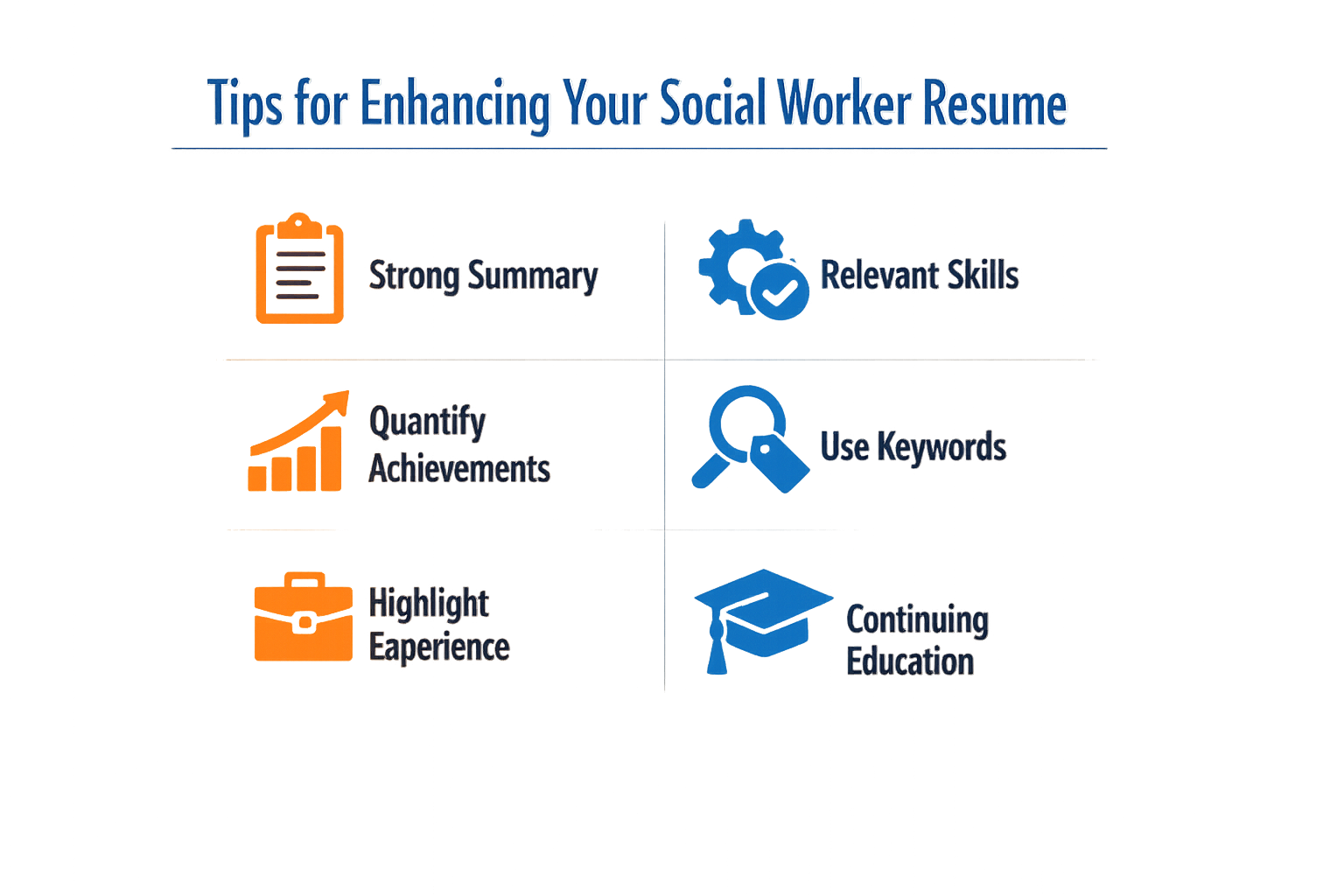
You've built the foundation—now it's time to polish. Small adjustments can dramatically improve how your resume performs with both ATS systems and human reviewers. These practical tips will help you refine your social worker resume template into a document that consistently opens doors.
Lead with Action Verbs That Demonstrate Impact
Every bullet point should start with a verb that shows initiative and results. Use powerful action verbs like Achieved, Led, Developed, and Managed to demonstrate your contributions. Avoid passive language like "responsible for" or "duties included"—these phrases bury your accomplishments under vague descriptions.
Instead of writing "Responsible for case management," try "Managed caseload of 35 families while maintaining 98% client satisfaction rating." The difference is immediate: one sounds like a job description, the other sounds like proof of performance.
Focus on Outcomes, Not Just Tasks
Use impact-focused bullets that show outcomes instead of only tasks. Hiring managers want to see what changed because you were there. Mention relevant tools and assessments naturally within the bullet, but always tie them back to results.
For example: "Conducted biopsychosocial assessments using the DSM-5 framework, reducing crisis intervention needs by 40% over six months." This bullet includes the tool (DSM-5) but centers the outcome (40% reduction). The assessment method supports the result—it doesn't replace it.
When you're unsure whether a bullet is strong enough, ask yourself: "Would this impress someone who's never worked in social services?" If the answer is no, add context or metrics that make the impact clear.
Quantify Everything You Can
Numbers make abstract work concrete. Whenever possible, include metrics: caseload size, percentage improvements, program reach, retention rates, funding secured, or training sessions delivered. Even approximate figures are better than none.
If you don't have exact numbers, estimate conservatively. "Coordinated services for approximately 20 clients monthly" is stronger than "Coordinated client services." Reviewers understand that social work doesn't always come with precise analytics—but showing you think in terms of scale and impact sets you apart.
Tailor Keywords to Each Job Description
Even with a strong template, you'll need to adjust keywords for each application. Read the job posting carefully and note which skills, certifications, and program names appear multiple times. If the posting mentions "trauma-informed care" three times and you have that experience, make sure those exact words appear in your resume.
This isn't about keyword stuffing—it's about speaking the employer's language. Many organizations use different terms for similar work. One posting might say "case management" while another says "care coordination." Match their terminology when it accurately describes your experience. For more on how systems parse these terms, see our guide on how ATS reads resumes.
Keep Formatting Clean and ATS-Friendly
Fancy designs rarely survive ATS parsing. Stick with standard fonts (Arial, Calibri, Times New Roman), clear section headings, and simple bullet points. Avoid tables, text boxes, headers, footers, and images in the body of your resume—these elements confuse parsing software and can cause your information to be read incorrectly or skipped entirely.
Use consistent formatting throughout: if you bold one job title, bold them all. If you write out "Bachelor of Social Work," don't abbreviate it as "BSW" elsewhere. Small inconsistencies signal carelessness to human reviewers.
Proofread Like Your Career Depends on It
Typos and grammatical errors are resume killers in social work, where attention to detail directly impacts client safety and documentation quality. Read your resume out loud, use spell-check, and then have someone else review it. Fresh eyes catch mistakes you've read past a dozen times.
Pay special attention to dates, phone numbers, and email addresses. A single transposed digit means a recruiter can't reach you—and they won't spend time tracking you down when they have 50 other qualified candidates.
Conclusion
A generic social worker resume template won't get you the interview you deserve. Throughout this guide, we've shown why tailoring your resume to each specific role—whether you're applying for clinical positions, case management, or community outreach—is the difference between landing in the rejection pile and getting that callback.
The ATS systems screening your application aren't looking for buzzwords; they're matching your experience against the exact language in the job description. When you quantify your achievements with specific metrics, align your professional summary with the role's requirements, and structure your resume to highlight relevant certifications and specialized skills, you give hiring managers exactly what they need to say yes.
Remember that your resume isn't just a document—it's your professional story told through the lens of what each employer values most. The time you invest in customizing your social worker resume template for each application pays dividends in interview invitations and career advancement.
If you're looking to strengthen other aspects of your job search strategy, explore our Account Manager Resume Template: The Ultimate Stress-Free Guide for additional insights on crafting compelling professional documents. Start with a compelling professional summary that highlights your most relevant experience, use concrete numbers to demonstrate your impact, and never send the same resume twice. Your next great opportunity is waiting—make sure your resume opens the door.
Related reading
LPN Resume: The Ultimate Guide to Stress-Free Applications
Administrative Assistant Resume: The Ultimate Stress-Free Guide

Written by
Emily Johnson
Published September 5, 2026 · 21 min read
Emily Johnson is a seasoned career strategist with over a decade of experience in recruitment and talent acquisition. With a background in human resources, she excels at helping professionals refine their job search strategies, from crafting compelling resumes to mastering interview techniques. As an expert in Applicant Tracking Systems (ATS), Emily is dedicated to guiding individuals toward their dream careers.
Want this kind of read on your résumé?
We'll tell you what's actually working, what's holding you back, and what to fix — in plain English.
Get My Job Match ScoreYou Might Also Like
More articles to help you advance your career

ATS Meaning Resume: Understanding ATS and What Applicant Tracking
Learn what ATS meaning resume entails and how Applicant Tracking Systems work in 2026 to streamline your hiring process and recruitment workflows.

Honest Résumé Score Example: What It Looks Like and How to Improve
Learn what an honest résumé score looks like with this real walkthrough. See actual examples and discover how to improve your résumé evaluation results with an honest

Why a Generic Cybersecurity Resume Won't Work and What Will
Discover why a generic cybersecurity resume won't cut it and learn how to tailor your application for success in the tech industry.

Free ATS Resume Checker: What's Useful and What's Not
Discover what Free ATS Resume Checker tools can and can't do. Learn which features actually help optimize your resume for applicant tracking systems.