



Teacher Resume Template: The Ultimate Guide to Best Results
Discover the best teacher resume template strategies and practical tips to create a standout application that gets results in your job search.
 Emily Johnson
Introduction
You've spent years developing your teaching skills, earning certifications, and shaping young minds. Yet when you submit a resume built from a generic template, it disappears into a digital void. The harsh reality? Most teacher resumes fail before a human ever reads them—they get filtered out by Applicant Tracking Systems before reaching a recruiter's desk.
As someone who has reviewed thousands of teacher applications, I've seen talented educators lose opportunities simply because their resumes weren't optimized for how schools actually hire. The difference between a resume that lands interviews and one that gets rejected often comes down to understanding a critical truth: teaching positions vary dramatically, and your resume must reflect the specific role you're pursuing.
Most school districts now rely on applicant tracking systems to manage the flood of applications they receive. This means your carefully crafted resume must first pass a software scan before any principal or hiring committee sees it. A one-size-fits-all approach simply doesn't work in this environment. Whether you're applying for an elementary position focused on foundational literacy or a high school role requiring subject-matter expertise, your resume must be strategically tailored to match both the technical requirements of ATS software and the specific qualifications the school is seeking.
The good news? Once you understand how to build a teacher resume template that addresses both ATS requirements and role-specific needs, you can create a powerful tool that opens doors throughout your career. This guide will show you exactly how to craft a resume that gets past the filters and into the hands of decision-makers who recognize your value.
The Problem with Generic Teacher Resumes

Generic teacher resume templates promise convenience, but they deliver mediocrity. When you download a one-size-fits-all template and fill in your information, you're creating a document that looks exactly like hundreds of others landing on the same hiring manager's desk. The real damage happens before anyone even reads your resume—most applications get filtered out by automated systems that scan for specific qualifications and keywords.
Why Generic Templates Fail in Education Hiring
The education sector has unique hiring requirements that generic templates simply can't address. A resume that works for a corporate position won't highlight the pedagogical skills, classroom management experience, or curriculum development expertise that school administrators actually need to see. Generic formats bury your teaching credentials under irrelevant sections and fail to emphasize the certifications and specialized training that matter in education.
School districts increasingly rely on applicant tracking systems to manage the volume of applications they receive. These systems scan resumes for specific keywords, formatting patterns, and role-relevant qualifications. A generic template typically lacks the education-specific terminology and structure that these systems are programmed to recognize. When your resume doesn't match the scanning criteria, it gets rejected automatically, regardless of how qualified you actually are.
The Hidden Cost of Template Convenience
Using a generic teacher resume template creates several problems that aren't immediately obvious. First, these templates often include sections that don't apply to teaching positions while omitting critical elements like classroom technology proficiency or student achievement metrics. Second, they use generic action verbs and descriptions that fail to demonstrate your specific impact on student learning and development.
The formatting choices in generic templates can also work against you. Many use complex layouts, graphics, or unusual fonts that confuse applicant tracking systems. Understanding how ATS reads resumes helps you avoid these technical pitfalls and create a document that both systems and humans can properly evaluate.
A resume that looks like everyone else's won't help you stand out in a competitive teaching market where dozens of qualified candidates apply for every position.
What Schools Actually Look For
Hiring managers in education scan resumes for specific indicators that generic templates rarely highlight effectively. They want to see your teaching philosophy in action through concrete examples, your ability to differentiate instruction for diverse learners, and evidence of continuous professional development. Generic templates treat these crucial elements as afterthoughts, relegating them to vague bullet points that don't tell your professional story.
Utilizing ATS-friendly resume templates and incorporating relevant keywords is essential for passing applicant tracking systems used by schools. But it's not just about getting past the software—it's about presenting your qualifications in a way that resonates with education professionals who understand the demands of the classroom. Your resume needs to speak the language of teaching, not the generic language of business.
Understanding Role-Specific Requirements
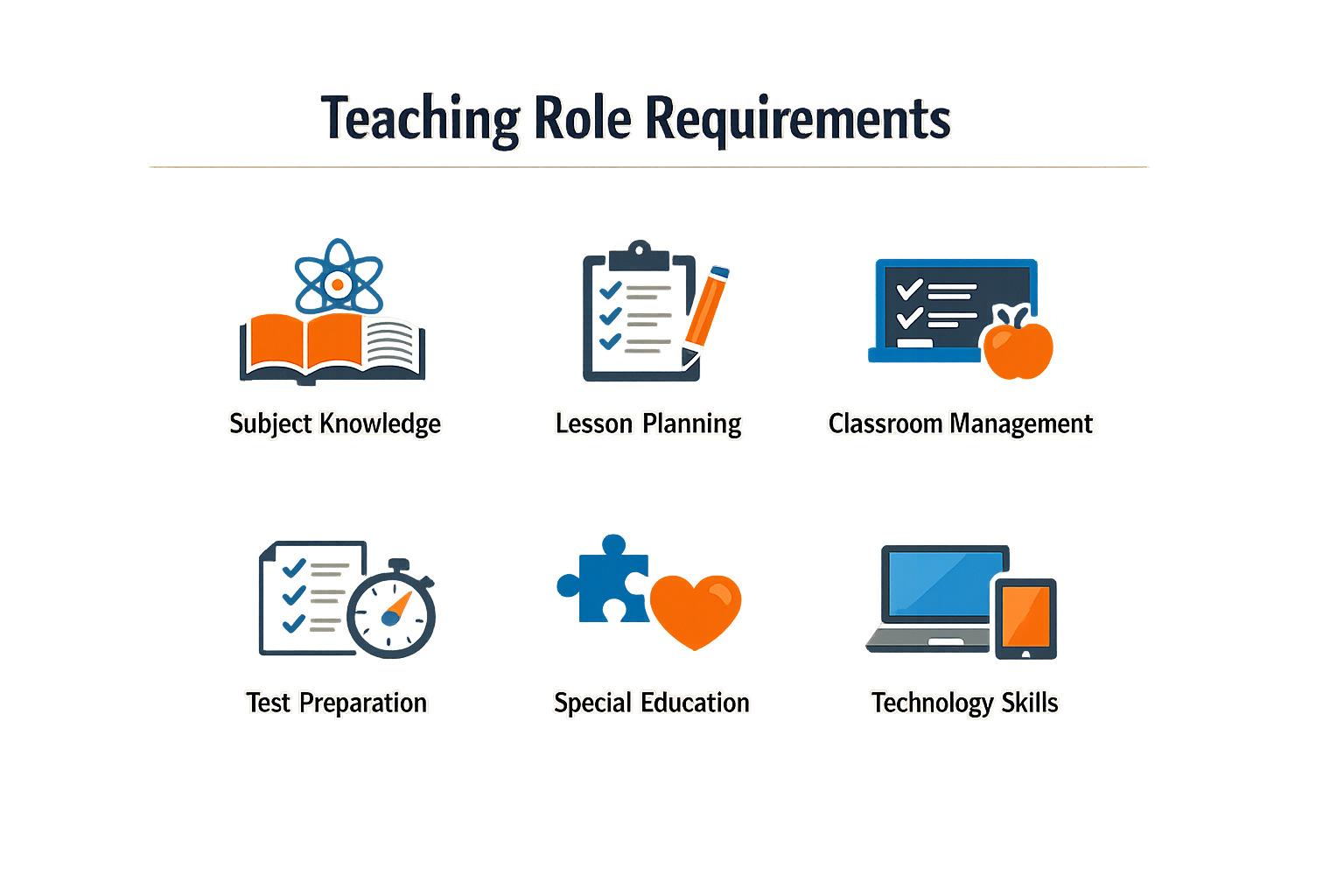
Every teaching position carries distinct expectations that extend far beyond the classroom. An elementary school teacher focuses on foundational literacy and numeracy, while a high school chemistry instructor must demonstrate laboratory management and advanced subject expertise. Your teacher resume template must reflect these differences clearly and convincingly.
School administrators scan resumes for role-specific indicators within seconds. They're looking for evidence that you understand the grade level, subject area, and institutional culture they represent. A resume that speaks to middle school social studies won't resonate with a kindergarten hiring committee, no matter how impressive your credentials.
Tailoring Your Resume to the Teaching Role
The most effective approach starts with a targeted professional summary. This 2-4 sentence section should emphasize your commitment and relevant skills for the specific position. Rather than writing a generic statement about "passionate educator," address the actual requirements listed in the job posting.
For example, if you're applying to teach high school mathematics, your summary should mention quantitative reasoning, curriculum alignment to state standards, and perhaps experience with AP or honors courses. If the role involves special education, highlight your familiarity with IEPs, differentiated instruction, and inclusive classroom strategies.
Demonstrating Measurable Impact
Modern hiring committees expect evidence of student outcomes. Your resume should highlight measurable student impact through concrete examples whenever possible. This might include improved test scores, increased engagement metrics, or successful implementation of new teaching strategies.
Instead of stating "taught 9th grade English," consider: "Implemented differentiated reading strategies that improved class-wide comprehension scores by supporting diverse learning needs." The second version shows both your methods and your results, giving administrators confidence in your effectiveness.
A strong teacher resume template connects your qualifications directly to the outcomes that matter most to the hiring school.
Adapting Across Educational Contexts
Different educational settings require different emphases. Public school positions often prioritize state certification, standardized test preparation, and compliance with district policies. Private or charter schools may value innovative pedagogy, extracurricular involvement, or alignment with specific educational philosophies.
International or specialized programs look for additional qualifications: ESL certification for language learners, Montessori or Waldorf training for alternative schools, or technology integration skills for STEM-focused institutions. Your resume should foreground the credentials that match each context.
When you're applying across multiple types of schools, maintain separate versions of your resume rather than using one generic document. This targeted approach demonstrates genuine interest and saves reviewers from having to guess which parts of your background are most relevant. For additional guidance on tailoring professional documents, explore our Account Manager Resume Template: The Ultimate Stress-Free Guide for insights on customization strategies that transfer across industries.
Key Elements of a Successful Teacher Resume
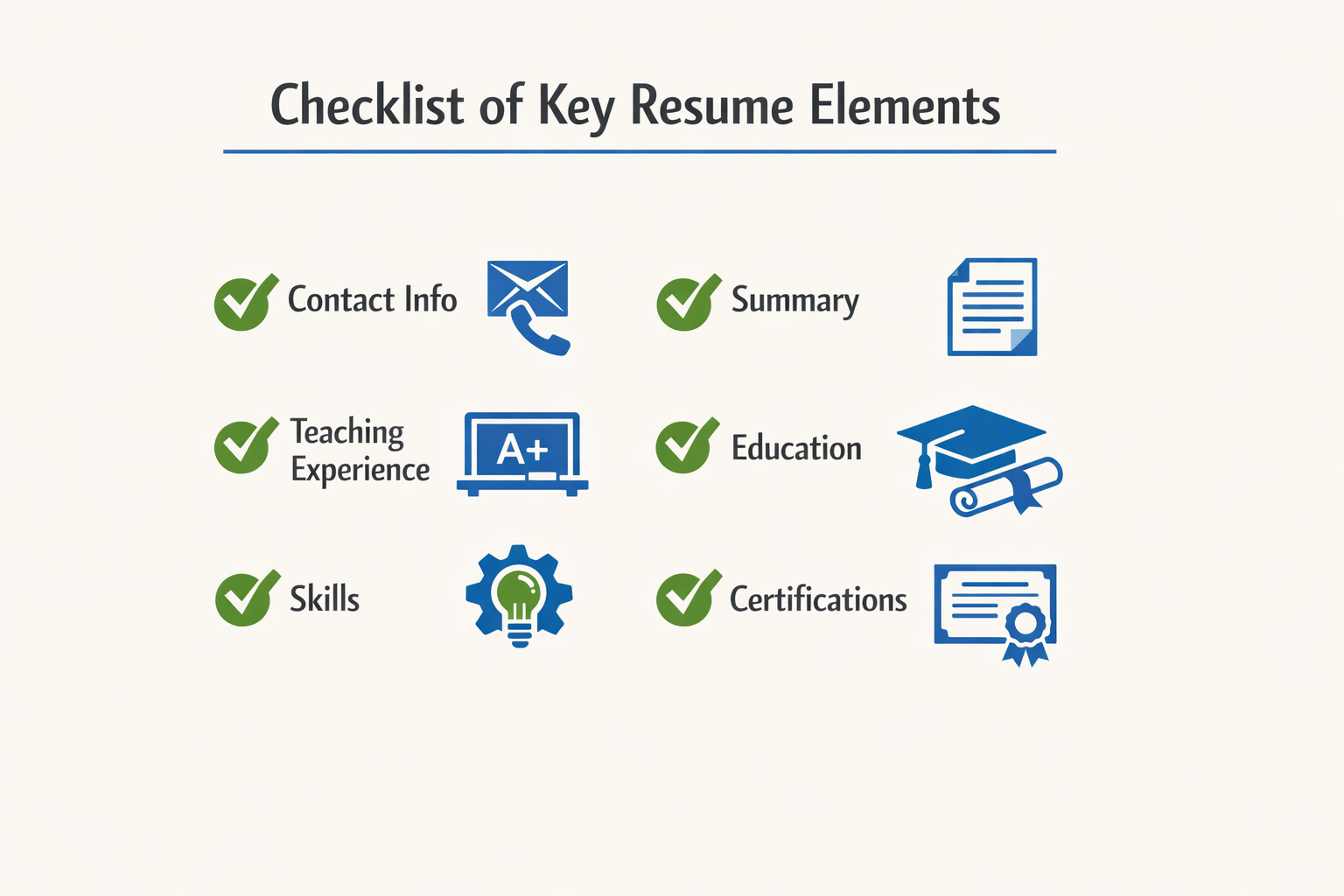
Building a strong teacher resume template means including the right components in the right order. Every section serves a specific purpose, and leaving out even one critical element can cost you an interview. Let's break down exactly what hiring managers expect to see when they review your application.
Contact Information and Certification Status
Your header should immediately establish your professional identity. Include your full name, phone number, professional email address, and LinkedIn profile if relevant. For teaching positions, add your certification status directly in the header—this tells administrators at a glance whether you meet basic licensure requirements. If you hold multiple certifications or endorsements, list the most relevant one for the position you're targeting.
Professional Summary or Resume Objective
This opening statement sets the tone for your entire application. A professional summary works best for experienced educators, highlighting years of experience, teaching philosophy, and key accomplishments. A resume objective suits career changers or new teachers, focusing on transferable skills and enthusiasm for the role. Either way, tailor this section to mirror the language in the job posting and include specific grade levels or subject areas.
Core Competencies and Skills
Organize your skills into clear categories that reflect what schools actually need. Instructional skills might include differentiated instruction, curriculum development, or assessment design. Technology skills should list specific platforms and tools you use regularly—not just generic phrases like "proficient in technology." Classroom management skills demonstrate your ability to create productive learning environments. This categorized approach makes it easy for hiring managers to scan your qualifications quickly.
For more insights on how resume formatting affects applicant tracking systems, check out our guide on How ATS Reads Resumes: The Ultimate Guide to Surprising Success.
Professional Experience with Measurable Outcomes
Your work history should tell a story of impact, not just duties. For each position, include your job title, school name, location, and dates of employment. Then describe your responsibilities and achievements using action verbs and quantifiable results wherever possible. Instead of "taught math to students," write "implemented standards-based math curriculum for 120 students across four sections, resulting in improved assessment scores." This approach transforms generic descriptions into evidence of your effectiveness.
Step 1
Structure each experience entry
Start with the context (grade level, class size, special circumstances), then describe your approach, and finish with the measurable outcome. This formula helps reviewers understand both what you did and why it mattered.
Education and Professional Development
List your degrees in reverse chronological order, including the institution name, degree type, major, and graduation year. If you graduated with honors or completed relevant coursework, include those details. Below your formal education, create a separate section for professional development that showcases your commitment to continuous learning. Include workshops, conferences, additional certifications, and specialized training that directly relates to the teaching role you're pursuing.
Teaching Certifications and Licenses
This section deserves prominent placement since certification is non-negotiable in education. List each credential with its full official name, the issuing state or organization, and the expiration date if applicable. If you're in the process of obtaining a certification, note it as "in progress" with an expected completion date. For positions requiring specific endorsements, make sure those credentials are easy to spot.
Effective Teaching Resume Examples
Seeing concrete examples helps transform abstract advice into actionable steps. The most effective teacher resumes share a common trait: they're built around specific teaching contexts and quantifiable outcomes rather than generic descriptions. Below are two examples that illustrate how tailoring your teacher resume template to your experience level and specialization creates immediate impact.
New Teacher Resume Example
For candidates entering the profession, your student teaching placements and practicum experiences become your professional portfolio. A strong new teacher resume includes a specific objective that signals both your teaching philosophy and target role.
Step 1
Craft a targeted objective
Instead of "Seeking a teaching position," write something like: "Elementary educator seeking to bring structured literacy strategies and differentiated instruction to second-grade learners at Lincoln Elementary." This specificity shows you've researched the school and understand the role's demands.
Your experience section should emphasize measurable outcomes from student teaching. For example: "Implemented daily guided reading sessions for 22 second-graders, resulting in 85% of students advancing at least one reading level during the 12-week placement." These concrete details demonstrate impact even without years of formal employment.
Include relevant coursework, certifications in progress, and any classroom technology tools you've mastered during training. New teachers often underestimate the value of their practicum work—treat each placement as a legitimate professional experience with its own bullet points and achievements.
Experienced Teacher Resume Example
For veterans, your resume must showcase progression and sustained impact across multiple years. Consider this approach for a high school English teacher:
High School English Teacher with 7 years of experience at CBSE and IB schools. Developed a project-based learning curriculum for Grades 9-12 that improved average board exam scores from 68% to 79% over 3 years.
This summary immediately establishes expertise in specific educational frameworks (CBSE, IB) and quantifies long-term achievement. The body of the resume should detail curriculum development, leadership roles, and any specialized programs you've launched.
Experienced teachers should highlight:
- Curriculum innovation: "Redesigned AP Literature curriculum to incorporate diverse voices, increasing student engagement scores by 34%"
- Mentorship roles: "Served as department lead for English faculty (8 teachers), coordinating professional development workshops quarterly"
- Technology integration: "Piloted Google Classroom implementation across grade levels, training 15 colleagues on digital assessment tools"
Notice how each bullet connects action to outcome. Whether you're applying for a similar role or seeking a department head position, your recruiter resume template principles apply here too: show progression, quantify impact, and align every detail with the target role's requirements.
The difference between these two examples isn't just experience level—it's the strategic use of detail. New teachers prove potential through targeted objectives and student teaching metrics. Experienced teachers demonstrate sustained excellence through curriculum impact and leadership contributions. Both approaches transform a generic teacher resume template into a compelling narrative of your unique value.
Optimizing Your Teacher Resume for ATS
Most school districts now use Applicant Tracking Systems (ATS) to filter incoming applications before a human ever sees them. Your carefully crafted teacher resume template might never reach a hiring manager if it doesn't pass this initial software scan. Understanding how these systems work—and how to work with them—is essential for any educator looking to advance their career.
ATS software scans resumes for specific keywords, formatting structures, and relevant qualifications. When the system can't read your document or doesn't find the right terms, it simply rejects your application. The good news is that optimizing for ATS doesn't mean sacrificing readability or personality—it means being strategic about structure and language.
Choose an ATS-Friendly Format
Start with a clean, simple layout that software can parse easily. Avoid complex designs, tables, text boxes, headers, footers, or graphics that confuse ATS algorithms. Stick to standard fonts like Arial, Calibri, or Times New Roman, and use conventional section headings like "Professional Experience," "Education," and "Certifications."
Save your resume as a .docx or PDF file, depending on the job posting's instructions. While most modern ATS can read PDFs, some older systems still struggle with them. When in doubt, .docx is the safer choice.
Incorporate Relevant Keywords Strategically
ATS systems rank candidates based on keyword matches from the job description. Read each posting carefully and identify the specific skills, qualifications, and terminology the district uses. If they mention "differentiated instruction," "classroom management," or "Common Core standards," those exact phrases should appear in your resume where truthful and relevant.
Don't stuff keywords artificially—ATS algorithms are increasingly sophisticated at detecting unnatural repetition. Instead, weave them naturally into your experience descriptions and skills section. For example, rather than listing "classroom management" in isolation, write: "Implemented classroom management strategies that reduced behavioral incidents by maintaining clear expectations and positive reinforcement systems."
For more insights on how automated systems evaluate applications, explore our guide on how ATS reads resumes.
Structure Your Experience for Machine Reading
List your work history in reverse chronological order with clear job titles, school names, locations, and employment dates. Use standard date formats like "August 2019 – June 2023" rather than abbreviations that might confuse the system.
Start each bullet point with strong action verbs, but avoid using the same verb repeatedly. Vary your language with terms like "developed," "implemented," "facilitated," "designed," and "collaborated." This approach satisfies both ATS keyword scanning and human readability.
Step 1
Match your title to the job description
If you're applying for a "5th Grade Teacher" position but your current title is "Elementary Educator," consider how you present your experience. While you shouldn't misrepresent your role, you can use the job description's language in your summary or skills section to ensure the ATS recognizes the match.
Step 2
Use standard section headings
ATS software looks for conventional labels. Creative headings like "Where I've Taught" or "My Teaching Journey" will likely be skipped. Stick with "Professional Experience," "Education," "Certifications," and "Skills" to ensure the system categorizes your information correctly.
Step 3
Include a skills section with exact matches
Create a dedicated skills section that lists both hard and soft skills mentioned in the job posting. Include specific items like "IEP development," "Google Classroom," "formative assessment," or "parent communication" when they align with your actual experience and the position requirements.
Test Your Resume's ATS Compatibility
Before submitting your application, run a simple test: copy your resume content and paste it into a plain text editor. If the formatting becomes jumbled, information disappears, or the order seems illogical, an ATS will likely have the same problem. Adjust your layout until the plain text version maintains a clear, logical structure.
Some online tools offer ATS compatibility checks, though results vary in accuracy. The most reliable method is to follow the formatting guidelines above and ensure every piece of information appears in a standard, easily scannable format.
Tips and Tricks for Crafting Your Teacher Resume
Creating a compelling teacher resume template requires more than listing your credentials—it demands strategic presentation that captures hiring committees' attention. After reviewing hundreds of teaching applications, I've identified specific techniques that consistently help candidates stand out from generic submissions.
Lead With Measurable Student Impact
The most effective teacher resumes open with a profile that immediately establishes your teaching scope and demonstrates tangible results. Rather than stating "Responsible for teaching 5th grade mathematics," quantify your impact: "Elevated 5th grade math proficiency scores by 18% over two academic years through differentiated instruction strategies." Employers prioritize measurable outcomes because they indicate your potential contribution to their school's performance.
Tailor Your Professional Summary to Each Position
Your opening profile should mirror the specific requirements in the job posting. If a position emphasizes STEM integration, lead with your science curriculum development experience. For roles highlighting classroom management, open with your behavior intervention success rates. This targeted approach signals immediate relevance to screening committees.
Generic summaries that could apply to any teaching role fail to capture attention. Specificity wins: mention grade levels, subject specializations, and particular methodologies that align with the school's stated needs.
Prioritize Relevant Certifications and Training
Place your most pertinent credentials prominently in your education section. If you're applying to a school implementing restorative justice practices, feature your conflict resolution training near the top. For STEAM-focused positions, highlight any coding bootcamps or maker education workshops you've completed.
The strongest teaching applications demonstrate continuous professional growth through targeted skill development that matches institutional priorities.
Use Action Verbs That Demonstrate Leadership
Begin each accomplishment with strong verbs that convey initiative: "Spearheaded," "Designed," "Implemented," "Coordinated," "Mentored." These terms position you as a proactive educator rather than someone who simply fulfilled baseline requirements. They're particularly valuable when describing collaborative projects across roles, committee work, or curriculum development initiatives.
Avoid passive constructions like "Was responsible for" or "Duties included." Active language creates a more dynamic impression of your teaching practice.
Showcase Technology Integration Naturally
Rather than creating a separate "Technology Skills" section with a laundry list of platforms, weave digital tools into your achievement descriptions. "Increased parent engagement 40% through implementation of ClassDojo communication system" demonstrates both technical competency and measurable impact simultaneously.
This integrated approach proves you don't just know educational technology—you use it strategically to improve outcomes.
Include Specific Examples of Differentiation
Hiring committees want evidence that you can meet diverse learning needs. Provide concrete examples: "Developed tiered lesson plans accommodating three proficiency levels, resulting in 100% of students meeting IEP goals for two consecutive quarters." These specifics demonstrate your instructional flexibility far better than generic statements about "meeting individual student needs."
Keep Formatting Clean and Scannable
Use consistent spacing, clear section headers, and bullet points that begin on the same vertical line. Hiring managers often review dozens of applications in one sitting—visual clarity helps your qualifications register quickly. Avoid decorative fonts, graphics, or colored text that can distract from your content or cause parsing issues with applicant tracking systems.
White space is your ally. Dense text blocks discourage thorough reading, while well-organized sections invite engagement with your qualifications.
Who Should Choose What Type of Resume
Not every teaching candidate faces the same hiring landscape. A first-year teacher applying for elementary positions has different needs than a veteran educator moving into administration or a career-changer pivoting from corporate training. The teacher resume template you choose should reflect where you are in your career and where you're headed—generic formats rarely serve anyone well.
Your resume format is a strategic decision. When you understand the strengths of each approach and match them to your situation, you create a document that works with your story instead of against it. Here's how to decide which format fits your teaching career stage and goals.
Chronological Format: For Traditional Career Paths
The chronological format lists your work history in reverse order, starting with your most recent position. This is the default choice for most educators with consistent teaching experience. If you've moved steadily through teaching roles—student teacher to classroom teacher to department head—this format showcases your progression clearly.
School administrators reviewing dozens of applications appreciate the straightforward timeline. They can quickly see how long you've been teaching, which grade levels you've covered, and how your responsibilities have grown. This format works best when your employment history tells a coherent story without significant gaps.
Choose chronological if you're an experienced teacher with three or more years in the classroom, applying for similar roles at new schools or districts. It's also ideal for educators seeking promotions within their current specialty—moving from middle school math teacher to department chair, for example.
Functional Format: For Career Changers and Gap Situations
The functional format emphasizes skills over chronology. Instead of leading with job titles and dates, you organize content around competency areas: classroom management, curriculum development, student assessment, technology integration. Your work history appears as a brief list at the end.
This approach helps when your timeline raises questions you'd rather address in an interview than on paper. Career-changers coming from corporate training, tutoring, or other education-adjacent fields benefit because the format highlights transferable skills without drawing attention to non-teaching job titles.
Recent graduates with limited classroom experience beyond student teaching can also use this format to emphasize what they can do rather than how long they've done it. The same applies if you're returning to teaching after raising children, caring for family members, or pursuing additional education.
The trade-off: some hiring managers view functional resumes with skepticism, assuming you're hiding something. If you choose this route, be prepared to explain your timeline clearly in your cover letter and interview. For guidance on how ATS systems process different formats, understanding the technical side helps you optimize any resume type.
Combination Format: For Mid-Career Transitions
The combination (or hybrid) format merges chronological and functional elements. You lead with a skills summary that highlights your strongest competencies, then follow with a traditional work history section. This gives you the best of both approaches: you control the first impression while still providing the timeline administrators expect.
This format works well for teachers making lateral moves—switching from elementary to special education, or from classroom teaching to instructional coaching. You can emphasize the relevant skills for your new target role while showing you have a stable employment record.
Mid-career educators with diverse experience also benefit. If you've taught multiple grade levels, worked in both public and private schools, or combined teaching with curriculum writing or professional development roles, the combination format lets you organize that complexity without overwhelming the reader.
| Resume Format | Best For | Key Advantage | Watch Out For |
|---|---|---|---|
| Chronological | 3+ years consistent teaching | Clear career progression | Highlights employment gaps |
| Functional | Career changers, recent grads | Emphasizes transferable skills | May raise red flags with some hiring managers |
| Combination | Mid-career transitions | Balances skills and experience | Can become too long if not edited carefully |
Matching Format to Your Teaching Specialty
Beyond career stage, your teaching specialty influences format choice. Elementary teachers often benefit from chronological resumes because schools want to see grade-level experience and longevity. Secondary teachers in specialized subjects (physics, AP courses, special education) might choose combination formats to highlight both subject expertise and teaching credentials.
Administrative candidates—assistant principals, curriculum coordinators, instructional coaches—should default to chronological unless their path into leadership was unconventional. These roles require demonstrated leadership progression, which chronological formats showcase naturally.
Use the following structure for your resume regardless of format: Contact Information, Professional Summary, Work Experience, Skills, Education, and Optional Sections. The format determines how you weight and order these elements, not whether you include them.
When to Break the Rules
Occasionally, you'll encounter application systems that dictate format through their input fields. When applying through district portals or platforms like TalentEd, your carefully chosen format gets dismantled into database fields anyway. In these cases, focus on content quality over format strategy—the system will reassemble your information according to its own logic.
Similarly, if a job posting explicitly requests a specific format or template, follow those instructions exactly. Demonstrating you can follow directions matters more than showcasing your preferred approach. Save your strategic format choice for general applications where you control the presentation.
Common Teacher Resume Mistakes to Avoid
Even strong candidates sabotage their chances with preventable resume errors. The difference between a callback and silence often comes down to a handful of fixable mistakes that hiring committees see repeatedly. Understanding these pitfalls helps you craft a teacher resume template that positions you as the standout candidate schools want to interview.
Using Vague Descriptions Instead of Measurable Impact
The most damaging mistake is listing duties without demonstrating results. Phrases like "Taught 4th-grade math" or "Managed classroom" tell principals what you were assigned to do, not what you accomplished. Instead of "Taught 4th-grade math," you should write, "Designed and implemented a data-driven math curriculum that resulted in a 25% increase in students scoring proficient or advanced on state assessments." Student-outcome metrics are the single biggest differentiator between a resume that gets a callback and one that does not.
Transform passive descriptions into active achievements. Replace "Responsible for differentiated instruction" with "Developed tiered lesson plans that reduced achievement gaps by 18% across three reading levels." Concrete numbers anchor your claims and give hiring committees a clear picture of your effectiveness.
Ignoring Keywords and ATS Optimization
Many districts use applicant tracking systems to filter resumes before human eyes ever see them. If your resume lacks the specific keywords from the job posting, it may never reach the principal's desk. Generic terms like "good communicator" or "team player" don't match the technical vocabulary schools search for, such as "differentiated instruction," "IEP implementation," or "formative assessment."
Mirror the language in the job description without keyword stuffing. If the posting emphasizes "data-driven instruction" and "collaborative planning," those exact phrases should appear naturally in your experience bullets. For more on how systems parse your application, explore our guide on how ATS reads resumes.
Overloading with Irrelevant Information
Including every job you've ever held dilutes your teaching credentials. Your summer retail position from college or unrelated office work rarely strengthens a teaching application unless you can directly tie the experience to classroom skills. Hiring committees spend seconds scanning each resume—irrelevant details push your strongest qualifications below the fold.
Similarly, avoid listing outdated technology skills or certifications that expired years ago. A reference to "proficient in overhead projectors" signals you haven't updated your materials in a decade. Highlight current edtech tools, learning management systems, and relevant digital platforms instead.
Neglecting to Tailor for Each Position
Sending the same generic resume to every school is a missed opportunity. Elementary positions prioritize classroom management and foundational literacy, while high school roles emphasize subject expertise and college-prep rigor. A one-size-fits-all approach signals you didn't invest time understanding what that specific school needs.
Customize your professional summary and top three experience bullets for each application. If the posting emphasizes STEM integration, lead with your robotics club or inquiry-based science projects. If it highlights social-emotional learning, feature your restorative practices training and conflict resolution outcomes. Small adjustments show you're not mass-applying—you're genuinely interested in that role.
Formatting Errors That Undermine Professionalism
Inconsistent fonts, misaligned bullets, or dense blocks of text make your resume hard to read and suggest carelessness. Hiring committees interpret sloppy formatting as a preview of how you'll organize lesson plans and grade records. A polished, clean layout demonstrates attention to detail and respect for the reader's time.
Use a single professional font, consistent heading styles, and adequate white space. Avoid graphics, tables, or columns that confuse ATS software. Proofread multiple times—typos in a teacher's resume are especially damaging because communication and literacy are core job requirements.
Conclusion
Creating an effective teacher resume template requires moving beyond generic formats and embracing tailored strategies that showcase your unique qualifications. Throughout this guide, we've explored why one-size-fits-all resumes fail to capture the attention of hiring committees and how role-specific customization dramatically improves your chances of landing interviews.
The key principles are straightforward: understand the specific requirements of each teaching position, highlight relevant classroom experience and pedagogical skills, optimize for applicant tracking systems without sacrificing readability, and avoid common mistakes that undermine even strong candidates. Whether you're an elementary educator emphasizing classroom management or a high school specialist showcasing subject expertise, your resume must speak directly to the needs of that particular role.
In my years working with educators across different grade levels and specialties, I've seen how a strategically crafted resume opens doors that generic templates simply cannot. The investment of time in customizing your application pays dividends when you receive that interview invitation.
As you refine your teacher resume template, remember that authenticity combined with strategic presentation creates the most compelling narrative. Your teaching philosophy, classroom achievements, and professional development journey deserve more than a cookie-cutter format—they deserve a resume that reflects the dedicated educator you are.
For additional guidance on crafting professional resumes across various fields, explore our Account Manager Resume Template: The Ultimate Stress-Free Guide to see how tailored approaches work across different career paths. Take the insights from this guide, apply them to your unique situation, and create a teacher resume that truly represents your professional value.

Written by
Emily Johnson
Published September 4, 2026 · 24 min read
Emily Johnson is a seasoned career strategist with over a decade of experience in recruitment and talent acquisition. With a background in human resources, she excels at helping professionals refine their job search strategies, from crafting compelling resumes to mastering interview techniques. As an expert in Applicant Tracking Systems (ATS), Emily is dedicated to guiding individuals toward their dream careers.
Want this kind of read on your résumé?
We'll tell you what's actually working, what's holding you back, and what to fix — in plain English.
Get My Job Match ScoreYou Might Also Like
More articles to help you advance your career

ATS Meaning Resume: Understanding ATS and What Applicant Tracking
Learn what ATS meaning resume entails and how Applicant Tracking Systems work in 2026 to streamline your hiring process and recruitment workflows.

Honest Résumé Score Example: What It Looks Like and How to Improve
Learn what an honest résumé score looks like with this real walkthrough. See actual examples and discover how to improve your résumé evaluation results with an honest

Why a Generic Cybersecurity Resume Won't Work and What Will
Discover why a generic cybersecurity resume won't cut it and learn how to tailor your application for success in the tech industry.

Free ATS Resume Checker: What's Useful and What's Not
Discover what Free ATS Resume Checker tools can and can't do. Learn which features actually help optimize your resume for applicant tracking systems.